Multiple Choice
Passage
Cable theory is a mathematical model used to calculate currents and voltages along and across axon membranes. The model treats small sections of the membrane as the resistor-capacitor circuit shown in Figure 1. An electric neuronal signal enters the circuit through the input node. A portion of the signal remains inside the axon and continues to the next section of membrane via Output 1, and the rest of the signal exits to the extracellular fluid via Output 2.
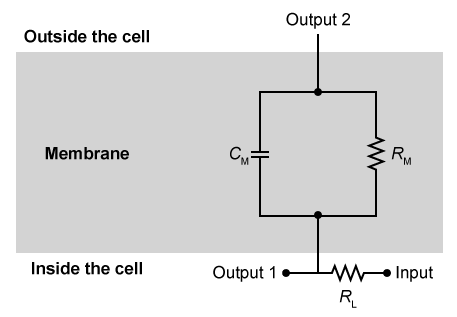 Figure 1 Circuit unit used to model axon membranesResearchers studied cable theory by recreating the circuit in Figure 1 using a 2 μF capacitor for CM, a 200 Ω resistor for RM, and a 1,000 Ω resistor for RL. The researchers sent an electrical signal through the input and discovered that the capacitor acted as a resistor whose resistance varied with the signal's frequency, as shown in Figure 2.
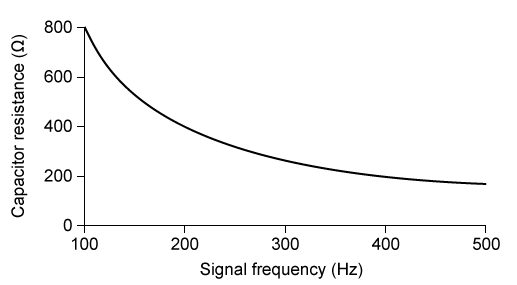 Figure 2 Capacitor equivalent resistance vs. signal frequency for CM
Adapted from Tuckwell H, Introduction to Theoretical Neurobiology 2006 SIAM.
- An ammeter is added to the circuit as shown. The voltage across the capacitor is kept constant while the frequency is increased from 200 Hz to 400 Hz. Through this change, the value shown by the ammeter:
A) will decrease by 50%.
B) will not change.
C) will increase by 50%.
D) will increase by 100%.
Correct Answer:

Verified
Correct Answer:
Verified
Q14: Passage<br>During deep underwater dives, scuba divers must
Q15: Passage<br>In the event of end-stage heart failure,
Q16: A block with mass M slides down
Q17: Passage<br>Sound waves propagate through many conducting structures
Q18: Passage<br>The flow of blood through the human
Q20: An observer perceives a sound to be
Q21: Blood flows through a vessel in the
Q22: A charged particle is accelerated in a
Q23: Passage<br>Hydrostatic weighing is a technique used to
Q24: Passage<br>Osteoporosis is a degenerative bone condition in