Solved

Passage Students Were Asked to Bring Items from Home to Serve

Question 106

Multiple Choice

Passage
Students were asked to bring items from home to serve as examples for different types of reactions.  The instructor provided additional reactants, solvents, heat, or a catalyst to demonstrate reactions with the household items.The students brought aluminum foil, table salt, sugar, baking soda, vinegar, toilet bowl cleaner, hydrogen peroxide, and antacid tablets.Experiment 1Reactions were performed using the household items.  The reaction conditions and student observations are recorded in Table 1.Table 1  Reaction Conditions and Visual Observations
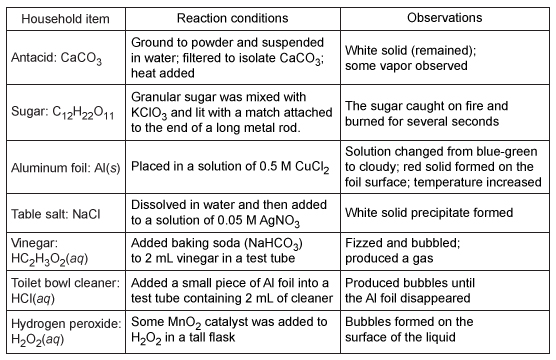
Passage Students were asked to bring items from home to serve as examples for different types of reactions.  The instructor provided additional reactants, solvents, heat, or a catalyst to demonstrate reactions with the household items.The students brought aluminum foil, table salt, sugar, baking soda, vinegar, toilet bowl cleaner, hydrogen peroxide, and antacid tablets.Experiment 1Reactions were performed using the household items.  The reaction conditions and student observations are recorded in Table 1.<strong>Table 1</strong>  Reaction Conditions and Visual Observations    Experiment 2The reactions that were observed to produce gas bubbles in Experiment 1 were repeated, and samples of the gases produced were collected.  Each gas sample was tested by holding a burning (glowing)  wooden splint within the reaction vessel to determine if the reaction evolved O<sub>2</sub>, H<sub>2</sub>, or CO<sub>2</sub>.  A glowing splint placed in O<sub>2</sub> will burn more brightly, one placed in H<sub>2</sub> will ignite the gas, and one placed in CO<sub>2</sub> will be extinguished.  The results of the gas tests are recorded in Table 2.<strong>Table 2</strong>  Glowing Splint Gas Test Observations    -Which of the following is the reaction for the decomposition of calcium carbonate based on the information in Tables 1 and 2? A) CaCO<sub>3</sub>(s)  + 2 HCl(aq)  → CaCl<sub>2</sub>(aq)  + H<sub>2</sub>O(l)  + CO<sub>2</sub>(g)  B) Ca(s)  + HCO<sub>3</sub><sup>−</sup>(aq)  → CaCO<sub>3</sub>(s)  + H<sup>+</sup>(aq)  C) CaCO<sub>3</sub>(s)  → CaO(s)  + CO<sub>2</sub>(g)  D) CaCl<sub>2</sub>(aq)  + Na<sub>2</sub>CO<sub>3</sub>(aq)  → CaCO<sub>3</sub>(s)  + 2 NaCl(aq) Experiment 2The reactions that were observed to produce gas bubbles in Experiment 1 were repeated, and samples of the gases produced were collected.  Each gas sample was tested by holding a burning (glowing) wooden splint within the reaction vessel to determine if the reaction evolved O2, H2, or CO2.  A glowing splint placed in O2 will burn more brightly, one placed in H2 will ignite the gas, and one placed in CO2 will be extinguished.  The results of the gas tests are recorded in Table 2.Table 2  Glowing Splint Gas Test Observations
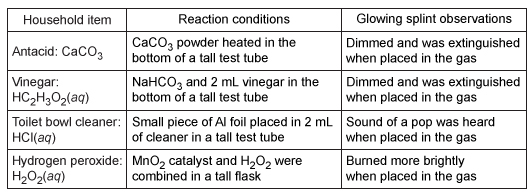
Passage Students were asked to bring items from home to serve as examples for different types of reactions.  The instructor provided additional reactants, solvents, heat, or a catalyst to demonstrate reactions with the household items.The students brought aluminum foil, table salt, sugar, baking soda, vinegar, toilet bowl cleaner, hydrogen peroxide, and antacid tablets.Experiment 1Reactions were performed using the household items.  The reaction conditions and student observations are recorded in Table 1.<strong>Table 1</strong>  Reaction Conditions and Visual Observations    Experiment 2The reactions that were observed to produce gas bubbles in Experiment 1 were repeated, and samples of the gases produced were collected.  Each gas sample was tested by holding a burning (glowing)  wooden splint within the reaction vessel to determine if the reaction evolved O<sub>2</sub>, H<sub>2</sub>, or CO<sub>2</sub>.  A glowing splint placed in O<sub>2</sub> will burn more brightly, one placed in H<sub>2</sub> will ignite the gas, and one placed in CO<sub>2</sub> will be extinguished.  The results of the gas tests are recorded in Table 2.<strong>Table 2</strong>  Glowing Splint Gas Test Observations    -Which of the following is the reaction for the decomposition of calcium carbonate based on the information in Tables 1 and 2? A) CaCO<sub>3</sub>(s)  + 2 HCl(aq)  → CaCl<sub>2</sub>(aq)  + H<sub>2</sub>O(l)  + CO<sub>2</sub>(g)  B) Ca(s)  + HCO<sub>3</sub><sup>−</sup>(aq)  → CaCO<sub>3</sub>(s)  + H<sup>+</sup>(aq)  C) CaCO<sub>3</sub>(s)  → CaO(s)  + CO<sub>2</sub>(g)  D) CaCl<sub>2</sub>(aq)  + Na<sub>2</sub>CO<sub>3</sub>(aq)  → CaCO<sub>3</sub>(s)  + 2 NaCl(aq)
-Which of the following is the reaction for the decomposition of calcium carbonate based on the information in Tables 1 and 2?


A) CaCO3(s) + 2 HCl(aq) → CaCl2(aq) + H2O(l) + CO2(g)
B) Ca(s) + HCO3−(aq) → CaCO3(s) + H+(aq)
C) CaCO3(s) → CaO(s) + CO2(g)
D) CaCl2(aq) + Na2CO3(aq) → CaCO3(s) + 2 NaCl(aq)

Correct Answer:

verifed

Verified

Unlock this answer now
Get Access to more Verified Answers free of charge

Related Questions