Multiple Choice
Passage
Bone growth and remodeling during fracture healing are often slow and have potentially poor outcomes, including malunion or nonunion at the fracture site. Magnesium bone implants can aid in bone formation and safely biodegrade in the body according to the following reaction:Mg(s) + 2H2O(l) → Mg(OH) 2(s) + H2(g) Reaction 1 Corrosion of magnesium metal in aqueous mediumHowever, magnesium metal tends to degrade too quickly and forms hydrogen gas pockets in the body. Corrosion is slowed as the metal naturally forms a protective layer of magnesium hydroxide in a process called passivation. Magnesium hydroxide is less soluble than magnesium metal, and its dissolution is described by the endothermic reaction:
 Reaction 2 Solubility equilibrium of Mg(OH) 2 in water at 25°CAlthough passivation slows down the corrosion rate, it must be slowed even further to adequately facilitate bone reformation.Researchers are interested in the differences in the corrosion rates of magnesium metal protected by different biocompatible coatings. They compared 10-mm magnesium disks coated with compounds of various cation and anion combinations, with solubility results shown in Table 1. The coated disks were immersed in simulated body fluid (SBF) at room temperature for 50 hours.Table 1 Solubility for Biocompatible Inorganic Salts Given in mmol/100mL of Pure Water at 25°C
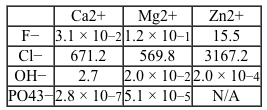 Adapted from Huan ZG, Leeflang MA, Zhou J, Fratila-apachitei LE, Duszczyk J. In vitro degradation behavior and cytocompatibility of Mg-Zn-Zr alloys. J Mater Sci Mater Med. 2010;21(9) :2623-35.
-If researchers wanted to use a coating material that is more soluble in pure water than Mg(OH) 2 but less soluble than MgF2, which of the following would be a good option?
A) Ca(OH) 2
B) CaF2
C) Zn(OH) 2
D) Ca3(PO4) 2
Correct Answer:

Verified
Correct Answer:
Verified
Q96: Passage<br>The alkali metals are a highly reactive
Q97: Passage<br>Living organisms that require oxygen to respire
Q98: When oxalate anions, C<sub>2</sub>O<sub>4</sub><sup>2−</sup>, are added to
Q99: Passage<br>The bicarbonate (HCO<sub>3</sub><sup>−</sup>) buffer system (Reaction 1)
Q100: A scientist uses extreme temperature environments to
Q102: Passage<br>Gastric acid is one of many acids
Q103: Based on the Pauli exclusion principle, which
Q104: Passage<br>The primary structure of a protein is
Q105: Passage<br>Students conducted an experiment to determine the
Q106: Passage<br>Students were asked to bring items from