Multiple Choice
Passage
The primary structure of a protein is a series of amino acids that are connected in a long chain via C−N peptide bonds (Figure 1) .
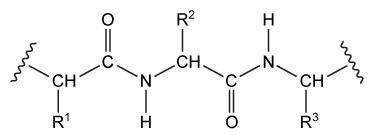 Figure 1 Peptide bonds within a protein segment (Note: Rn = amino acid side chains) Protein chain folding is guided by multiple intramolecular interactions that can occur between two peptide bonds, between a peptide bond and a side chain, or between two side chains, as shown in the protein in Figure 2. Although these interactions are intramolecular because they are within the same molecule, they act effectively like intermolecular interactions because proteins are such large molecules.
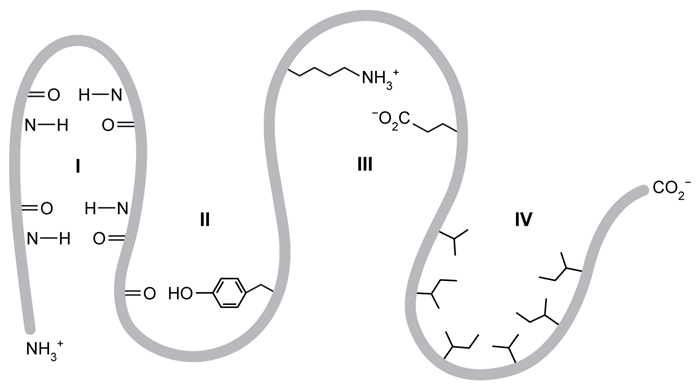 Figure 2 Intramolecular interactions between the peptide chain and amino acid side chains within a hypothetical proteinBecause intramolecular interactions play a significant role in maintaining the three-dimensional folded structure of a protein, having a greater number of interactions or stronger interactions will result in increased protein stability. The energy required to break these interactions within a protein is related to free energy, ΔG. The greater the ΔG value, the more stable the protein.To find the overall contribution of particular intramolecular interactions to protein stability, researchers made several protein variants in which one amino acid is replaced by another to change the noncovalent interactions between the side chains. The difference in free energy between the variant and the original protein, Δ(ΔG) , indicates the change in overall stability of the protein. A negative Δ(ΔG) means the variant protein is less stable than the original.Table 1 shows the results of the amino acid substitution experiments for a protein with the approximate energy difference when each amino acid is changed.Table 1 Change in Free Energy Based on Changing Intramolecular Interactions Caused by Amino Acid Substitutions
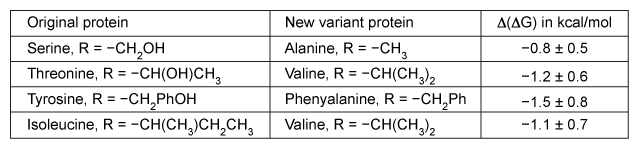 Adapted from: C. N. Pace, J. M. Scholtz, G. R. Grimsley, "Forces stabilizing proteins." FEBS Lett. ©2014 Wiley.
-Assuming the amino acid substitutions found in Table 1 occur on the protein surface, which substitution would cause the smallest change in the water solubility of the protein?
A) Serine to alanine
B) Threonine to valine
C) Tyrosine to phenylalanine
D) Isoleucine to valine
Correct Answer:

Verified
Correct Answer:
Verified
Q99: Passage<br>The bicarbonate (HCO<sub>3</sub><sup>−</sup>) buffer system (Reaction 1)
Q100: A scientist uses extreme temperature environments to
Q101: Passage<br>Bone growth and remodeling during fracture healing
Q102: Passage<br>Gastric acid is one of many acids
Q103: Based on the Pauli exclusion principle, which
Q105: Passage<br>Students conducted an experiment to determine the
Q106: Passage<br>Students were asked to bring items from
Q107: Passage<br>Depending on the active compound's specific method
Q108: Passage<br>Although acetylsalicylic acid (aspirin) is a well-known
Q109: Passage<br>Living organisms that require oxygen to respire