Multiple Choice
Passage
Living organisms that require oxygen to respire can build up hydrogen peroxide (H2O2) as a byproduct of respiration. Because hydrogen peroxide can cause oxidative damage to cells, the amount of H2O2 in cells must be closely regulated. Although H2O2 decomposes spontaneously, a catalyst is needed for the reaction to occur at a sufficiently rapid rate suitable for biological purposes. In biological systems, an enzyme called a catalase accelerates the catalytic decomposition of H2O2 into water and oxygen (Reaction 1) .
 Reaction 1In a laboratory setting, several different inorganic compounds can also serve as catalysts for H2O2 decomposition, allowing researchers to compare how different catalysts affect the efficiency of the reaction. To compare Fe(NO3) 3 (a metal homogeneous catalyst) and NaI (a halogen homogeneous catalyst) , researchers measured the amount of heat evolved after placing each catalyst in a fresh solution of 3% hydrogen peroxide.To perform the measurements, the researchers placed 50 mL of 3% H2O2 in an insulated coffee cup to be used as a calorimeter, as shown in Figure 1. Before adding any catalyst, the initial, baseline temperature of the H2O2 solution was determined by recording the temperature every 30 seconds for 5 minutes. Then 10 mL of 0.10 M Fe(NO3) 3(aq) catalyst was added to the H2O2 solution. The temperature was recorded every 30 seconds for another 15 minutes. The experiment was then repeated using 10 mL of 0.50 M sodium iodide in 0.01 M NaOH as the catalyst. The results for each reaction are shown in Figure 2.
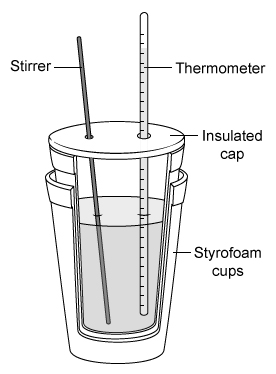 Figure 1 Coffee cup calorimeter
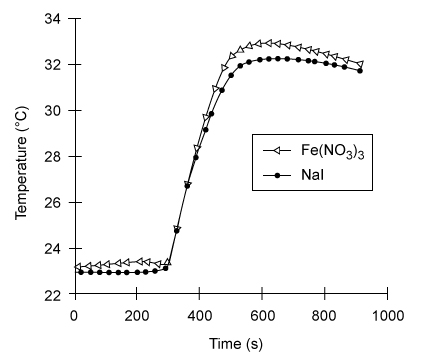 Figure 2 Temperature vs. time measurements for reactions catalyzed by Fe(NO3) 3 and NaI
Adapted from: C. Marzzacco, "The effect of a change in catalyst on the enthalpy of decomposition of hydrogen peroxide." Chem13 News Magazine. ©2008 University of Waterloo.
-The results in Figure 2 would most likely NOT be affected by which of the following changes to the experiment?
A) Adding a sodium phosphate inhibitor
B) Using 30% H2O2
C) Replacing the catalyst with potassium iodide
D) Heating the reaction to 35°C
Correct Answer:

Verified
Correct Answer:
Verified
Q104: Passage<br>The primary structure of a protein is
Q105: Passage<br>Students conducted an experiment to determine the
Q106: Passage<br>Students were asked to bring items from
Q107: Passage<br>Depending on the active compound's specific method
Q108: Passage<br>Although acetylsalicylic acid (aspirin) is a well-known
Q110: Which of the following compounds can participate
Q111: Passage<br>Water is unique in that all three
Q112: Passage<br>The radiopharmaceutical 2-deoxy-2-(<sup>18</sup>F)fluoro-D-glucose (abbreviated as <sup>18</sup>F-FDG) is
Q113: The bond enthalpies for six selected chemical
Q114: Passage<br>Amino acids and copper both serve vital