Multiple Choice
Passage
The nicotinic acetylcholine receptor (nAChR) is a protein embedded in the muscle fiber membrane that facilitates cell-to-cell communication across the neuromuscular junction. When acetylcholine (ACh) binds nAChR, electrical depolarization within skeletal muscle fibers is induced and ultimately gives rise to contractile activity. The nAChR is composed of five protein subunits symmetrically organized around a central ion pore. Previous studies demonstrated that these subunits may serve as epitopes (antibody binding sites) in autoimmune disease. By reversibly binding nAChR subunits, anti-nAChr antibodies may temporarily block the attachment site for ACh, resulting in muscle weakness.Researchers harvested muscle samples from mice to investigate the effects of anti-nAChR antibodies on muscle tension, the pulling force transmitted by muscles during contraction.Experiment 1First, skeletal muscle samples (tibialis anterior) of adult male mice were surgically harvested (n = 30) , washed, and stripped of connective tissues. Next, the isolated muscle samples were placed in a 150-mL oxygen-infused, electrolyte-rich bath containing glucose and Ca2+ ions that were able to enter the muscle fibers and enable maximal contractile force. One end of the submerged muscle was anchored in place while the other was attached to an apparatus that measures muscle tension and modifies muscle length. Using electrodes, action potentials were elicited in the harvested muscle tissue to evaluate contractile function (Figure 1) .
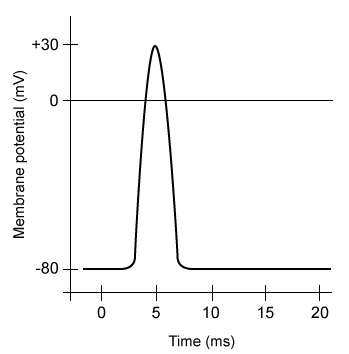 Figure 1 Action potential elicited from a harvested skeletal muscle sampleExperiment 2The researchers divided the 30 muscle samples into three groups of 10. Resting muscle tension was measured, and the electrolyte-rich baths of each group were further infused with a 7.5-mL solution containing mouse-specific anti-nAChR antibodies, ACh, or a mixture of both (Table 1) . Post-infusion (peak) muscle tension was measured for 30 minutes, with results displayed in Figure 2.Table 1 Solutions Infused into the Electrolyte-Rich Bath
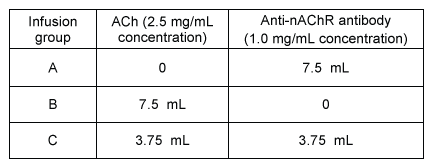
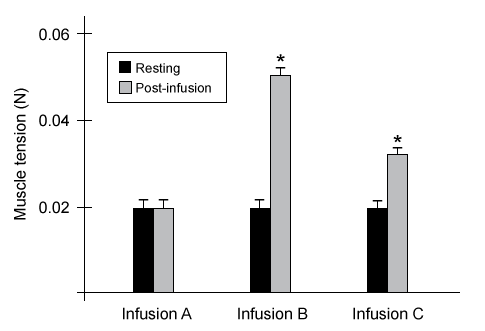 Figure 2 Pre-infusion resting muscle tension and post-infusion peak muscle tension in harvested muscle samples (Note: * indicates p < 0.05.)
-In humans, skeletal muscles are innervated by the somatic nervous system and function to mediate:
A) blood pressure regulation.
B) heart contraction.
C) propulsion of food contents along the digestive tract.
D) movement of the jaw during chewing.
Correct Answer:

Verified
Correct Answer:
Verified
Q270: Scientists identified two distinct pathogens in blood
Q271: Passage<br>Lipopolysaccharides (LPS) found in gram-negative bacterial cells
Q272: Passage<br>Spinal muscular atrophy (SMA) is an autosomal
Q273: Passage<br>Spinal muscular atrophy (SMA) is an autosomal
Q274: Passage<br>Alzheimer disease (AD) is a progressive condition
Q276: Passage<br>At the blood-brain barrier, the cerebral spinal
Q277: Passage<br>Eukaryotic organelles such as mitochondria and chloroplasts
Q278: Passage<br>The lumen of the human gut is
Q279: Passage<br>Hematological anomalies have been observed in patients
Q280: Certain turtle species exhibit embryonic expression of