Multiple Choice
Passage
Hematological anomalies have been observed in patients with prolonged liver damage. For example, patients with chronic cirrhosis (scarring of the liver) often develop anemia and other blood disorders. Hemoglobin is the metalloprotein within red blood cells that is responsible for the oxygen-carrying capacity of blood, and its function may be affected by liver damage. The poor prognosis of patients with cirrhosis and anemia has stimulated further study of hemoglobin function and oxygen saturation.Blood samples from both cirrhotic patients and healthy individuals at rest and after exercise were exposed to varying partial pressures of oxygen. Measurement of oxyhemoglobin dissociation curves (ODCs [Figure 1]) from the blood samples revealed significant functional differences in the hemoglobin from cirrhotic patients relative to control subjects.
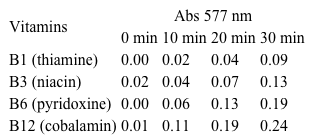
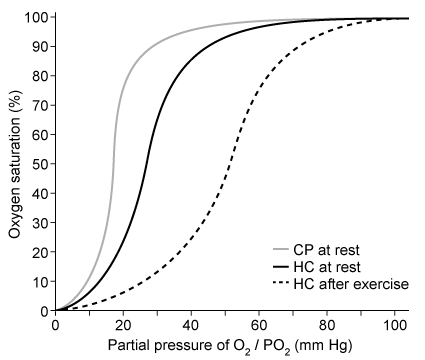 Figure 1 Oxyhemoglobin dissociation curve for cirrhotic patients (CP) at rest and for healthy controls (HC) at rest and after 20 minutes of exerciseVitamins are considered nontoxic supplements and are frequently provided to anemic patients to increase red blood cell production. They may therefore have therapeutic benefits for cirrhotic patients. However, some studies indicate that excessive vitamin consumption may lead to oxidative stress that could induce anemia through hemolysis (red blood cell rupturing) . Hemoglobin strongly absorbs light at 577 nm, and researchers conducted hemolysis assays by spinning down red blood cells and measuring absorbance (Abs) of the supernatant at 577 nm to determine how much hemoglobin was released. The assay was carried out in the presence of four vitamins to determine their potential as oxidizing agents, and results are shown in Table 1.Table 1 Hemolysis of Red Blood Cells from Healthy Donors Treated With Vitamins [2 mM] for 30 Minutes, Measured by Absorbance at 577 nm
 Adapted from Clerbaux T, Detry B, Geubel A, et al. The oxyhemoglobin dissociation curve in liver cirrhosis. Chest. 2006;129(2) :438-45.
-Individuals with glucose-6-phosphate dehydrogenase (G6PDH) deficiencies are more susceptible to oxidative stress than others. If a patient with cirrhosis also suffered from G6PDH deficiency, which vitamin could cause the most severe reduction in that patient's hematocrit?
A) Vitamin B1
B) Vitamin B3
C) Vitamin B6
D) Vitamin B12
Correct Answer:

Verified
Correct Answer:
Verified
Q274: Passage<br>Alzheimer disease (AD) is a progressive condition
Q275: Passage<br>The nicotinic acetylcholine receptor (nAChR) is a
Q276: Passage<br>At the blood-brain barrier, the cerebral spinal
Q277: Passage<br>Eukaryotic organelles such as mitochondria and chloroplasts
Q278: Passage<br>The lumen of the human gut is
Q280: Certain turtle species exhibit embryonic expression of
Q281: Passage<br>Beta-thalassemia is a blood disorder caused by
Q282: Passage<br>Eukaryotic organelles such as mitochondria and chloroplasts
Q283: Passage<br>Parathyroid hormone (PTH) is an important regulator
Q284: Passage<br>Neurulation refers to the early formation of