Passage Lipopolysaccharides (LPS) Found in Gram-Negative Bacterial Cells Can Elicit a a Lethal
Multiple Choice
Passage
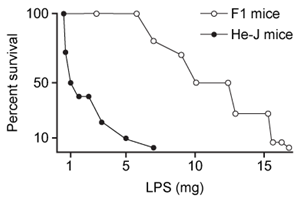
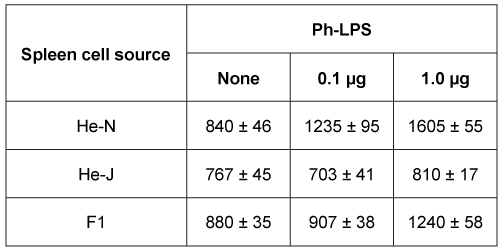
Lipopolysaccharides (LPS) found in gram-negative bacterial cells can elicit a lethal degree of adjuvanticity, or immune activation, in LPS-responsive host organisms. In mice, responses may be modulated by abnormalities in the toll-like receptor (TLR) encoded by the Tlr4 gene closely linked to coat color on Chromosome 4. To investigate the effect of a particular Tlr4 mutation on LPS response, three experiments were performed following a cross between fully responsive He-N mice [tlr4(+) /tlr4(+) ] and He-J mice homozygous for the mutation [tlr4(d) /tlr4(d) ].Experiment 1Researchers isolated spleen cells for analysis of protein expression and LPS response. In cells isolated from F1 mice, both wild-type and mutant TLRs were distinguishable by protein electrophoresis. Following this first analysis, spleen cells from each cohort were exposed to 2 × 10⁵ SRC, an antigen formed by sheep erythrocytes. Cultures were then incubated in the presence or absence of Ph-LPS, with LPS extracted from Escherichia coli K345 cells using a phenol-water mixture. Titers of anti-SRC antibody were recorded on incubation day 5, with the results shown in Table 1.Table 1 Mean anti-SRC titers with standard error
Experiment 2Serum samples were assayed for interferon production 2 hours post LPS injection. Interferon was quantified using a plaque reduction assay on mouse cells challenged with vesicular stomatitis virus.
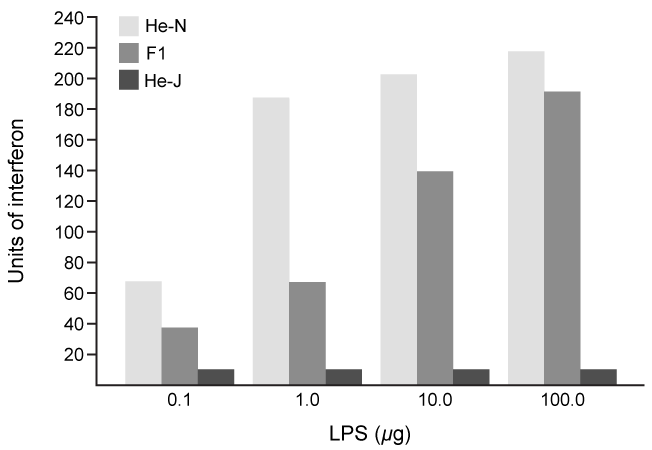
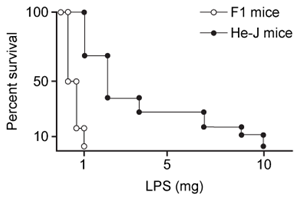
Figure 1 Average serum interferon levels in mice cohortsExperiment 3Mice were injected with varying doses of Ph-LPS and monitored for 4 days. The lethal dose (LD50) was defined as the minimum dose causing death in 50% of injected mice. Compared to He-N mice, results reflected a 10-fold increase in LD50 for F1 mice and a 100-fold increase in LD50 for He-J mice.
-According to the results of Experiment 3, which of the following could represent survival curves for F1 and He-J mice?
A) ![Passage Lipopolysaccharides (LPS) found in gram-negative bacterial cells can elicit a lethal degree of adjuvanticity, or immune activation, in LPS-responsive host organisms. In mice, responses may be modulated by abnormalities in the toll-like receptor (TLR) encoded by the Tlr4 gene closely linked to coat color on Chromosome 4. To investigate the effect of a particular Tlr4 mutation on LPS response, three experiments were performed following a cross between fully responsive He-N mice [tlr4(+) /tlr4(+) ] and He-J mice homozygous for the mutation [tlr4(d) /tlr4(d) ].Experiment 1Researchers isolated spleen cells for analysis of protein expression and LPS response. In cells isolated from F1 mice, both wild-type and mutant TLRs were distinguishable by protein electrophoresis. Following this first analysis, spleen cells from each cohort were exposed to 2 × 10<sup>5</sup> SRC, an antigen formed by sheep erythrocytes. Cultures were then incubated in the presence or absence of Ph-LPS, with LPS extracted from Escherichia coli K345 cells using a phenol-water mixture. Titers of anti-SRC antibody were recorded on incubation day 5, with the results shown in Table 1.<strong>Table 1</strong> Mean anti-SRC titers with standard error Experiment 2Serum samples were assayed for interferon production 2 hours post LPS injection. Interferon was quantified using a plaque reduction assay on mouse cells challenged with vesicular stomatitis virus. <strong>Figure 1</strong> Average serum interferon levels in mice cohortsExperiment 3Mice were injected with varying doses of Ph-LPS and monitored for 4 days. The lethal dose (LD<sub>50</sub>) was defined as the minimum dose causing death in 50% of injected mice. Compared to He-N mice, results reflected a 10-fold increase in LD<sub>50</sub> for F1 mice and a 100-fold increase in LD<sub>50</sub> for He-J mice. -According to the results of Experiment 3, which of the following could represent survival curves for F1 and He-J mice? A) B) C) D)](https://d2lvgg3v3hfg70.cloudfront.net/MD0008/11ecba2d_0f43_d171_a3bf_41d636b7e3ec_MD0008_00.jpg)
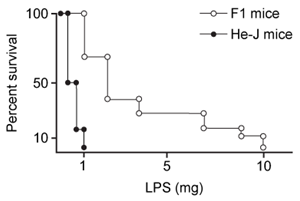
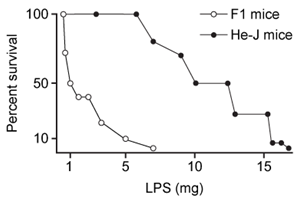
B) ![Passage Lipopolysaccharides (LPS) found in gram-negative bacterial cells can elicit a lethal degree of adjuvanticity, or immune activation, in LPS-responsive host organisms. In mice, responses may be modulated by abnormalities in the toll-like receptor (TLR) encoded by the Tlr4 gene closely linked to coat color on Chromosome 4. To investigate the effect of a particular Tlr4 mutation on LPS response, three experiments were performed following a cross between fully responsive He-N mice [tlr4(+) /tlr4(+) ] and He-J mice homozygous for the mutation [tlr4(d) /tlr4(d) ].Experiment 1Researchers isolated spleen cells for analysis of protein expression and LPS response. In cells isolated from F1 mice, both wild-type and mutant TLRs were distinguishable by protein electrophoresis. Following this first analysis, spleen cells from each cohort were exposed to 2 × 10<sup>5</sup> SRC, an antigen formed by sheep erythrocytes. Cultures were then incubated in the presence or absence of Ph-LPS, with LPS extracted from Escherichia coli K345 cells using a phenol-water mixture. Titers of anti-SRC antibody were recorded on incubation day 5, with the results shown in Table 1.<strong>Table 1</strong> Mean anti-SRC titers with standard error Experiment 2Serum samples were assayed for interferon production 2 hours post LPS injection. Interferon was quantified using a plaque reduction assay on mouse cells challenged with vesicular stomatitis virus. <strong>Figure 1</strong> Average serum interferon levels in mice cohortsExperiment 3Mice were injected with varying doses of Ph-LPS and monitored for 4 days. The lethal dose (LD<sub>50</sub>) was defined as the minimum dose causing death in 50% of injected mice. Compared to He-N mice, results reflected a 10-fold increase in LD<sub>50</sub> for F1 mice and a 100-fold increase in LD<sub>50</sub> for He-J mice. -According to the results of Experiment 3, which of the following could represent survival curves for F1 and He-J mice? A) B) C) D)](https://d2lvgg3v3hfg70.cloudfront.net/MD0008/11ecba2d_0f43_f882_a3bf_e1fa106ae4a1_MD0008_00.jpg)
C) ![Passage Lipopolysaccharides (LPS) found in gram-negative bacterial cells can elicit a lethal degree of adjuvanticity, or immune activation, in LPS-responsive host organisms. In mice, responses may be modulated by abnormalities in the toll-like receptor (TLR) encoded by the Tlr4 gene closely linked to coat color on Chromosome 4. To investigate the effect of a particular Tlr4 mutation on LPS response, three experiments were performed following a cross between fully responsive He-N mice [tlr4(+) /tlr4(+) ] and He-J mice homozygous for the mutation [tlr4(d) /tlr4(d) ].Experiment 1Researchers isolated spleen cells for analysis of protein expression and LPS response. In cells isolated from F1 mice, both wild-type and mutant TLRs were distinguishable by protein electrophoresis. Following this first analysis, spleen cells from each cohort were exposed to 2 × 10<sup>5</sup> SRC, an antigen formed by sheep erythrocytes. Cultures were then incubated in the presence or absence of Ph-LPS, with LPS extracted from Escherichia coli K345 cells using a phenol-water mixture. Titers of anti-SRC antibody were recorded on incubation day 5, with the results shown in Table 1.<strong>Table 1</strong> Mean anti-SRC titers with standard error Experiment 2Serum samples were assayed for interferon production 2 hours post LPS injection. Interferon was quantified using a plaque reduction assay on mouse cells challenged with vesicular stomatitis virus. <strong>Figure 1</strong> Average serum interferon levels in mice cohortsExperiment 3Mice were injected with varying doses of Ph-LPS and monitored for 4 days. The lethal dose (LD<sub>50</sub>) was defined as the minimum dose causing death in 50% of injected mice. Compared to He-N mice, results reflected a 10-fold increase in LD<sub>50</sub> for F1 mice and a 100-fold increase in LD<sub>50</sub> for He-J mice. -According to the results of Experiment 3, which of the following could represent survival curves for F1 and He-J mice? A) B) C) D)](https://d2lvgg3v3hfg70.cloudfront.net/MD0008/11ecba2d_0f44_1f93_a3bf_3723ecb8b55d_MD0008_00.jpg)
D) ![Passage Lipopolysaccharides (LPS) found in gram-negative bacterial cells can elicit a lethal degree of adjuvanticity, or immune activation, in LPS-responsive host organisms. In mice, responses may be modulated by abnormalities in the toll-like receptor (TLR) encoded by the Tlr4 gene closely linked to coat color on Chromosome 4. To investigate the effect of a particular Tlr4 mutation on LPS response, three experiments were performed following a cross between fully responsive He-N mice [tlr4(+) /tlr4(+) ] and He-J mice homozygous for the mutation [tlr4(d) /tlr4(d) ].Experiment 1Researchers isolated spleen cells for analysis of protein expression and LPS response. In cells isolated from F1 mice, both wild-type and mutant TLRs were distinguishable by protein electrophoresis. Following this first analysis, spleen cells from each cohort were exposed to 2 × 10<sup>5</sup> SRC, an antigen formed by sheep erythrocytes. Cultures were then incubated in the presence or absence of Ph-LPS, with LPS extracted from Escherichia coli K345 cells using a phenol-water mixture. Titers of anti-SRC antibody were recorded on incubation day 5, with the results shown in Table 1.<strong>Table 1</strong> Mean anti-SRC titers with standard error Experiment 2Serum samples were assayed for interferon production 2 hours post LPS injection. Interferon was quantified using a plaque reduction assay on mouse cells challenged with vesicular stomatitis virus. <strong>Figure 1</strong> Average serum interferon levels in mice cohortsExperiment 3Mice were injected with varying doses of Ph-LPS and monitored for 4 days. The lethal dose (LD<sub>50</sub>) was defined as the minimum dose causing death in 50% of injected mice. Compared to He-N mice, results reflected a 10-fold increase in LD<sub>50</sub> for F1 mice and a 100-fold increase in LD<sub>50</sub> for He-J mice. -According to the results of Experiment 3, which of the following could represent survival curves for F1 and He-J mice? A) B) C) D)](https://d2lvgg3v3hfg70.cloudfront.net/MD0008/11ecba2d_0f44_1f94_a3bf_81e6826eb40a_MD0008_00.jpg)
Correct Answer:

Verified
Correct Answer:
Verified
Q266: Passage<br>Domestic pigs have been used as valuable
Q267: A scientist sequences the genomes of several
Q268: Passage<br>The adrenal glands are divided into two
Q269: Passage<br>Overexpression of the miR-17~92 gene cluster occurs
Q270: Scientists identified two distinct pathogens in blood
Q272: Passage<br>Spinal muscular atrophy (SMA) is an autosomal
Q273: Passage<br>Spinal muscular atrophy (SMA) is an autosomal
Q274: Passage<br>Alzheimer disease (AD) is a progressive condition
Q275: Passage<br>The nicotinic acetylcholine receptor (nAChR) is a
Q276: Passage<br>At the blood-brain barrier, the cerebral spinal