



 Chat with AI
Exam 14: Tax Consequences of Home Ownership

Exam 1: An Introduction to Tax113 Questions
Exam 2: Tax Compliance, the IRS, and Tax Authorities112 Questions
Exam 3: Tax Planning Strategies and Related Limitations115 Questions
Exam 4: Individual Income Tax Overview, Dependents, and Filing Status125 Questions
Exam 5: Gross Income and Exclusions130 Questions
Exam 6: Individual Deductions98 Questions
Exam 7: Investments74 Questions
Exam 8: Individual Income Tax Computation and Tax Credits154 Questions
Exam 9: Business Income, Deductions, and Accounting Methods99 Questions
Exam 10: Property Acquisition and Cost Recovery109 Questions
Exam 11: Property Dispositions110 Questions
Exam 12: Compensation101 Questions
Exam 13: Retirement Savings and Deferred Compensation115 Questions
Exam 14: Tax Consequences of Home Ownership108 Questions
Exam 15: Entities Overview80 Questions
Exam 16: Corporate Operations109 Questions
Exam 17: Accounting for Income Taxes100 Questions
Exam 18: Corporate Taxation: Nonliquidating Distributions100 Questions
Exam 19: Corporate Formation, Reorganization, and Liquidation100 Questions
Exam 20: Forming and Operating Partnerships106 Questions
Exam 21: Dispositions of Partnership Interests and Partnership Distributions100 Questions
Exam 22: S Corporations134 Questions
Exam 23: State and Local Taxes117 Questions
Exam 24: The Us Taxation of Multinational Transactions89 Questions
Exam 25: Transfer Taxes and Wealth Planning123 Questions
Select questions type


Tyson owns a condominium near Laguna Beach, California. This year, he incurs the following expenses in connection with his condo:
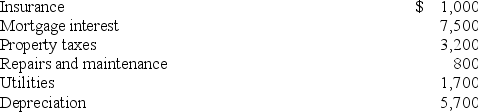 During the year, Tyson rented the condo for 100 days, receiving $25,000 of gross income. He personally used the condo for 60 days. Assuming Tyson uses the Tax Court method of allocating expenses to rental use of the property. What is Tyson's net rental income for the year (assume this is not a leap year)?
 (Essay)
4.9/5  (69)
(69) For determining whether a taxpayer qualifies to exclude gain on the sale of a principal residence, the periods of ownership and use need not be continuous nor do they need to cover the same two-year period.
(True/False)
4.8/5 (89)
(89) In general terms, the tax laws favor taxpayers who own a principal residence relative to those who rent a principal residence.
(True/False)
4.9/5 (73)
(73) When a taxpayer finances her personal residence, in general, she may not deduct points paid for loan origination fees, but she may deduct points paid as prepaid interest.
(True/False)
4.8/5 (79)
(79) When determining the number of days a taxpayer has rented out a home during the year, any day when the home is available for rent but not actually rented out counts as a day of rental use.
(True/False)
4.8/5 (77)
(77) Joshua and Mary Sullivan purchased a new home on October 1 of year 1 for $400,000. At the time of the purchase, it was estimated that the real property tax rate for the year would be 1 percent of the property's value. Because the taxing jurisdiction collects taxes on a July 1 year-end, it was estimated that the Sullivans would be required to pay $3,000 in property taxes for the property tax year relating to October through June of year 2 ($400,000 × 1% × 9/12). The seller would be required to pay the $1,000 for July through September of year 1. Along with their monthly payment of principal and interest, the Sullivans paid $333 a month to the mortgage company to cover the property taxes. The mortgage company placed the money in escrow and used the escrow funds to pay the $3,000 property tax bill in July of year 2. The Sullivans' itemized deductions exceed the standard deduction before considering property taxes. What amount are the Sullivans allowed to deduct for property taxes relating to the property in year 1 (ending July 1, year 1) and year 2 (ending July 1, year 2)?
(Essay)
4.7/5 (80)
(80) Jennifer owns a home that she rents for 364 days and uses for personal purposes for one day. Jennifer is required to allocate expenses associated with the home between rental and personal use.
(True/False)
4.9/5 (78)
(78) Jorge owns a home that he rents for 360 days and uses for personal purposes for five days. Jorge is not required to allocate expenses associated with the home between rental and personal use.
(True/False)
4.9/5 (78)
(78) 
Filters
- Essay(0)
- Multiple Choice(0)
- Short Answer(0)
- True False(0)
- Matching(0)