



 Chat with AI
Exam 16: Resource Planning

Exam 1: Using Operations to Compete107 Questions
Exam 2: Project Management151 Questions
Exam 3: Process Strategy149 Questions
Exam 4: Process Analysis192 Questions
Exam 5: Quality and Performance223 Questions
Exam 6: Capacity Planning133 Questions
Exam 7: Constraint Management160 Questions
Exam 8: Lean Systems179 Questions
Exam 9: Supply Chain Inventory Management216 Questions
Exam 10: Supply Chain Design93 Questions
Exam 11: Supply Chain Location Decisions126 Questions
Exam 12: Supply Chain Integration130 Questions
Exam 13: Supply Chain Sustainability and Humanitarian Logistics77 Questions
Exam 14: Forecasting183 Questions
Exam 15: Operations Planning and Scheduling191 Questions
Exam 16: Resource Planning149 Questions
Exam 17: Decision Making118 Questions
Exam 18: Waiting Line127 Questions
Exam 19: Special Inventory Models53 Questions
Exam 20: Linear Programming84 Questions
Exam 21: Simulation61 Questions
Exam 22: Financial Analysis60 Questions
Exam 23: Acceptance Sampling Plans88 Questions
Exam 24: Measuring Output Rates103 Questions
Exam 25: Learning Curve Analysis56 Questions
Exam 26: Operations Scheduling131 Questions
Select questions type


Figure 16.8 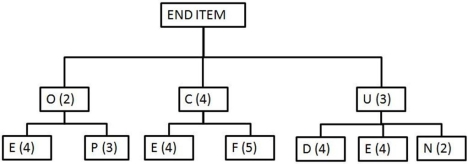
 Inventory amounts indicated in the table are available to produce the end item indicated in this bill of materials.
-Use Figure 16.8 to answer this question.How many additional units of N are needed to produce eighteen end items?
Inventory amounts indicated in the table are available to produce the end item indicated in this bill of materials.
-Use Figure 16.8 to answer this question.How many additional units of N are needed to produce eighteen end items? (Multiple Choice)
4.8/5  (76)
(76) ________ is a technique used for projecting time-phased capacity requirements for workstations.
(Essay)
4.9/5 (79)
(79) A(n)________ is a record that divides the future into time periods called time buckets.
(Essay)
4.8/5 (79)
(79) The sums of the quantities in the master production schedule must equal those in the ________.
(Essay)
4.9/5 (81)
(81) ________ is a computerized information system developed specifically to aid in managing dependent-demand inventory and scheduling replenishment orders.
(Essay)
4.9/5 (69)
(69) A companywide process that cuts across functional areas,business units,geographic regions,and product lines is a(n)________.
(Essay)
4.8/5 (76)
(76) A companywide process that cuts across traditional functional areas,business units,geographic regions,and product lines is a(n):
(Multiple Choice)
4.8/5 (70)
(70) ________ are the total demand derived from all parent production plans.
(Essay)
4.9/5 (82)
(82) Entering new information in the database of an ERP system is a(n):
(Multiple Choice)
4.9/5 (72)
(72) Table 16.2 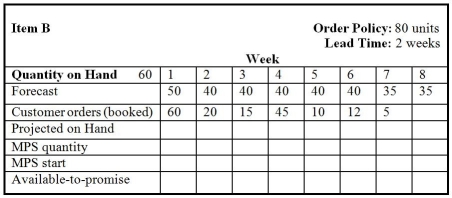 -Use the information in partially completed Table 16.2.What is the MPS start quantity in week 1?
 (Multiple Choice)
5.0/5 (80)
(80) ________ is the degree to which a component has more than one immediate parent.
(Essay)
4.9/5 (76)
(76) Table 16.7
Viola Products produces one item with the following bill of materials 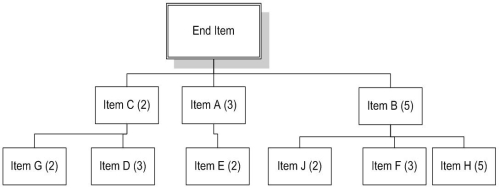 A recent check of their inventory reveals the following quantities on hand.
 Currently no scheduled receipts exist for any of the dependent demand items.
-Use Table 16.7 to answer this question.How many additional units of H are needed to produce 20 end items?
A recent check of their inventory reveals the following quantities on hand.
Currently no scheduled receipts exist for any of the dependent demand items.
-Use Table 16.7 to answer this question.How many additional units of H are needed to produce 20 end items? (Multiple Choice)
4.8/5 (83)
(83) MRP can be used to best advantage under which one of the following circumstances?
(Multiple Choice)
4.8/5 (77)
(77) Table 16.3 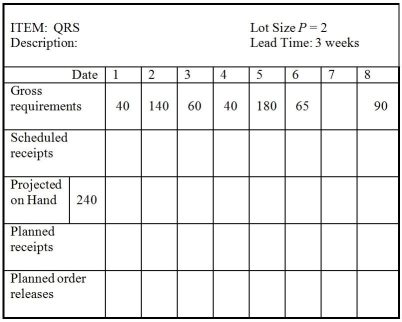 -Use the information in partially completed Table 16.3.In which week will the second planned order release occur?
 (Multiple Choice)
4.9/5 (73)
(73) For items manufactured in-house,one component of the planned lead time is waiting time.
(True/False)
4.8/5 (77)
(77) Table 16.2
-Use the information in partially completed Table 16.2.In which week does the second nonzero MPS quantity occur?
-Use the information in partially completed Table 16.2.In which week does the second nonzero MPS quantity occur? (Multiple Choice)
4.9/5 (77)
(77) Table 16.1 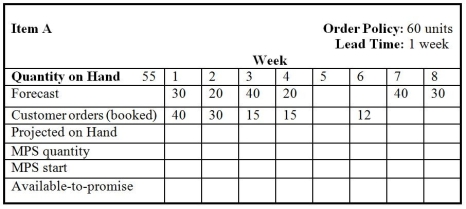 -Use the information in partially completed Table 16.1.What is the available-to-promise (ATP)inventory in week 7?
 (Multiple Choice)
4.8/5 (71)
(71) Available-to-promise inventory is the amount of end items that marketing can promise to customers by a certain date.
(True/False)
4.7/5 (80)
(80) 
Filters
- Essay(0)
- Multiple Choice(0)
- Short Answer(0)
- True False(0)
- Matching(0)