



 Chat with AI
Exam 16: Resource Planning

Exam 1: Using Operations to Compete107 Questions
Exam 2: Project Management151 Questions
Exam 3: Process Strategy149 Questions
Exam 4: Process Analysis192 Questions
Exam 5: Quality and Performance223 Questions
Exam 6: Capacity Planning133 Questions
Exam 7: Constraint Management160 Questions
Exam 8: Lean Systems179 Questions
Exam 9: Supply Chain Inventory Management216 Questions
Exam 10: Supply Chain Design93 Questions
Exam 11: Supply Chain Location Decisions126 Questions
Exam 12: Supply Chain Integration130 Questions
Exam 13: Supply Chain Sustainability and Humanitarian Logistics77 Questions
Exam 14: Forecasting183 Questions
Exam 15: Operations Planning and Scheduling191 Questions
Exam 16: Resource Planning149 Questions
Exam 17: Decision Making118 Questions
Exam 18: Waiting Line127 Questions
Exam 19: Special Inventory Models53 Questions
Exam 20: Linear Programming84 Questions
Exam 21: Simulation61 Questions
Exam 22: Financial Analysis60 Questions
Exam 23: Acceptance Sampling Plans88 Questions
Exam 24: Measuring Output Rates103 Questions
Exam 25: Learning Curve Analysis56 Questions
Exam 26: Operations Scheduling131 Questions
Select questions type


Use the bill of materials and inventory records to determine the additional quantities of purchased items necessary to assemble 20 end items if the manufacturer uses lot-for-lot ordering.There are no end items currently on hand,and none of the components have any scheduled receipts. 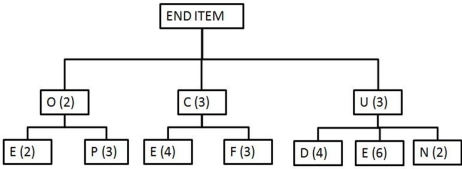
 Inventory amounts indicated in the table are available to produce the end item indicated in this bill of materials.
 (Essay)
4.8/5  (80)
(80) A component is an item that may go through one or more operations to be transformed into or become part of one or more parents.
(True/False)
5.0/5 (83)
(83) The master production schedule (MPS)is the part of the material requirements planning that specifies when components must be ordered or assembled.
(True/False)
4.9/5 (68)
(68) ________ is an estimate of the amount of inventory available each week after gross requirements have been satisfied.
(Essay)
4.9/5 (72)
(72) Case Study 16.1
Sunshine Manufacturing produces three products: X,Y,Z.The production of these end items is controlled by an MRP system.Each end item X is assembled with two components of A and one component of B.Each end item of Y is assembled with two components of C and one component of A.End item Z is assembled from one unit of D and one unit of C;D is manufactured from one unit of A;and C is manufactured from one unit of B.
-Use the information in Case Study 16.1.If item C has a manufacturing lead time of two weeks,and a planned receipt of 65 units is needed in week 4,which of the following statements is TRUE?
(Multiple Choice)
5.0/5 (70)
(70) Table 16.4
Consider the following MPS,BOM,and inventory data.Blank MRP records are provided at the end of this exam.
Master Production Schedule: The following table shows the MPS start quantities.  Bill of Material
-End item A uses 1 each of component C and 1 each of subassembly D.
-Subassembly D uses 2 each of component E and 2 each of component F.
-End item B uses 1 each of component C and 2 each of component F.
Selected Inventory Data
 -Use the information in Table 16.4.Which one of the following statements about item E is TRUE?
Bill of Material
-End item A uses 1 each of component C and 1 each of subassembly D.
-Subassembly D uses 2 each of component E and 2 each of component F.
-End item B uses 1 each of component C and 2 each of component F.
Selected Inventory Data
-Use the information in Table 16.4.Which one of the following statements about item E is TRUE? (Multiple Choice)
4.8/5 (92)
(92) The projected on-hand inventory in the MPS takes into account scheduled receipts,but not planned receipts.
(True/False)
4.9/5 (79)
(79) Which of the following uses of MRP in promoting a healthy environment is NOT used?
(Multiple Choice)
4.8/5 (83)
(83) Table 16.2  -Use the following partially completed MRP record to answer the question.
 What are the quantities of planned order releases for item XYZ for the first six weeks (weeks 1,2,3,4,5,and 6)?
-Use the following partially completed MRP record to answer the question. What are the quantities of planned order releases for item XYZ for the first six weeks (weeks 1,2,3,4,5,and 6)? (Multiple Choice)
4.8/5 (83)
(83) Which one of the following statements about lot-sizing rules is TRUE?
(Multiple Choice)
4.9/5 (92)
(92) The portion of the master production schedule farthest into the future is often frozen to reduce forecasting requirements.
(True/False)
4.9/5 (81)
(81) Lot-for-lot (L4L)is a rule that maintains the same order quantity each time an order is issued.
(True/False)
4.7/5 (70)
(70) Use the bill of materials and inventory records to determine the quantity of purchased items necessary to assemble 20 end items if the manufacturer uses lot-for-lot ordering.There are no end items currently on hand,and none of the components have any scheduled receipts.

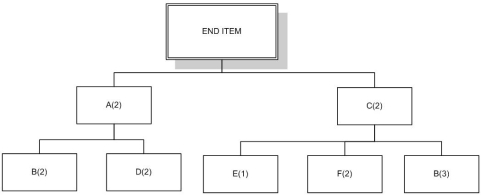
(Essay)
4.8/5 (85)
(85) Which one of the following is an MRP lot-sizing rule that attempts to minimize the amount of average inventory?
(Multiple Choice)
4.9/5 (83)
(83) Available-to-promise (ATP)quantities are only shown in the first period (if the projected on-hand inventory is greater than zero in the first period),and subsequently in periods when the MPS quantity is greater than 0.
(True/False)
4.9/5 (68)
(68) Table 16.6  -Use the information from Table 16.6.If an L4L lot-sizing rule is used,how many planned order releases are there for item XYZ? (Hint: The 80-unit scheduled receipt should remain unchanged,because it has already been released and is being worked on. )
 (Multiple Choice)
4.9/5 (90)
(90) 
Filters
- Essay(0)
- Multiple Choice(0)
- Short Answer(0)
- True False(0)
- Matching(0)