



 Chat with AI
Exam 19: Capital Investment

Exam 1: Introduction to Cost Management151 Questions
Exam 2: Basic Cost Management Concepts199 Questions
Exam 3: Cost Behavior193 Questions
Exam 4: Activity-Based Costing198 Questions
Exam 5: Product and Service Costing: Job-Order System149 Questions
Exam 6: Process Costing181 Questions
Exam 7: Allocating Costs of Support Departments and Joint Products171 Questions
Exam 8: Budgeting for Planning and Control202 Questions
Exam 9: Standard Costing: a Functional-Based Control Approach125 Questions
Exam 10: Decentralization: Responsibility, Accounting, Performance Evaluation, and Transfer Pricing134 Questions
Exam 11: Strategic Cost Management148 Questions
Exam 12: Activity-Based Management146 Questions
Exam 13: The Balanced Scorecard: Strategic-Based Control124 Questions
Exam 14: Quality and Environmental Cost Management199 Questions
Exam 15: Lean Accounting and Productivity Measurement161 Questions
Exam 16: Cost-Volume-Profit Analysis128 Questions
Exam 17: Activity Resource Usage Model and Tactical Decision Making121 Questions
Exam 18: Pricing and Profitability Analysis159 Questions
Exam 19: Capital Investment125 Questions
Exam 20: Inventory Management: Economic Order Quantity, Jit, and the Theory of Constraints127 Questions
Select questions type


Azimuth Company was considering the purchase of equipment. Details on the equipment are as follows:  What is the payback period in years, assuming no taxes are paid?
 (Multiple Choice)
4.7/5  (89)
(89) Which of the following capital investment models would be preferred when choosing among mutually exclusive alternatives?
(Multiple Choice)
4.7/5 (69)
(69) A firm is considering a project requiring an investment of $200,000. The project would generate an annual cash flow of $55,478 for the next five years. The company uses the straight-line method of depreciation with no mid- year convention. Ignore income taxes. The approximate internal rate of return for the project is
(Multiple Choice)
4.9/5 (76)
(76) Wastenot Production Company is considering the purchase of a flexible manufacturing system. The after-tax cash benefits/savings associated with the system are as follows:
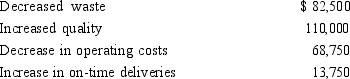 The system will cost $825,000 and will last ten years.
The company's cost of capital is 10 percent.
Required:
a. What is the payback period for the flexible manufacturing system?
b. What is the NPV for the flexible manufacturing system?
c. What is the IRR for the flexible manufacturing system?
The system will cost $825,000 and will last ten years.
The company's cost of capital is 10 percent.
Required:
a. What is the payback period for the flexible manufacturing system?
b. What is the NPV for the flexible manufacturing system?
c. What is the IRR for the flexible manufacturing system? (Essay)
4.7/5 (78)
(78) The accounting rate of return on original investment is calculated as
(Multiple Choice)
4.9/5 (86)
(86) If the internal rate of return (IRR) is less than the cost of capital, then the investment is acceptable.
(True/False)
4.8/5 (82)
(82) Which of the following is NOT an example of information the payback period can provide to management?
(Multiple Choice)
4.9/5 (93)
(93) Nondiscounting models for making capital investments explicitly consider the time value of money.
(True/False)
4.8/5 (72)
(72) Net present value (NPV) is the difference between the present value of cash inflows and outflows associated with a project.
(True/False)
4.8/5 (90)
(90) If the tax rate is 40 percent and a company has $800,000 of income, a depreciation deduction of $160,000 would result in a tax savings of
(Multiple Choice)
4.8/5 (77)
(77) Anselmo Corp. is considering the purchase of a new machine for $76,000. The machine would generate an annual cash flow of $23,214 for five years. At the end of five years, the machine would have no salvage value. The company's cost of capital is 12 percent. The company uses straight-line depreciation with no mid-year convention. What is the payback period in years for the machine approximated to two decimal points, assuming no taxes are paid?
(Multiple Choice)
4.9/5 (81)
(81) Mutually exclusive projects are those which preclude the acceptance of all other competing projects.
(True/False)
4.9/5 (72)
(72) In today's markets, longterm investments in technology and pollution prevention can provide significant competitive
advantages.
(True/False)
4.9/5 (90)
(90) A firm is considering a project with an annual cash flow of $240,000. The project would have an 8-year life, and the company uses a discount rate of 12 percent. Ignoring income taxes, what is the maximum amount the company could invest in the project and have the project still be acceptable (rounded)?
(Multiple Choice)
4.8/5 (79)
(79) the two ways to compute after-tax cash flows are the income method and the composition method.
(True/False)
4.9/5 (83)
(83) Davidson, Inc., is considering the purchase of production equipment that costs $300,000. The equipment is expected to generate an annual cash flow of $100,000 and have a useful life of five years with no salvage value. The firm's cost of capital is 14 percent. The company uses the straight-line method of depreciation with no mid-year convention. Ignore income taxes. Payback for the project is
(Multiple Choice)
4.8/5 (81)
(81) A machine with a book value of $60,000 could be sold for $80,000. The corporation that owns the machine has taxable income of $670,000 and a 40 percent tax rate. What would be the tax on the sale of the machine?
(Multiple Choice)
5.0/5 (81)
(81) Which of the following methods uses income instead of cash flows?
(Multiple Choice)
4.9/5 (72)
(72) Colorform Company is considering the purchase of the following computer equipment, which is considered 5-year property for tax purposes: 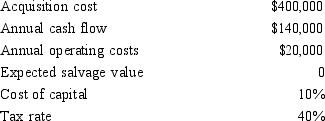 Colorform Company plans to use MACRS and keep the production equipment for seven years. (Round amounts to
Dollars.)
Tax savings from depreciation in Year 3 would be
Colorform Company plans to use MACRS and keep the production equipment for seven years. (Round amounts to
Dollars.)
Tax savings from depreciation in Year 3 would be (Multiple Choice)
4.9/5 (77)
(77) 
Filters
- Essay(0)
- Multiple Choice(0)
- Short Answer(0)
- True False(0)
- Matching(0)