



 Chat with AI
Exam 19: Capital Investment

Exam 1: Introduction to Cost Management151 Questions
Exam 2: Basic Cost Management Concepts199 Questions
Exam 3: Cost Behavior193 Questions
Exam 4: Activity-Based Costing198 Questions
Exam 5: Product and Service Costing: Job-Order System149 Questions
Exam 6: Process Costing181 Questions
Exam 7: Allocating Costs of Support Departments and Joint Products171 Questions
Exam 8: Budgeting for Planning and Control202 Questions
Exam 9: Standard Costing: a Functional-Based Control Approach125 Questions
Exam 10: Decentralization: Responsibility, Accounting, Performance Evaluation, and Transfer Pricing134 Questions
Exam 11: Strategic Cost Management148 Questions
Exam 12: Activity-Based Management146 Questions
Exam 13: The Balanced Scorecard: Strategic-Based Control124 Questions
Exam 14: Quality and Environmental Cost Management199 Questions
Exam 15: Lean Accounting and Productivity Measurement161 Questions
Exam 16: Cost-Volume-Profit Analysis128 Questions
Exam 17: Activity Resource Usage Model and Tactical Decision Making121 Questions
Exam 18: Pricing and Profitability Analysis159 Questions
Exam 19: Capital Investment125 Questions
Exam 20: Inventory Management: Economic Order Quantity, Jit, and the Theory of Constraints127 Questions
Select questions type


NPV is preferred to IRR because it assumes that each cash inflow is not reinvested at the required rate of return.
(True/False)
4.8/5  (64)
(64) A firm is considering a project with an annual cash flow of $80,000. The project would have a 10-year life, and the company uses a discount rate of 8 percent. Ignoring income taxes, what is the maximum amount the company could invest in the project and have the project still be acceptable (rounded)?
(Multiple Choice)
4.8/5 (83)
(83) The rate of return sets the present value of cash inflows equal to the present value of a project's
cost.
(Short Answer)
4.7/5 (72)
(72) Mutually exclusive projects do not affect the of other projects.
(Short Answer)
4.9/5 (67)
(67) Ursula Company is considering the purchase of a new machine for $160,000. The machine would generate an annual cash flow before depreciation and taxes of $62,588 for four years. At the end of four years, the machine would have no salvage value. The company's cost of capital is 12 percent. The company uses straight-line depreciation with no mid-year convention and has a 40 percent tax rate. What is the internal rate of return for the machine rounded to the nearest percent?
(Multiple Choice)
4.8/5 (74)
(74) Decisions concerned with the process of planning, setting goals and priorities, arranging financing, and using certain criteria to select long-term assets are called:
(Multiple Choice)
4.8/5 (74)
(74) Joyous Corporation is considering an investment in equipment for $25,000. Data related to the investment are as follows: Cash Flow before
Year Depreciation and Taxes
1 $12,500
2 12,500
3 12,500
4 12,500
Joyous uses the straight-line method of depreciation with no mid-year convention. In addition, its tax rate is 40 percent and the life of the equipment is four years with no salvage value. Cost of capital is 12 percent.
What is the payback period in years approximated to two decimal points?
(Multiple Choice)
4.9/5 (81)
(81) Los Gatos Shop is considering the purchase of a used wide-format printer costing $9,600. The wide-format printer would generate a net cash inflow of $4,000 per year for three years. At the end of three years, the printer would have no salvage value. The company's cost of capital is 10 percent. The company uses straight-line depreciation with no mid-year convention. What is the net present value for the press, assuming no taxes are paid?
(Multiple Choice)
4.9/5 (60)
(60) Langueville Manufacturing Company is considering the following investment proposal:  The firm uses the straight-line method of depreciation with no mid-year convention.
What is the payback period in years approximated to two decimal points, assuming no taxes are paid?
The firm uses the straight-line method of depreciation with no mid-year convention.
What is the payback period in years approximated to two decimal points, assuming no taxes are paid? (Multiple Choice)
4.9/5 (84)
(84) Hollister Company is considering the purchase of a new machine for $60,000. The machine would generate an annual cash flow before depreciation and taxes of $25,647 for four years. At the end of four years, the machine would have no salvage value. The company's cost of capital is 12 percent. The company uses straight-line depreciation with no mid-year convention and has a 40 percent tax rate. What is the accounting rate of return on the original investment in the machine approximated to two decimal points?
(Multiple Choice)
4.8/5 (83)
(83) When comparing the payback method and the accounting rate of return methods, which of the following is true? 
(Multiple Choice)
4.9/5 (75)
(75) Projects that, if accepted preclude the acceptance of all other competing projects are called:
(Multiple Choice)
4.9/5 (70)
(70) The present value of $4,000 to be received three years from now and earning a 12 percent return (rounded) is
(Multiple Choice)
4.8/5 (81)
(81) Vendome Company is considering the purchase of the following computer equipment, which is considered 5-year property for tax purposes: 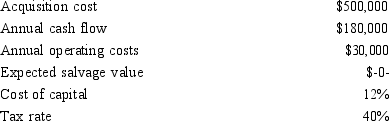 Vendome plans to use MACRS and keep the production equipment for seven years. (Round amounts to dollars.)
The MACRS deduction in Year 2 would be
Vendome plans to use MACRS and keep the production equipment for seven years. (Round amounts to dollars.)
The MACRS deduction in Year 2 would be (Multiple Choice)
4.9/5 (83)
(83) Accelerated methods of are preferred because of the tax benefits created.
(Short Answer)
4.8/5 (86)
(86) Five mutually exclusive projects had the following information:  Which project is preferred?
 (Multiple Choice)
4.9/5 (72)
(72) Discounted cash flows are used by discounting models which are future cash flows expressed in terms of their present value.
(True/False)
4.8/5 (84)
(84) Bellamy Company is considering the purchase of a computerized manufacturing system. The after-tax cash benefits/savings associated with the system are as follows: 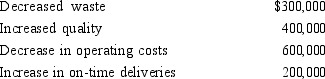 The system will cost $9,000,000 and will last ten years. The company's cost of capital is 12 percent.
What is the payback period for the computerized manufacturing system?
The system will cost $9,000,000 and will last ten years. The company's cost of capital is 12 percent.
What is the payback period for the computerized manufacturing system? (Multiple Choice)
4.9/5 (71)
(71) MakeitRite Company is considering the purchase of a new machine for $80,000. The machine would generate an annual cash flow before depreciation and taxes of $28,778 for five years. At the end of five years, the machine would have no salvage value. The company's cost of capital is 12 percent. The company uses straight-line depreciation with no mid-year convention and has a 40 percent tax rate. What is the net present value for the machine?
(Multiple Choice)
4.9/5 (83)
(83) If the tax rate is 40 percent and a company has $800,000 of income, a depreciation deduction of $100,000 would result in a tax savings of
(Multiple Choice)
4.8/5 (84)
(84) 
Filters
- Essay(0)
- Multiple Choice(0)
- Short Answer(0)
- True False(0)
- Matching(0)