



 Chat with AI
Exam 11: Strategic Cost Management

Exam 1: Introduction to Cost Management151 Questions
Exam 2: Basic Cost Management Concepts199 Questions
Exam 3: Cost Behavior193 Questions
Exam 4: Activity-Based Costing198 Questions
Exam 5: Product and Service Costing: Job-Order System149 Questions
Exam 6: Process Costing181 Questions
Exam 7: Allocating Costs of Support Departments and Joint Products171 Questions
Exam 8: Budgeting for Planning and Control202 Questions
Exam 9: Standard Costing: a Functional-Based Control Approach125 Questions
Exam 10: Decentralization: Responsibility, Accounting, Performance Evaluation, and Transfer Pricing134 Questions
Exam 11: Strategic Cost Management148 Questions
Exam 12: Activity-Based Management146 Questions
Exam 13: The Balanced Scorecard: Strategic-Based Control124 Questions
Exam 14: Quality and Environmental Cost Management199 Questions
Exam 15: Lean Accounting and Productivity Measurement161 Questions
Exam 16: Cost-Volume-Profit Analysis128 Questions
Exam 17: Activity Resource Usage Model and Tactical Decision Making121 Questions
Exam 18: Pricing and Profitability Analysis159 Questions
Exam 19: Capital Investment125 Questions
Exam 20: Inventory Management: Economic Order Quantity, Jit, and the Theory of Constraints127 Questions
Select questions type


According to the authors, 90 percent or more of a product's life-cycle costs are determined during
(Multiple Choice)
4.9/5  (74)
(74) Activities required to design, develop, produce, market, distribute, and service a product are known as
(Multiple Choice)
4.7/5 (81)
(81) The strategy to create better customer value for the same or lower cost than competitors or creating equivalent value for lower cost than offered by competitors is called:
(Multiple Choice)
5.0/5 (86)
(86) The strategy which involves choosing among alternative strategies with the goal of selecting a strategy or strategies that provides a company with reasonable assurance of long-term growth and survival is called:
(Multiple Choice)
5.0/5 (87)
(87) Which of the following manufacturing costs is assigned to products in a traditional and JIT environment using allocation?
(Multiple Choice)
5.0/5 (65)
(65) Strategic cost management emphasizes the importance of an external focus and the need to recognize and exploit internal and external linkages.
(True/False)
4.8/5 (69)
(69) Which of the following is NOT a stage of the marketing viewpoint of the product life cycle?
(Multiple Choice)
4.9/5 (86)
(86) Loganberry Corporation sells a product for $400 per unit. Its market share is 22 percent of the units sold. The marketing manager feels that the market share can be increased to 28 percent of the units sold with a reduction in price to $340. The product is currently earning a profit of $64 per unit. The president of Loganberry Corporation feels that his company needs to maintain the same profit level per unit. The market share consists of $4,000,000 (10,000 units).
Required:
a. How many units does Loganberry Corporation currently sell of the product?
b. What is the target price per unit?
c. What is the original cost per unit?
d. What is the target cost per unit?
(Essay)
4.9/5 (84)
(84) The stage during which a product loses market acceptance is called the stage.
(Short Answer)
4.9/5 (67)
(67) Figure 11-2
Blue Vibrance Company sells a product used in many manufacturing processes. The sales activity involves three activity areas:
Activity Area Cost Driver and Rate
Order taking $100 per purchase order
Sales visits $50 per visit
Delivery vehicles $1 per delivery mile
The following customer information is given:
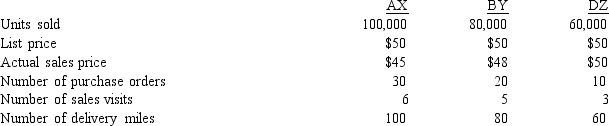 -Refer to Figure 11-2. What is the profitability of customer BY?
 (Multiple Choice)
4.9/5 (98)
(98) Which of the life-cycle viewpoints is the cost-oriented viewpoint?
(Multiple Choice)
4.9/5 (86)
(86) Which of the following is NOT a stage of the consumable life-cycle viewpoint?
(Multiple Choice)
4.9/5 (76)
(76) In JIT purchasing, materials are usually at warehouse long before they are needed.
(True/False)
4.9/5 (77)
(77) Which of the following are true about total quality control?
(Multiple Choice)
5.0/5 (73)
(73) Value-chain analysis is identifying and exploiting internal and external linkages to achieve strong strategic positions.
(True/False)
4.9/5 (75)
(75) Acceptable quality level (AQL) allows defects to occur within predetermined parameters.
(True/False)
4.8/5 (80)
(80) JIT manufacturing differs from traditional manufacturing in all of the following ways EXCEPT
(Multiple Choice)
4.9/5 (70)
(70) The manufacturing which reduces inventory levels because production is geared to demand is called:
(Multiple Choice)
4.8/5 (77)
(77) Which of the life-cycle viewpoints is the revenue-oriented viewpoint?
(Multiple Choice)
4.8/5 (82)
(82) 
Filters
- Essay(0)
- Multiple Choice(0)
- Short Answer(0)
- True False(0)
- Matching(0)