



 Chat with AI
Exam 11: Strategic Cost Management

Exam 1: Introduction to Cost Management151 Questions
Exam 2: Basic Cost Management Concepts199 Questions
Exam 3: Cost Behavior193 Questions
Exam 4: Activity-Based Costing198 Questions
Exam 5: Product and Service Costing: Job-Order System149 Questions
Exam 6: Process Costing181 Questions
Exam 7: Allocating Costs of Support Departments and Joint Products171 Questions
Exam 8: Budgeting for Planning and Control202 Questions
Exam 9: Standard Costing: a Functional-Based Control Approach125 Questions
Exam 10: Decentralization: Responsibility, Accounting, Performance Evaluation, and Transfer Pricing134 Questions
Exam 11: Strategic Cost Management148 Questions
Exam 12: Activity-Based Management146 Questions
Exam 13: The Balanced Scorecard: Strategic-Based Control124 Questions
Exam 14: Quality and Environmental Cost Management199 Questions
Exam 15: Lean Accounting and Productivity Measurement161 Questions
Exam 16: Cost-Volume-Profit Analysis128 Questions
Exam 17: Activity Resource Usage Model and Tactical Decision Making121 Questions
Exam 18: Pricing and Profitability Analysis159 Questions
Exam 19: Capital Investment125 Questions
Exam 20: Inventory Management: Economic Order Quantity, Jit, and the Theory of Constraints127 Questions
Select questions type


Which of the following manufacturing costs is assigned to products in a traditional environment using driver tracing?
(Multiple Choice)
4.8/5  (89)
(89) Luminous Company sells a product for $450 per unit. Its market share is 25 percent. The marketing manager feels that the market share can be increased to 33 percent with a reduction in price to $390. The product is currently earning a profit of $72 per unit. The president of Luminous Company feels that the $72 profit per unit must be maintained. What is the target price per unit?
(Multiple Choice)
4.9/5 (91)
(91) Which stage in the marketing viewpoint is characterized by preproduction and startup activities?
(Multiple Choice)
5.0/5 (80)
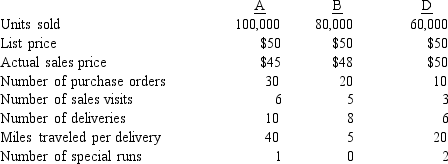
(80) Ethereal Company sells a product used in many manufacturing processes. The sales activity involves four activity areas:
Activity Area Cost Driver and Rate
Order taking $100 per purchase order
Sales visits $50 per visit
Delivery vehicles $1 per delivery mile
Special runs $300 per run
The following customer information is given:
 Required:
What is the profitability of customer B?
Required:
What is the profitability of customer B? (Essay)
4.8/5 (74)
(74) The viewpoint which defines stages of the life cycle by changes in the type of activities performed is called the:
(Multiple Choice)
4.8/5 (80)
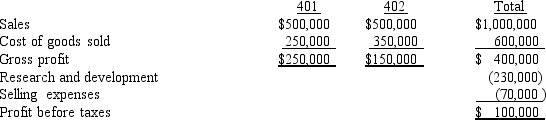
(80) Eva Rodriguez, chairwoman of Wiccan Industries, had just completed examining a projected profit summary for two components that would be used in LCD Screens. Both units were still in a very preliminary planning stage, and a decision had to be made regarding their continued viability. The components would be developed, produced, and sold at the same time. Each product's life cycle is 40 months. The projected profit performance of the two items promised a return on sales of 10 percent-less than the 14 percent rate set by company standards. From the statements below, it appeared to Eva that the culprit was Component 402 because its gross profit percentage was much lower than that of Component 401.
 Required:
a. Explain why Eva may be wrong in her assessment of the relative performances of the two products. What change in the company's life-cycle budgeting approach would you suggest?
b. Suppose that 75 percent of the research and development and 75 percent of the selling expenses are traceable to Component 401. Prepare budgeted life-cycle income statements for each product and calculate the return on sales. What does this tell you about the importance of accurate life-cycle budgeting?
Required:
a. Explain why Eva may be wrong in her assessment of the relative performances of the two products. What change in the company's life-cycle budgeting approach would you suggest?
b. Suppose that 75 percent of the research and development and 75 percent of the selling expenses are traceable to Component 401. Prepare budgeted life-cycle income statements for each product and calculate the return on sales. What does this tell you about the importance of accurate life-cycle budgeting? (Essay)
4.8/5 (84)
(84) The use of cost data to develop and identify superior strategies that will produce a sustainable competitive advantage is called:
(Multiple Choice)
4.8/5 (72)
(72) Which of the following is NOT a stage of the production life-cycle viewpoint?
(Multiple Choice)
4.8/5 (76)
(76) The creation of customer value for same or lower cost than competitors is called advantage.
(Short Answer)
4.8/5 (89)
(89) Information for life-cycle cost management is supported by a(n)
(Multiple Choice)
4.8/5 (82)
(82) JIT manufacturing eliminates waste by producing products only when, and in the quantities needed.
(True/False)
4.9/5 (87)
(87) the traditional approach of permitting defects to occur as long as they do NOT exceed a certain level is called
(Multiple Choice)
4.8/5 (78)
(78) If JIT manufacturing is used and each manufacturing cell produces a single product, all of the following are considered direct product costs EXCEPT
(Multiple Choice)
4.9/5 (72)
(72) A firm that has implemented JIT had the following transactions:
1) Materials were purchased on account for $40,000.
2) Materials were placed into production.
3) Actual direct labor costs were $6,000.
4) Actual overhead costs were $40,000.
5) Conversion costs applied were $42,000.
6) All work was completed for the month.
7) All completed work was sold.
8) The variance is recognized.
What will be the entry to record material purchases using the traditional approach?
(Multiple Choice)
4.8/5 (76)
(76) Figure 11-4
The Algonquin Company developed the following budgeted life-cycle income statement for two proposed products. Each product's life cycle is expected to be two years.
 A 10 percent return on sales is required for new products. Because the proposed products did not have a 10
percent return on sales, the products were going to be dropped.
Relative to Product B, Product A requires more research and development costs but fewer resources to market the product. Sixty percent of the research and development costs are traceable to Product A, and 30 percent of the marketing costs are traceable to Product A.
-Refer to figure 11-4. If research and development costs and marketing costs are traced to each product, life-cycle income for Product B would be
A 10 percent return on sales is required for new products. Because the proposed products did not have a 10
percent return on sales, the products were going to be dropped.
Relative to Product B, Product A requires more research and development costs but fewer resources to market the product. Sixty percent of the research and development costs are traceable to Product A, and 30 percent of the marketing costs are traceable to Product A.
-Refer to figure 11-4. If research and development costs and marketing costs are traced to each product, life-cycle income for Product B would be (Multiple Choice)
4.9/5 (86)
(86) When a computer company targets customers in the South, it is following a
(Multiple Choice)
4.9/5 (75)
(75) If JIT manufacturing is used and each manufacturing cell produces a single product, which of the following is considered a direct product cost?
(Multiple Choice)
4.9/5 (89)
(89) Figure 11-3
Awesome Products Company manufactures a product sold to retailers. It is considering suppliers for its process. The supplier quality involves four activity areas:
Activity Area Cost Driver and Rate
Order cost $120 per purchase order
Defective units $200 per unit internal failure costs
Delivery trips $5 per delivery mile
Carrying cost $1 per order
The following supplier information is given:
 -Refer to Figure 11-3. Which supplier has the most defective units?
 (Multiple Choice)
4.9/5 (76)
(76) 
Filters
- Essay(0)
- Multiple Choice(0)
- Short Answer(0)
- True False(0)
- Matching(0)