



 Chat with AI
Exam 8: Budgeting for Planning and Control

Exam 1: Introduction to Cost Management151 Questions
Exam 2: Basic Cost Management Concepts199 Questions
Exam 3: Cost Behavior193 Questions
Exam 4: Activity-Based Costing198 Questions
Exam 5: Product and Service Costing: Job-Order System149 Questions
Exam 6: Process Costing181 Questions
Exam 7: Allocating Costs of Support Departments and Joint Products171 Questions
Exam 8: Budgeting for Planning and Control202 Questions
Exam 9: Standard Costing: a Functional-Based Control Approach125 Questions
Exam 10: Decentralization: Responsibility, Accounting, Performance Evaluation, and Transfer Pricing134 Questions
Exam 11: Strategic Cost Management148 Questions
Exam 12: Activity-Based Management146 Questions
Exam 13: The Balanced Scorecard: Strategic-Based Control124 Questions
Exam 14: Quality and Environmental Cost Management199 Questions
Exam 15: Lean Accounting and Productivity Measurement161 Questions
Exam 16: Cost-Volume-Profit Analysis128 Questions
Exam 17: Activity Resource Usage Model and Tactical Decision Making121 Questions
Exam 18: Pricing and Profitability Analysis159 Questions
Exam 19: Capital Investment125 Questions
Exam 20: Inventory Management: Economic Order Quantity, Jit, and the Theory of Constraints127 Questions
Select questions type


Shiller Corporation has the following sales forecasts for the selected three-month period in 2016: 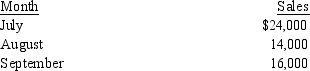 All sales are on account. Seventy percent of sales are collected in the month of the sale, and the remainder are
Collected in the following month.
Accounts receivable balance (July 1, 2016) $20,000
Cash balance (July 1, 2016) 10,000
Minimum cash balance is $10,000. Cash can be borrowed in $1,000 increments from the local bank (assume no interest charges).
What is the cash balance at the end of July, assuming that cash is received only from customers and that $40,000 is paid out during July?
All sales are on account. Seventy percent of sales are collected in the month of the sale, and the remainder are
Collected in the following month.
Accounts receivable balance (July 1, 2016) $20,000
Cash balance (July 1, 2016) 10,000
Minimum cash balance is $10,000. Cash can be borrowed in $1,000 increments from the local bank (assume no interest charges).
What is the cash balance at the end of July, assuming that cash is received only from customers and that $40,000 is paid out during July? (Multiple Choice)
4.8/5  (73)
(73) Figure 8-7
Macheski Company, an importer and retailer of Polish pottery and kitchenware, prepares a monthly master budget. Data for the July master budget are given below:
The June 30th balance sheet follows:
 Actual sales for June and budgeted sales for July, August, and September are given below:
 Sales are 20 percent for cash and 80 percent on credit. All credit sales are collected in the month following the
sale. There are no bad debts.
The gross margin percentage is 40 percent of sales. The desired ending inventory is equal to 25 percent of the following month's sales. One fourth of the purchases are paid for in the month of purchase and the others are purchased on account and paid in full the following month.
The monthly cash operating expenses are $43,000, and the monthly depreciation expenses are $7,000.
-Refer to Figure 8-7. What are the total assets at the end of July?
Actual sales for June and budgeted sales for July, August, and September are given below:
Sales are 20 percent for cash and 80 percent on credit. All credit sales are collected in the month following the
sale. There are no bad debts.
The gross margin percentage is 40 percent of sales. The desired ending inventory is equal to 25 percent of the following month's sales. One fourth of the purchases are paid for in the month of purchase and the others are purchased on account and paid in full the following month.
The monthly cash operating expenses are $43,000, and the monthly depreciation expenses are $7,000.
-Refer to Figure 8-7. What are the total assets at the end of July? (Multiple Choice)
4.8/5 (75)
(75) Figure 8-4
Discus Productions needs to know its anticipated cash inflows for the next quarter by month. Cash sales are 10 percent of total sales each month. Historically, sales on account have been collected as follows: 60 percent in the month of sale, 30 percent in the month after the sale, and the remaining 10 percent two months after the sale. Sales for the quarter are projected as follows: April, $120,000; May, $100,000; and June, $80,000. Accounts receivable on March 31 were $60,000.
-Shiller Corporation has the following sales forecasts for the selected three-month period in 2016: 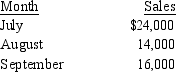 All sales are on account. Seventy percent of sales are collected in the month of the sale, and the remainder are collected in the following month.
Accounts receivable balance (July 1, 2016) $20,000
Cash balance (July 1, 2016) 10,000
Minimum cash balance is $10,000. Cash can be borrowed in $1,000 increments from the local bank (assume no interest charges).
How much cash would be collected in September from sales?
All sales are on account. Seventy percent of sales are collected in the month of the sale, and the remainder are collected in the following month.
Accounts receivable balance (July 1, 2016) $20,000
Cash balance (July 1, 2016) 10,000
Minimum cash balance is $10,000. Cash can be borrowed in $1,000 increments from the local bank (assume no interest charges).
How much cash would be collected in September from sales? (Multiple Choice)
4.8/5 (79)
(79) Figure 8-7
Macheski Company, an importer and retailer of Polish pottery and kitchenware, prepares a monthly master budget. Data for the July master budget are given below:
The June 30th balance sheet follows:
Actual sales for June and budgeted sales for July, August, and September are given below:
Sales are 20 percent for cash and 80 percent on credit. All credit sales are collected in the month following the
sale. There are no bad debts.
The gross margin percentage is 40 percent of sales. The desired ending inventory is equal to 25 percent of the following month's sales. One fourth of the purchases are paid for in the month of purchase and the others are purchased on account and paid in full the following month.
The monthly cash operating expenses are $43,000, and the monthly depreciation expenses are $7,000.
-Refer to Figure 8-7. What is the balance of the accounts receivable at the end of July?
Actual sales for June and budgeted sales for July, August, and September are given below:
Sales are 20 percent for cash and 80 percent on credit. All credit sales are collected in the month following the
sale. There are no bad debts.
The gross margin percentage is 40 percent of sales. The desired ending inventory is equal to 25 percent of the following month's sales. One fourth of the purchases are paid for in the month of purchase and the others are purchased on account and paid in full the following month.
The monthly cash operating expenses are $43,000, and the monthly depreciation expenses are $7,000.
-Refer to Figure 8-7. What is the balance of the accounts receivable at the end of July? (Multiple Choice)
4.8/5 (80)
(80) Figure 8-5
The following forecasted sales pertain to Spyware Corporation:
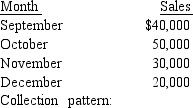 65 percent in month of sale
35 percent in month following sale
Accounts receivable as of August 31 $7,000
Finished goods inventory as of August 31 1,500 units
Spyware Corporation has a selling price of $2.50 per unit and expects to maintain ending inventories equal to 25 percent of the next month's sales.
-Refer to Figure 8-5. How many dollars are expected to be collected in December?
65 percent in month of sale
35 percent in month following sale
Accounts receivable as of August 31 $7,000
Finished goods inventory as of August 31 1,500 units
Spyware Corporation has a selling price of $2.50 per unit and expects to maintain ending inventories equal to 25 percent of the next month's sales.
-Refer to Figure 8-5. How many dollars are expected to be collected in December? (Multiple Choice)
5.0/5 (77)
(77) Silver Faces, Inc., has done a cost analysis for its production of reflectors. The following activities and cost drivers have been developed: Activity Cost Formula
Maintenance $15,000 + $4 per machine hour
Machining $35,000 + $1 per machine hour
Inspection $60,000 + $750 per batch
Setups $1,000 per batch
Purchasing $50,000 + $10 per purchase order
What is the budgeted purchasing cost if there was production of 50,000 reflectors that will require 8,000 machine hours, 25 batches, and 15,000 purchase orders?
(Multiple Choice)
4.8/5 (78)
(78) The static budget variance for materials is $250 F and the budgeted cost for materials is $52,000. If the budgeted volume is 13,000 and the actual volume is 13,500, then the flexible budget variance is
(Multiple Choice)
4.9/5 (64)
(64) Which of the following is NOT a component of the master budget?
(Multiple Choice)
4.8/5 (89)
(89) Natasha Company has a sales budget for next month of $150,000. Cost of goods sold is expected to be 40 percent of sales. All goods are purchased in the month used and paid for in the month following purchase. The beginning inventory of merchandise is $5,000, and an ending inventory of $6,000 is desired. Beginning accounts payable is $38,000.
For Natasha Company, the ending accounts payable should be
(Multiple Choice)
5.0/5 (85)
(85) Laramie, Inc., has an operating environment with considerable uncertainty. The company prepares the budget for several different volume levels. Laramie had the following budgeted data: Budgeted variable costs per unit:
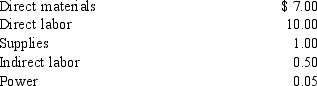 Budgeted fixed overhead for 2016:
 What are the total budgeted costs for 3,000 units?
Budgeted fixed overhead for 2016:
What are the total budgeted costs for 3,000 units? (Multiple Choice)
4.9/5 (70)
(70) Figure 8-1
Armando Company produces and sells mattresses. It expects to sell 10,000 mattresses in the year 2017 and had 1,000 mattresses in finished goods inventory at the end of 2016. Armando would like to complete operations in the year 2017 with at least 1,250 completed mattresses in inventory. There is no ending work-in-process inventory. The mattresses sell for $300 each.
-Refer to Figure 8-1. How many mattresses would be produced in the year 2015?
(Multiple Choice)
4.7/5 (72)
(72) The following forecasted sales pertain to Alicia Company:  Finished goods inventory as of March 31 4,000 units
The company has a selling price of $20 per unit and expects to maintain ending inventories equal to 20 percent of the next month's sales.
How many units are expected to be produced in April?
Finished goods inventory as of March 31 4,000 units
The company has a selling price of $20 per unit and expects to maintain ending inventories equal to 20 percent of the next month's sales.
How many units are expected to be produced in April? (Multiple Choice)
4.9/5 (76)
(76) Figure 8-8
Rammazzotti, Inc., is looking for feedback on company performance. The company compares the budget for the year with the actual costs. Data have been collected below:
Rammazzotti Inc., had the following budgeted data:
Unit sales for 2016 26,000
Unit production for 2016 26,000
Budgeted fixed overhead for 2016:
Supervision $ 800
Depreciation 2,000
Rent 100
Budgeted variable costs per unit:
Direct materials $0.15
Direct labor 0.20
Supplies 0.02
Indirect labor 0.05
Power 0.02
The following actually occurred:
Actual unit sales for 2016 24,000
Actual unit production for 2016 28,000
Actual fixed overhead for 2016:
Supervision $ 850
Depreciation 2,000
Rent 100
Actual variable costs:
Direct materials $3,500
Direct labor 4,900
Supplies 530
Indirect labor 1,250
Power 470
-Refer to Figure 8-8. The flexible budget variance for supervision for 2016 is
(Multiple Choice)
4.8/5 (78)
(78) Which of the following is the most common starting point in the information gathering process for budgeting?
(Multiple Choice)
4.7/5 (78)
(78) Villanova, Inc., has done a cost analysis for its production of rubber stamps. The following activities and cost drivers have been developed: Activity Cost Formula
Design $5,000 + $0.05 per machine hour
Machining $25,000 + $0.01 per machine hour
Setups $35 per batch
Purchasing $50 + $15 per purchase order
Following are the actual costs of producing 35,000 rubber stamps: 1,000 machine hours; 5 batches; 30 purchase orders
Design $5,080
Machining ?
Setups ?
Purchasing $600
The following variances were given in the activity performance report:
Design ?
Machining $40 F
Setups $15 F
Purchasing ?
What is the actual cost of setups?
(Multiple Choice)
4.9/5 (63)
(63) Budgeting means to set standards, receive feedback, and executing corrective action.
(True/False)
4.9/5 (72)
(72) 
Filters
- Essay(0)
- Multiple Choice(0)
- Short Answer(0)
- True False(0)
- Matching(0)