



 Chat with AI
Exam 6: Process Costing

Exam 1: Introduction to Cost Management151 Questions
Exam 2: Basic Cost Management Concepts199 Questions
Exam 3: Cost Behavior193 Questions
Exam 4: Activity-Based Costing198 Questions
Exam 5: Product and Service Costing: Job-Order System149 Questions
Exam 6: Process Costing181 Questions
Exam 7: Allocating Costs of Support Departments and Joint Products171 Questions
Exam 8: Budgeting for Planning and Control202 Questions
Exam 9: Standard Costing: a Functional-Based Control Approach125 Questions
Exam 10: Decentralization: Responsibility, Accounting, Performance Evaluation, and Transfer Pricing134 Questions
Exam 11: Strategic Cost Management148 Questions
Exam 12: Activity-Based Management146 Questions
Exam 13: The Balanced Scorecard: Strategic-Based Control124 Questions
Exam 14: Quality and Environmental Cost Management199 Questions
Exam 15: Lean Accounting and Productivity Measurement161 Questions
Exam 16: Cost-Volume-Profit Analysis128 Questions
Exam 17: Activity Resource Usage Model and Tactical Decision Making121 Questions
Exam 18: Pricing and Profitability Analysis159 Questions
Exam 19: Capital Investment125 Questions
Exam 20: Inventory Management: Economic Order Quantity, Jit, and the Theory of Constraints127 Questions
Select questions type


In operation costing, the process which produces batches of different products which are identical in many ways but differ in others is called process
(Short Answer)
4.9/5  (72)
(72) Figure 6-11
Rawlings, Inc. manufactures a product that passes through two processes: mixing and molding. All manufacturing costs are added uniformly in the Mixing Department. Information for the Mixing Department for January follows:
 During January, 26,750 units were completed and transferred to the Molding Department. The following costs were incurred by the Mixing Department during January:
 -Beginning inventory consisted of 1,000 units with costs of $31,000. All materials and 60 percent of labor and overhead were added in the prior period. In addition, another 8,000 units were started and completed. Unit costs are materials, $8.00; labor, $20.00; overhead, $9.00. What is the total cost of goods transferred out using FIFO?
During January, 26,750 units were completed and transferred to the Molding Department. The following costs were incurred by the Mixing Department during January:
-Beginning inventory consisted of 1,000 units with costs of $31,000. All materials and 60 percent of labor and overhead were added in the prior period. In addition, another 8,000 units were started and completed. Unit costs are materials, $8.00; labor, $20.00; overhead, $9.00. What is the total cost of goods transferred out using FIFO? (Multiple Choice)
4.9/5 (89)
(89) Figure 6-9
Anzalone Corporation adds raw materials to production at the beginning of the process in the Assembly Department. Materials data for this department for May 2016 are as follows:
 Beginning inventory was 70 percent complete. Ending inventory was 40 percent complete.
-Refer to Figure 6-9. How many equivalent units for conversion costs would there be for Anzalone Corporation in May using the FIFO method?
Beginning inventory was 70 percent complete. Ending inventory was 40 percent complete.
-Refer to Figure 6-9. How many equivalent units for conversion costs would there be for Anzalone Corporation in May using the FIFO method? (Multiple Choice)
4.9/5 (73)
(73) Figure 6-12
Twinnings Corporation manufactures Scheduling Books. There are two processes: printing and binding. The following information is given for the printing department for September.

 The company uses FIFO inventory assumption.
-Refer to Figure 6-12. What are the FIFO cost per unit for materials?
The company uses FIFO inventory assumption.
-Refer to Figure 6-12. What are the FIFO cost per unit for materials? (Multiple Choice)
4.9/5 (75)
(75) In a __________ costing system, production costs are accumulated by process.
(Short Answer)
4.9/5 (88)
(88) Figure 6-6
Mannassass Company manufactures chairs. The following information was given for the company:
 Materials in the ending inventory were 100 percent complete and conversion in the ending inventory was 20 percent complete.
-Refer to Figure 6-6. What are the costs per unit for materials and conversion respectively?
Materials in the ending inventory were 100 percent complete and conversion in the ending inventory was 20 percent complete.
-Refer to Figure 6-6. What are the costs per unit for materials and conversion respectively? (Multiple Choice)
4.8/5 (72)
(72) Figure 6-14
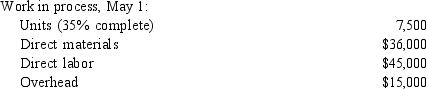
The following information is available for Department C for the month of June:
 Materials are added at the beginning of the process. Round unit costs to two decimal places.
-Mortimer Company manufactures a product that passes through two processes: Mixing and Molding. All manufacturing costs are added uniformly in the Mixing Department. Information for the Mixing Department for May follows:
 During May, 37,500 units were completed and transferred to the Molding Department. The following costs were
Incurred by the Mixing Department during May:
 There were 3,750 units that were 80 percent complete remaining in mixing at May 31. The equivalent units of
Production using the weighted average method is
Materials are added at the beginning of the process. Round unit costs to two decimal places.
-Mortimer Company manufactures a product that passes through two processes: Mixing and Molding. All manufacturing costs are added uniformly in the Mixing Department. Information for the Mixing Department for May follows: During May, 37,500 units were completed and transferred to the Molding Department. The following costs were
Incurred by the Mixing Department during May:
There were 3,750 units that were 80 percent complete remaining in mixing at May 31. The equivalent units of
Production using the weighted average method is (Multiple Choice)
4.8/5 (79)
(79) Spoilage in a process costing process means that more units enter the process than leave it.
(True/False)
4.7/5 (87)
(87) In a process-costing system, the costing of goods transferred out in BWIP inventory is difficult because there are multiple categories of completed units.
(True/False)
4.8/5 (69)
(69) Figure 6-7
Edelstein Company had the following data for 2016:
Units in process at the beginning of the month 4,000
Units in process at the end of the month 10,000
Units started during the month 40,000
Materials are added at the beginning of the process. Beginning work in process was 40 percent complete as to conversion. Ending work in process was 70 percent complete as to conversion.
-Refer to Figure 6-7. What is the number of units completed and transferred out during the period?
(Multiple Choice)
4.8/5 (79)
(79) Figure 6-22
The following information is available for Department C for the month of August:
Units Cost
Work in process, August 1 (70% complete) 10,000
 Materials are added at the beginning of the process. Inspection takes place at the 50 percent point in the conversion
process to determine spoiled units. Round unit costs to two decimal places. The company uses the weighted average cost flow assumption.
-Refer to Figure 6-22. Department C's equivalent units of production for conversion using the weighted average method is
Materials are added at the beginning of the process. Inspection takes place at the 50 percent point in the conversion
process to determine spoiled units. Round unit costs to two decimal places. The company uses the weighted average cost flow assumption.
-Refer to Figure 6-22. Department C's equivalent units of production for conversion using the weighted average method is (Multiple Choice)
4.9/5 (68)
(68) Services that are basically homogeneous and repetitive cannot take advantage of a process-costing approach.
(True/False)
4.9/5 (84)
(84) Figure 6-13
Wonder Paints Corporation's Mixing Department began August 2016 with 10,000 gallons of product (40 percent completed) in process. During August, Wonder Paints started 100,000 gallons of new product, of which 15,000 gallons remained in ending inventory (70 percent completed).
-Refer to Figure 6-13. If materials were added when the units were 80 percent complete, how many equivalent units of production for materials would there be for Wonder Paints using the weighted average costing method?
(Multiple Choice)
4.9/5 (82)
(82) Figure 6-19
Mountainside Industries manufactures specialized plastic boxes in two processes: Molding and Packaging. In the Packaging Department, materials are added at the end of the process. The following data are given:
Costs
 The conversion process on the beginning inventory is 70 percent completed and the ending inventory is 60 percent completed.
-Refer to Figure 6-19.Mountainside's equivalent units for materials using weighted average would be
The conversion process on the beginning inventory is 70 percent completed and the ending inventory is 60 percent completed.
-Refer to Figure 6-19.Mountainside's equivalent units for materials using weighted average would be (Multiple Choice)
4.7/5 (79)
(79) In calculating equivalent units of production using the weighted average method, the transferred-in goods are treated as materials added at the beginning of the process.
(True/False)
4.8/5 (89)
(89) Figure 6-13
Wonder Paints Corporation's Mixing Department began August 2016 with 10,000 gallons of product (40 percent completed) in process. During August, Wonder Paints started 100,000 gallons of new product, of which 15,000 gallons remained in ending inventory (70 percent completed).
-Refer to Figure 6-13. If materials were added at the beginning of the process, how many equivalent units of production for conversion costs would there be for Wonder Paints using the weighted average costing method?
(Multiple Choice)
5.0/5 (83)
(83) Figure 6-7
Edelstein Company had the following data for 2016:
Units in process at the beginning of the month 4,000
Units in process at the end of the month 10,000
Units started during the month 40,000
Materials are added at the beginning of the process. Beginning work in process was 40 percent complete as to conversion. Ending work in process was 70 percent complete as to conversion.
-Refer to Figure 6-7. How many equivalent units for materials would there be using the FIFO method?
(Multiple Choice)
4.8/5 (79)
(79) When manufacturing companies exhibit characteristics of both job and process environments, they use batch production processes.
(True/False)
4.8/5 (81)
(81) Figure 6-20
Outrageous Cups Corp. manufactures cups. The company's manufacturing operations and costs applied to products for April were:
 Three types of cups were produced in April. The quantities and direct materials costs were:
 Casts are produced in the Molding Department. Cups pass through the Molding and Finishing Departments. Mugs
pass through all three departments. An operations costing system is used.
-Refer to Figure 6-20. What is Outrageous Cups' conversion cost per unit for the heat-treat operation, rounded to two decimal places?
Three types of cups were produced in April. The quantities and direct materials costs were:
Casts are produced in the Molding Department. Cups pass through the Molding and Finishing Departments. Mugs
pass through all three departments. An operations costing system is used.
-Refer to Figure 6-20. What is Outrageous Cups' conversion cost per unit for the heat-treat operation, rounded to two decimal places? (Multiple Choice)
4.9/5 (88)
(88) 
Filters
- Essay(0)
- Multiple Choice(0)
- Short Answer(0)
- True False(0)
- Matching(0)