



 Chat with AI
Exam 6: Process Costing

Exam 1: Introduction to Cost Management151 Questions
Exam 2: Basic Cost Management Concepts199 Questions
Exam 3: Cost Behavior193 Questions
Exam 4: Activity-Based Costing198 Questions
Exam 5: Product and Service Costing: Job-Order System149 Questions
Exam 6: Process Costing181 Questions
Exam 7: Allocating Costs of Support Departments and Joint Products171 Questions
Exam 8: Budgeting for Planning and Control202 Questions
Exam 9: Standard Costing: a Functional-Based Control Approach125 Questions
Exam 10: Decentralization: Responsibility, Accounting, Performance Evaluation, and Transfer Pricing134 Questions
Exam 11: Strategic Cost Management148 Questions
Exam 12: Activity-Based Management146 Questions
Exam 13: The Balanced Scorecard: Strategic-Based Control124 Questions
Exam 14: Quality and Environmental Cost Management199 Questions
Exam 15: Lean Accounting and Productivity Measurement161 Questions
Exam 16: Cost-Volume-Profit Analysis128 Questions
Exam 17: Activity Resource Usage Model and Tactical Decision Making121 Questions
Exam 18: Pricing and Profitability Analysis159 Questions
Exam 19: Capital Investment125 Questions
Exam 20: Inventory Management: Economic Order Quantity, Jit, and the Theory of Constraints127 Questions
Select questions type


Figure 6-9
Anzalone Corporation adds raw materials to production at the beginning of the process in the Assembly Department. Materials data for this department for May 2016 are as follows:
 Beginning inventory was 70 percent complete. Ending inventory was 40 percent complete.
-Refer to Figure 6-9. How many equivalent units for materials would there be for Anzalone Corporation in May using the FIFO method?
Beginning inventory was 70 percent complete. Ending inventory was 40 percent complete.
-Refer to Figure 6-9. How many equivalent units for materials would there be for Anzalone Corporation in May using the FIFO method? (Multiple Choice)
4.9/5  (76)
(76) What system would a manufacturer of unique special orders or batch processes most likely use to accumulate costs?
(Multiple Choice)
4.8/5 (80)
(80) Figure 6-16
Ramses Corporation produces a product that passes through two processes. During April, the first department transferred 19,000 units to the second department. The cost of the units transferred was $30,000. Materials are added uniformly in the second process. The following information is provided about the second department's operations during October:
Units, beginning work in process 4,000
Units, ending work in process 5,500
-Refer to Figure 6-16. The number of units started and completed in the second department during April is
(Multiple Choice)
4.8/5 (93)
(93) The FIFO method unit costs are used to value output that is related to future periods.
(True/False)
4.8/5 (93)
(93) Figure 6-8
Thunder Roads Enterprises makes the following information available:
Units in process at the beginning of the month 2,000
Units in process at the end of the month 4,000
Units started during the month 30,000
Materials are added at the beginning of the process.
-Refer to Figure 6-8. Beginning and ending units were 60 percent complete as to conversion costs. What is the number of units started and completed?
(Multiple Choice)
4.8/5 (79)
(79) Transferred-in costs are accounted for in the same manner as
(Multiple Choice)
4.8/5 (74)
(74) The major benefit of the weighted average method is simplicity. The major disadvantage is that accuracy and performance measurements are impaired.
(True/False)
4.9/5 (82)
(82) Which is NOT a difference between the job-order costing system and the process costing system?
(Multiple Choice)
4.8/5 (84)
(84) Figure 6-22
The following information is available for Department C for the month of August:
Units Cost
Work in process, August 1 (70% complete) 10,000
 Materials are added at the beginning of the process. Inspection takes place at the 50 percent point in the conversion
process to determine spoiled units. Round unit costs to two decimal places. The company uses the weighted average cost flow assumption.
-Refer to Figure 6-22. Department C's equivalent units of production for materials using the weighted average method is
Materials are added at the beginning of the process. Inspection takes place at the 50 percent point in the conversion
process to determine spoiled units. Round unit costs to two decimal places. The company uses the weighted average cost flow assumption.
-Refer to Figure 6-22. Department C's equivalent units of production for materials using the weighted average method is (Multiple Choice)
4.9/5 (83)
(83) The cost assigned to goods from a prior process is called the cost.
(Short Answer)
4.7/5 (75)
(75) The process that accumulates production costs by process and uses a work-in-process account for each process is called:
(Multiple Choice)
4.7/5 (83)
(83) Transferred-in goods, must be converted to the units of measure used by the current department.
(True/False)
4.9/5 (78)
(78) Which is NOT a disadvantage of the weighted average costing assumption in process costing?
(Multiple Choice)
4.9/5 (87)
(87) Which of the following would NOT be true when there is spoilage?
(Multiple Choice)
4.9/5 (92)
(92) Figure 6-20
Outrageous Cups Corp. manufactures cups. The company's manufacturing operations and costs applied to products for April were:
 Three types of cups were produced in April. The quantities and direct materials costs were:
 Casts are produced in the Molding Department. Cups pass through the Molding and Finishing Departments. Mugs
pass through all three departments. An operations costing system is used.
-Refer to Figure 6-20. What is Outrageous Cups' total cost for Casts in April?
Three types of cups were produced in April. The quantities and direct materials costs were:
Casts are produced in the Molding Department. Cups pass through the Molding and Finishing Departments. Mugs
pass through all three departments. An operations costing system is used.
-Refer to Figure 6-20. What is Outrageous Cups' total cost for Casts in April? (Multiple Choice)
4.9/5 (82)
(82) Figure 6-19
Mountainside Industries manufactures specialized plastic boxes in two processes: Molding and Packaging. In the Packaging Department, materials are added at the end of the process. The following data are given:
Costs
 The conversion process on the beginning inventory is 70 percent completed and the ending inventory is 60 percent completed.
-Refer to Figure 6-19. Mountainside's equivalent units for transferred-in units using FIFO would be
The conversion process on the beginning inventory is 70 percent completed and the ending inventory is 60 percent completed.
-Refer to Figure 6-19. Mountainside's equivalent units for transferred-in units using FIFO would be (Multiple Choice)
4.7/5 (70)
(70) Figure 6-12
Twinnings Corporation manufactures Scheduling Books. There are two processes: printing and binding. The following information is given for the printing department for September.

 The company uses FIFO inventory assumption.
-Refer to Figure 6-12. What is the journal entry for the cost of goods sent to binding?
The company uses FIFO inventory assumption.
-Refer to Figure 6-12. What is the journal entry for the cost of goods sent to binding? (Multiple Choice)
4.8/5 (65)
(65) Figure 6-2
Leandro Corp. manufactures wooden desks. Production consists of three processes: cutting, assembly, and finishing. The following costs are given for April:
 There were no work in process inventories and 1,000 podiums were produced.
-In a process costing system, which of the following would be TRUE?
There were no work in process inventories and 1,000 podiums were produced.
-In a process costing system, which of the following would be TRUE? (Multiple Choice)
4.7/5 (84)
(84) Figure 6-21
Golden Ring Company produces two types of product: Large and Larger. Two work orders for two batches of the products are shown below, along with some additional cost information:
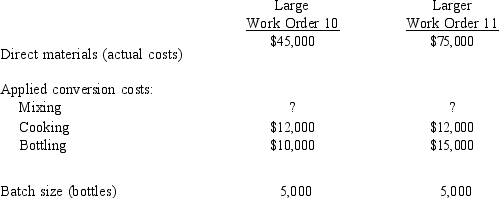 In the Mixing Department, conversion costs are applied on the basis of direct labor hours. Budgeted conversion costs for the department for the year were $50,000 for labor and $125,000 for overhead. Budgeted direct labor hours were 2,500. It takes three minutes to mix the ingredients needed for each bottle.
Large (Work Order 10) and Larger (Work Order 11) flow through the Mixing Department first, then through the Cooking and Bottling departments.
-Refer to Figure 6-21. What is Golden Ring Company's unit cost of Larger?
In the Mixing Department, conversion costs are applied on the basis of direct labor hours. Budgeted conversion costs for the department for the year were $50,000 for labor and $125,000 for overhead. Budgeted direct labor hours were 2,500. It takes three minutes to mix the ingredients needed for each bottle.
Large (Work Order 10) and Larger (Work Order 11) flow through the Mixing Department first, then through the Cooking and Bottling departments.
-Refer to Figure 6-21. What is Golden Ring Company's unit cost of Larger? (Multiple Choice)
4.9/5 (82)
(82) Figure 6-12
Twinnings Corporation manufactures Scheduling Books. There are two processes: printing and binding. The following information is given for the printing department for September.
The company uses FIFO inventory assumption.
-Refer to Figure 6-12. What are the FIFO equivalent units for conversion?
The company uses FIFO inventory assumption.
-Refer to Figure 6-12. What are the FIFO equivalent units for conversion? (Multiple Choice)
4.7/5 (82)
(82) 
Filters
- Essay(0)
- Multiple Choice(0)
- Short Answer(0)
- True False(0)
- Matching(0)