



 Chat with AI
Exam 2: Operations Strategy in a Global Environment

Exam 1: Operations and Productivity126 Questions
Exam 2: Operations Strategy in a Global Environment119 Questions
Exam 3: Project Management120 Questions
Exam 4: Forecasting141 Questions
Exam 5: Design of Goods and Services118 Questions
Exam 6: Managing Quality123 Questions
Exam 7: Process Strategy108 Questions
Exam 8: Capacity and Constraint Management96 Questions
Exam 9: Location Strategies120 Questions
Exam 10: Layout Strategies146 Questions
Exam 11: Human Resources, job Design, and Work Measurement154 Questions
Exam 12: Supply Chain Management144 Questions
Exam 13: Inventory Management163 Questions
Exam 14: Aggregate Planning and Sop116 Questions
Exam 15: Material Requirements Planning Mrpand Erp113 Questions
Exam 16: Short-Term Scheduling116 Questions
Exam 17: Jit, tps, and Lean Operations115 Questions
Exam 18: Maintenance and Reliability111 Questions
Exam 19: Sustainability in the Supply Chain80 Questions
Exam 20: Statistical Process Control144 Questions
Exam 21: Supply Chain Management Analytics55 Questions
Exam 22: Decision-Making Tools97 Questions
Exam 23: Linear Programming80 Questions
Exam 24: Transportation Models89 Questions
Exam 25: Waiting-Line Models119 Questions
Exam 26: Learning Curves105 Questions
Exam 27: Simulation75 Questions
Select questions type


A multinational corporation is a firm with extensive international business involvement.
(True/False)
4.9/5  (79)
(79) Identify and explain the four basic global operations strategies.Give an example of each strategy.
(Essay)
4.8/5 (76)
(76) The multidomestic OM strategy maximizes local responsiveness while achieving a significant cost advantage.
(True/False)
4.8/5 (77)
(77) An operations manager is performing a factor-rating analysis to help him choose an outsourcing provider.He is focusing on two factors: A and B,using a weight of 75% for factor A and 25% for factor B.He has scored five different potential providers on both factors,using a scale of 1-5,with 1 representing the BEST score.Based on the scores provided in the table below,which provider should be chosen? 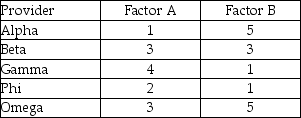
(Multiple Choice)
4.9/5 (62)
(62) The ________ strategy uses subsidiaries,franchises,or joint ventures with substantial independence.
(Short Answer)
4.8/5 (82)
(82) Multinational organizations can shop from country to country and cut costs through:
(Multiple Choice)
4.8/5 (74)
(74) Which of the following represents a reason for globalizing operations?
(Multiple Choice)
4.9/5 (83)
(83) Low-cost leadership is the ability to distinguish the offerings of the organization in a way that the customer perceives as adding value.
(True/False)
4.9/5 (76)
(76) Which of the following statements about organizational missions is FALSE?
(Multiple Choice)
4.9/5 (70)
(70) Which of the following is an example of competing on the basis of differentiation?
(Multiple Choice)
4.9/5 (73)
(73) Which of the following is LEAST likely to be a low-cost leadership competitive advantage?
(Multiple Choice)
4.8/5 (72)
(72) The ________ strategy utilizes a standardized product across countries.
(Short Answer)
4.8/5 (86)
(86) Porter's Five Forces Model contains which of the following?
(Multiple Choice)
4.8/5 (75)
(75) The ________ strategy uses exports and licenses to penetrate globally.
(Short Answer)
4.8/5 (84)
(84) Since the early 1990s,residents in a number of developing countries have overcome culture,religious,ethnic,and political productivity barriers.These disappearing barriers coupled with simultaneous advances in technology,reliable shipping,and cheap communication have all led to the growth of what three things?
(Essay)
4.7/5 (77)
(77) Which of the international operations strategies uses import/export or licensing of existing products?
(Multiple Choice)
4.8/5 (80)
(80) ________ and ________ are two issues where significant cultural differences are large,yet progress toward global uniformity is slowly being accepted.
(Essay)
4.7/5 (86)
(86) 
Filters
- Essay(0)
- Multiple Choice(0)
- Short Answer(0)
- True False(0)
- Matching(0)