



 Chat with AI
Exam 14: Aggregate Planning and Sop

Exam 1: Operations and Productivity126 Questions
Exam 2: Operations Strategy in a Global Environment119 Questions
Exam 3: Project Management120 Questions
Exam 4: Forecasting141 Questions
Exam 5: Design of Goods and Services118 Questions
Exam 6: Managing Quality123 Questions
Exam 7: Process Strategy108 Questions
Exam 8: Capacity and Constraint Management96 Questions
Exam 9: Location Strategies120 Questions
Exam 10: Layout Strategies146 Questions
Exam 11: Human Resources, job Design, and Work Measurement154 Questions
Exam 12: Supply Chain Management144 Questions
Exam 13: Inventory Management163 Questions
Exam 14: Aggregate Planning and Sop116 Questions
Exam 15: Material Requirements Planning Mrpand Erp113 Questions
Exam 16: Short-Term Scheduling116 Questions
Exam 17: Jit, tps, and Lean Operations115 Questions
Exam 18: Maintenance and Reliability111 Questions
Exam 19: Sustainability in the Supply Chain80 Questions
Exam 20: Statistical Process Control144 Questions
Exam 21: Supply Chain Management Analytics55 Questions
Exam 22: Decision-Making Tools97 Questions
Exam 23: Linear Programming80 Questions
Exam 24: Transportation Models89 Questions
Exam 25: Waiting-Line Models119 Questions
Exam 26: Learning Curves105 Questions
Exam 27: Simulation75 Questions
Select questions type


Identify (a)the demand options for aggregate planning; and (b)the capacity (supply)options for aggregate planning.

Free
(Essay)
4.8/5  (72)
(72) Correct Answer: Verified
(a)Demand options are: influencing demand (through price,promotion,advertising,selling),back ordering during high-demand periods,and counterseasonal product and service mixing. (b)Capacity options are: changing inventory levels,varying workforce size by hiring or layoffs,varying production rates through overtime or idle time,subcontracting,and using part-time workers.
Which of the following is NOT consistent with level scheduling?
Free
(Multiple Choice)
4.7/5 (75)
(75) Correct Answer:Verified
VerifiedD
Which of the following is NOT an advantage of level scheduling?
Free
(Multiple Choice)
4.9/5 (84)
(84) Correct Answer:Verified
VerifiedC
Explain the fundamental difference between the "capacity options" and the "demand options" of aggregate planning strategies.
(Essay)
4.8/5 (72)
(72) The aggregate planning process usually includes dispatching of individual jobs.
(True/False)
4.8/5 (91)
(91) ________ for developing aggregate plans work with a few variables at a time and are easy to understand and use.
(Short Answer)
4.8/5 (80)
(80) Industries in which revenue management techniques are easiest to apply are those where:
(Multiple Choice)
4.8/5 (67)
(67) One question that operations managers must answer when generating an aggregate plan is whether prices or other factors should be changed to influence demand.
(True/False)
4.9/5 (77)
(77) Graphical techniques are easy to understand and use,but are not well-suited for generating optimal strategies.
(True/False)
4.9/5 (78)
(78) The ________ strategy sets production equal to forecasted demand.
(Short Answer)
4.7/5 (85)
(85) Fairview Industries is preparing its aggregate plan for the second half of the year.The table below contains monthly demand estimates and working days per month.Complete the table by computing total demand,demand per day (for each month),and the average requirement (in units per day)over the six-month planning horizon.Prepare a graph of forecast demand and level production,by months,for the planning period.Label your graph carefully.
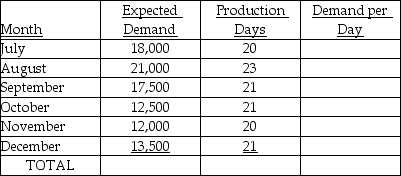
(Essay)
4.9/5 (69)
(69) A hotel room that goes unrented,a dental appointment that no patient booked,and an airline seat that went unsold,are all examples of ________ in services.
(Short Answer)
4.9/5 (82)
(82) Normally,the transportation model is used to solve problems involving several physical sources of product and several physical uses of the product,as in factories and warehouses.How is it possible to use the transportation model where the "routes" are from one time period to another? Describe how this provides aggregate planners with a usable mathematical model.
(Essay)
4.8/5 (91)
(91) Dependence on an external source of supply is found in which of the following aggregate planning strategies?
(Multiple Choice)
4.8/5 (75)
(75) Under which of the following do planning tasks associated with production planning and budgeting,as well as setting employment,inventory,and subcontracting levels,typically fall?
(Multiple Choice)
4.8/5 (73)
(73) An electronics manufacturer makes video security systems for parking lots.Demand estimates for the next four quarters are 15,9,23,and 17 units.The company is preparing an aggregate plan that uses inventory,regular time,overtime,and back orders.Subcontracting is not allowed.Regular time capacity is 12 units for quarters 1 and 2,15 units for quarters 3 and 4.Overtime capacity is 6 units per quarter.Regular time cost is $20,000 per system,while overtime cost is $30,000 per unit.Back order cost is $2000 per system per quarter; inventory holding cost is $500 per unit per quarter.Beginning inventory is zero.
Complete the table of data inputs for solving this aggregate planning problem with the transportation method.Specifically,how many sources are there,and how many destinations? What is the supply from each source,and the demand of each destination? What is the cost of each source-destination pair?
(Essay)
4.8/5 (75)
(75) Aggregate planning occurs over the medium or intermediate future of 3 to 18 months.
(True/False)
5.0/5 (81)
(81) The textbook illustrates demand management in the form of price cuts or discounts.Can demand manipulation for aggregate planning involve price increases? Explain; provide an example.
(Essay)
4.8/5 (64)
(64) One of the four things needed for aggregate planning is a logical overall unit for measuring sales and output.
(True/False)
4.9/5 (84)
(84) 
Filters
- Essay(0)
- Multiple Choice(0)
- Short Answer(0)
- True False(0)
- Matching(0)