



 Chat with AI
Exam 3: The Double-Entry Accounting System

Exam 1: An Introduction to Accounting148 Questions
Exam 2: Accounting for Accruals and Deferrals151 Questions
Exam 3: The Double-Entry Accounting System156 Questions
Exam 4: Accounting for Merchandising Businesses157 Questions
Exam 5: Accounting for Inventories142 Questions
Exam 6: Internal Control and Accounting for Cash140 Questions
Exam 7: Accounting for Receivables145 Questions
Exam 8: Accounting for Long-Term Operational Assets159 Questions
Exam 9: Accounting for Current Liabilities and Payroll130 Questions
Exam 10: Accounting for Long-Term Debt158 Questions
Exam 11: Proprietorships, Partnerships, and Corporations153 Questions
Exam 12: Statement of Cash Flows134 Questions
Exam 13: Financial Statement Analysis Available Online in the Connect Library139 Questions
Select questions type


Indicate whether each of the following statements is true or false.
_____ a) In an accrual accounting system, a debit entry to Cash is never accompanied by a credit entry to Revenue.
_____ b) The adjustment for accrued salaries would involve a debit to Salaries Expense and a credit to Salaries Payable.
_____ c) Adjusting entries will always include either a debit to an expense account or a credit to a revenue account.
_____ d) The closing entry for an expense involves a debit to the expense and a credit to Retained Earnings.
_____ e) The closing entry for a revenue involves a debit to the revenue and a credit to Retained Earnings.
(Short Answer)
5.0/5  (92)
(92) Wilson Company began the accounting period with a $16,000 debit balance in its accounts receivable account. During the accounting period, the company recorded revenue on account amounting to $44,000. The accounts receivable account at the end of the accounting period contained a $8,000 debit balance. Based on this information, the cash collected from accounts receivable during the period is
(Multiple Choice)
4.8/5 (91)
(91) Indicate whether each of the following statements is true or false.
_____ a) An asset source transaction may involve a debit to an asset and a credit to equity.
_____ b) An asset use transaction may involve a credit to an asset and a debit to a liability.
_____ c) A credit to the common stock account would be included in an asset use transaction.
_____ d) The payment of rent in advance involves a debit to Prepaid Rent and a credit to Cash.
_____ e) Recognition of Rent Expense (when a cash payment had previously been made in advance) involves a debit to Rent Expense and a credit to Cash.
(Short Answer)
4.7/5 (69)
(69) 
Indicate whether each of the following statements concerning the debit-credit feature of the accounting model is true or false.
_____ a) Upon payment of an account payable, the liability account should be debited.
_____ b) Payment of a cash expense requires a debit to cash and a credit to the expense.
_____ c) On a T-account debits are entered on the left and credits are entered on the right.
_____ d) A debit entry decreases an asset account.
_____ e) Increases in revenues are recorded as debits.
(Short Answer)
4.7/5 (81)
(81) Source documents provide information that serves as the basis for entries into the accounting system. Examples of source documents include invoices and deposit tickets.
(True/False)
4.7/5 (89)
(89) The financial statement ratio that may be of greatest interest to a company's stockholders is the amount of its return on equity.
(True/False)
4.8/5 (83)
(83) Hayes, Inc. had the following balances on its 12/31/13 balance sheet. 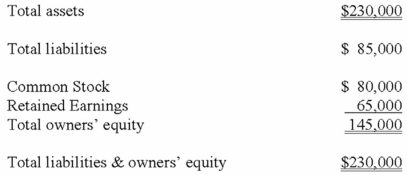 If Hayes were to purchase land for $40,000 on credit under an agreement to pay for the land in one year, what would be its debt-to-assets ratio immediately after the purchase?
 (Multiple Choice)
4.7/5 (86)
(86) The balance in Retained Earnings is decreased by debiting the account.
(True/False)
5.0/5 (93)
(93) Which of the following accounts normally has a debit balance?
(Multiple Choice)
4.8/5 (69)
(69) Gander Company's accounts and their balances as of December 31, 2013 are listed in alphabetical order below. The account balances do include the effects of the company's year-end adjusting entries. 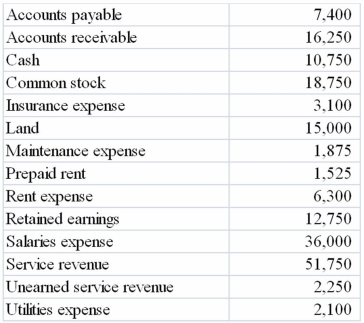 Required:
a) Prepare the adjusted trial balance for Gander Company as of December 31, 2013.
b) Prepare Gander's 2013 income statement and balance sheet.
Required:
a) Prepare the adjusted trial balance for Gander Company as of December 31, 2013.
b) Prepare Gander's 2013 income statement and balance sheet. (Essay)
4.8/5 (83)
(83) The following transactions apply to Jack's Computer Service for the year 2013.
1) Issued stock to investors for $15,000 cash.
2) Purchased land for $12,000 cash.
3) Performed services on account for $17,000.
4) Collected $11,200 on accounts receivable.
5) Paid operating expenses of $6,500.
Required:
a) Draw T-accounts and post the above transactions to the appropriate T-accounts.
b) Prepare a balance sheet for Jack's Computer Service for December 31, 2013.
(Essay)
4.9/5 (78)
(78) What is one effect of the following general journal entry? 
(Multiple Choice)
4.8/5 (85)
(85) The Greene Corporation recorded a business event using T-accounts as follows:  Which of the following reflects how this event affects the company's financial statements?

Which of the following reflects how this event affects the company's financial statements? (Multiple Choice)
4.8/5 (89)
(89) The information in the following T-accounts of Gibson Company indicates that: 
(Multiple Choice)
4.9/5 (72)
(72) Many companies choose to end their fiscal years during a part of the year when they expect low activity.
(True/False)
5.0/5 (79)
(79) An adjusting entry recorded as a debit to Salaries Expense and a credit to Salaries Payable. 
(Short Answer)
4.9/5 (83)
(83) 
Filters
- Essay(0)
- Multiple Choice(0)
- Short Answer(0)
- True False(0)
- Matching(0)