



 Chat with AI
Exam 4: Accounting for Merchandising Businesses


Indicate how accounting for lost and stolen merchandise differs between firms using a perpetual inventory system and those using a periodic inventory system. Which system provides the best way to account for such losses and why?

 (83)
 Verified
In both systems, such losses are not known immediately. In the perpetual system, losses are often discovered only when comparing a physical inventory count with the current balance of the inventory account. An adjusting entry is then made reducing the inventory balance and recording an increase in the cost of goods sold (expense) account. Under a periodic system, losses are not really "discovered" but rather are included in the computation of cost of goods sold after the physical inventory is taken. Periodic systems assume that all inventory not on hand at the end of the year have been sold and do not separate the cost of lost, damaged or stolen merchandise from the cost of goods sold.
After the temporary accounts are closed, what is the balance of Retained Earnings?
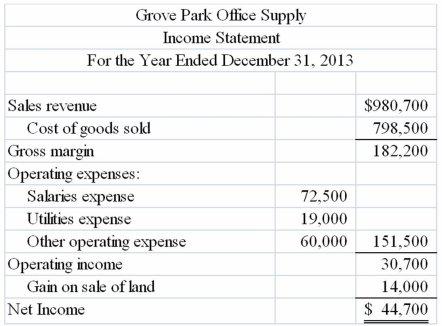
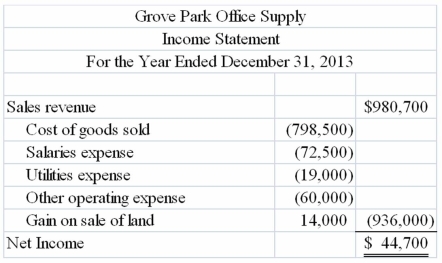
2. From the above information, prepare:
a. A multistep income statement.
b. A single-step income statement.
(82) Verified1) 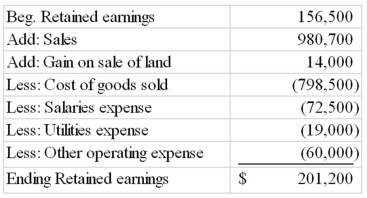 2 a) Multistep income statement:
 2 b) Single step income statement
Patty's Pet Shop had the following transactions for 2013, the first year of operations:
1) Borrowed $50,000 from the bank.
2) Purchased merchandise on account, $44,000, terms 1/10, n/30.
3) Sold merchandise on account for $51,000. The inventory sold had a cost of $28,000.
4) Paid for the merchandise purchased within the discount period.
5) Collected $41,500 on the merchandise sold on account.
6) Paid operating expense of $17,000.
7) Recognized accrued interest expense of $2,000.
Required:
a) What are total assets at the end of 2013?
b) What is the balance of the cash account at the end of 2013?
c) What is gross margin for 2013?
d) What is operating income for 2013?
e) What is net income for 2013?
f) What are total liabilities at the end of 2013?
g) What is total equity at the end of 2013?
h) What is total retained earnings at the end of 2013?
(71) Verified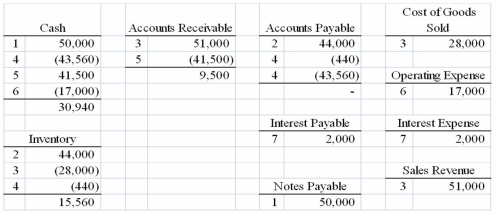 a) $30,940+$15,560 + $9,500 = $56,000
b) $30,940
c) $51,000 - $28,000 = $23,000
d) $23,000 - $17,000 = $6,000
e) $6,000 - $2,000 = $4,000
f) $2,000 + $50.000 = $52,000
g) $4,000
h) $4,000
The following T-accounts are from the ledger of Hiatt Company. Hiatt uses the periodic inventory system. 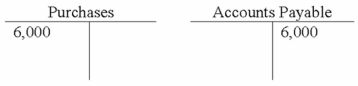 Which of the following is true about Hiatt Company?
 (79) On April 6, 2013, Mitchell Company purchased $70,000 of merchandise inventory. Terms of the purchase included a discount of 3/20, n/30 and the freight terms were FOB destination. Freight costs amounted to $2,300. Mitchell paid the account payable on April 24. Mitchell sold all inventory for $94,750.
Required:
Determine the amount of gross margin Mitchell would report on the income statement.
(81) The Warren Company purchased $22,000 of merchandise from the Garden Wholesale Company. Warren also paid $1,500 for freight costs to have the goods shipped to its location. Which of the following statements regarding the necessary entries for the transactions is true? Warren uses the perpetual inventory system.
(84) Frank Company granted a $60 allowance to a customer who was not totally satisfied with the quality of goods received. The customer did not return the goods and had not yet paid for them. 
(86) Costs charged to the Merchandise Inventory account are product costs.
(80) On June 1, 2013, merchandise subject to terms 2/10, n/30 was sold on account to a customer for $24,500. On June 3, the seller issued a credit memorandum for $5,300, accepting merchandise returned by the customer. This was prior to payment by the customer.
a) What is the amount of cash collected by the seller if the payment is made by the customer on June 8, 2013?
b) What is the amount of cash collected by the seller if payment is made by the customer on June 21, 2013?
(77) The following are the income statements for Ace and Diamond Companies. 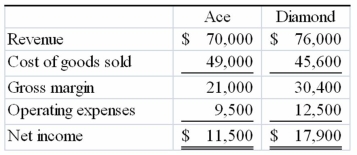 What are the net income percentages for the above companies?
 (86) The income statement is not affected by a purchase of merchandise.
(79) Barstow Company uses the perpetual inventory system. The company purchased $8,000 of merchandise from Andrews Company under the terms 2/10, net/30. Bartstow paid for the merchandise within 10 days and also paid $250 freight to obtain the goods under terms FOB shipping point. All of the merchandise purchased was sold for $15,000 cash. The amount of gross margin for this merchandise is:
(64) James Co. sold goods with the terms 2/10, n/30. What do the terms mean?
(80) Under a periodic inventory system, the buyer does not use which of the following accounts in recording purchases and related transactions?
(70) Indicate whether each of the following statements is true or false.
_____ a) A cash discount is extended to reward the buyer for purchasing large quantities of goods.
_____ b) A purchase discount refers to a cash discount as seen from the seller's viewpoint.
_____ c) A sales discount refers to a cash discount as seen from the buyer's view.
_____ d) In a perpetual inventory system, a sales discount is recorded as a reduction of sales revenue.
_____ e) In a perpetual inventory system, a purchase discount is recorded as a reduction of merchandise inventory.
(97) When using a perpetual inventory system, which of the following events is an asset use transaction?
(84) If a company uses the perpetual inventory method, when would it normally discover that merchandise inventory has been lost or stolen?
(76) 
Filters
- Essay(0)
- Multiple Choice(0)
- Short Answer(0)
- True False(0)
- Matching(0)