



 Chat with AI
Exam 4: Accounting for Merchandising Businesses

Exam 1: An Introduction to Accounting148 Questions
Exam 2: Accounting for Accruals and Deferrals151 Questions
Exam 3: The Double-Entry Accounting System156 Questions
Exam 4: Accounting for Merchandising Businesses157 Questions
Exam 5: Accounting for Inventories142 Questions
Exam 6: Internal Control and Accounting for Cash140 Questions
Exam 7: Accounting for Receivables145 Questions
Exam 8: Accounting for Long-Term Operational Assets159 Questions
Exam 9: Accounting for Current Liabilities and Payroll130 Questions
Exam 10: Accounting for Long-Term Debt158 Questions
Exam 11: Proprietorships, Partnerships, and Corporations153 Questions
Exam 12: Statement of Cash Flows134 Questions
Exam 13: Financial Statement Analysis Available Online in the Connect Library139 Questions
Select questions type


How do gains and losses differ from revenues and expenses? How are they similar?
(Essay)
4.9/5  (86)
(86) Adirondack Outdoor Supply, which uses the perpetual inventory system, experienced the following events during June 2013.
1. Issued common stock for cash.
2. Purchased inventory on account, terms 2/10, n/30, FOB shipping point.
3. Paid the shipping charges on the purchase in event #2.
4. Sold merchandise to a customer on account, terms 2/10, n/30, FOB destination. Record the revenue recognition as 4(a) and the expense recognition as 4(b).
5. Paid the shipping charges on goods sold in event #4.
6. Customer returned some of the merchandise sold in event #4. Record the effect on revenue as 6(a) and the effect on expenses as 6(b).
7. Recorded discount granted to the customer in event #4.
8. Recorded payment received from the customer in event #4.
9. Recorded discount received on purchase in event #2.
10. Recorded payment of amount due on purchase in event #2.
Required:
Identify each event as asset source (AS), asset use (AU), asset exchange (AE), or claims exchange (CE). Also explain how each event affects the financial statements by placing a + for increase, - for decrease, or NA for not affected under each of the components of the following statements model. Also, indicate in the cash column if the event would be recorded as an operating activity (OA), an investing activity (IA) or a financing activity (FA). The first event is recorded as an example. 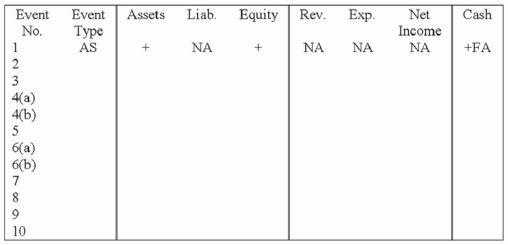
(Essay)
4.9/5 (83)
(83) A business firm that primarily sells merchandise to other businesses is known as a:
(Multiple Choice)
4.9/5 (88)
(88) A multistep income statement shows Sales, Cost of Goods Sold, and Gross Margin.
(True/False)
4.9/5 (83)
(83) A multistep income statement separates routine operating results from peripheral or non-operating items.
(True/False)
4.8/5 (89)
(89) Indicate whether each of the following statements is true or false.
_____ a) A common size income statement facilitates comparison between two or more companies of different size and in the same industry.
_____ b) A common size income statement is prepared by dividing the various amounts reported on the income statement by the amount of total assets.
_____ c) A common size income statement is helpful in comparing the results of operations in different time periods.
_____ d) The gross margin percentage is computed by dividing gross margin by net income.
_____ e) Return on sales is computed by dividing net income by net sales.
(Short Answer)
4.9/5 (72)
(72) A purchase allowance is treated as a decrease in expenses by the company that purchased the goods.
(True/False)
4.7/5 (85)
(85) What event and inventory method may have produced the following journal entry? 
(Multiple Choice)
4.8/5 (66)
(66) The following events pertain to the Harper Garden Supply Company for January 2013.
The company uses the periodic inventory system.
1) Jan. 4 Purchased $5,000 of merchandise on account, terms 1/10, n/30, FOB shipping point.
2) Jan. 5 Paid shipping cost of $550 on the Jan. 4 purchase.
3) Jan. 6 Returned $600 of the merchandise purchased on Jan. 4.
4) Jan. 7 Sold merchandise for $2,900 on account, terms 2/10, n/30, FOB Destination.
5) Jan. 7 Paid the shipping cost of $175 on the previous sale.
6) Jan. 10 Recorded the discount and paid the amount due from the purchase of merchandise on Jan. 4.
7) Jan. 28 Sold merchandise for $3,600 cash.
Required:
a) Record the above transactions in general journal form.
b) Harper's beginning inventory balance for January was $17,500. A physical count of inventory on January 31 revealed $16,800 of merchandise on hand. Calculate Harper's cost of goods available for sale and cost of goods sold for January. 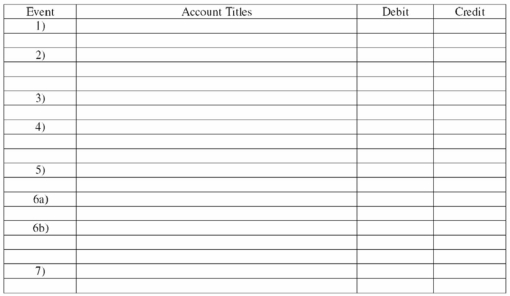
(Essay)
4.8/5 (78)
(78) Indicate whether each of the following statements is true or false. (Assume a periodic inventory system)
_____ a) If the balance in ending inventory is overstated, net income will be understated.
_____ b) If the balance in ending inventory is understated, retained earnings will be understated.
_____ c) If the balance in ending inventory is overstated, selling and administrative expenses will not be affected.
_____ d) If the balance in ending inventory is overstated, cost of goods sold will be overstated.
_____ e) If the balance in ending inventory is overstated, assets will be overstated.
(Short Answer)
4.8/5 (77)
(77) The balance in the inventory account shown at December 31, 2014 is:
(Multiple Choice)
4.8/5 (67)
(67) Andrews Company sold merchandise with a cost of $500 to a customer for $800 on account. Due to an error, this sale was never recorded in the accounting records. What effect will the failure to make the necessary entries have on the company's accounting equation?
(Multiple Choice)
4.8/5 (66)
(66) Frank Co. discovered that a recent shipment of merchandise it had purchased was not of the same quality it had expected. The seller agreed to grant Frank an allowance of $200. Frank had not yet paid the amount owed on the shipment. 
(Short Answer)
5.0/5 (67)
(67) The following general journal entry is taken from the journal of Old Town Bookstore:  Which of the following choices reflects how the entry will affect the company's financial statements?
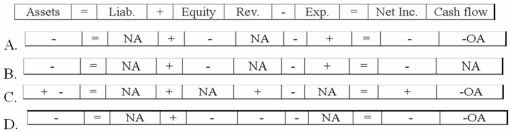
Which of the following choices reflects how the entry will affect the company's financial statements? (Multiple Choice)
5.0/5 (76)
(76) Which of the following would be considered as primarily a merchandising business?
(Multiple Choice)
5.0/5 (75)
(75) Discuss the major differences between a perpetual inventory system and a periodic inventory system.
(Essay)
4.7/5 (77)
(77) 
Filters
- Essay(0)
- Multiple Choice(0)
- Short Answer(0)
- True False(0)
- Matching(0)