



 Chat with AI
Exam 3: The Double-Entry Accounting System

Exam 1: An Introduction to Accounting148 Questions
Exam 2: Accounting for Accruals and Deferrals151 Questions
Exam 3: The Double-Entry Accounting System156 Questions
Exam 4: Accounting for Merchandising Businesses157 Questions
Exam 5: Accounting for Inventories142 Questions
Exam 6: Internal Control and Accounting for Cash140 Questions
Exam 7: Accounting for Receivables145 Questions
Exam 8: Accounting for Long-Term Operational Assets159 Questions
Exam 9: Accounting for Current Liabilities and Payroll130 Questions
Exam 10: Accounting for Long-Term Debt158 Questions
Exam 11: Proprietorships, Partnerships, and Corporations153 Questions
Exam 12: Statement of Cash Flows134 Questions
Exam 13: Financial Statement Analysis Available Online in the Connect Library139 Questions
Select questions type


The adjusting entry to record expense related to the use of a delivery van would involve which of the following?
(Multiple Choice)
4.8/5  (77)
(77) Domino Co. purchased land and paid the full purchase price in cash. The journal entry necessary to record this event includes a:
(Multiple Choice)
4.8/5 (88)
(88) Explain how the following general journal entry affects the accounting equation. 
(Multiple Choice)
4.7/5 (78)
(78) Explain the significance of the return on equity ratio. Who (what category or type of financial statement users) would normally be most interested in this ratio?
(Essay)
4.9/5 (83)
(83) Newcomb Company began operations on December 1, 2013. The following transactions were recorded in December: 1) The business received $3,000 cash from the issuance of common stock to its stockholders.
2) Provided services on account for $2,500.
3) Paid $1,500 cash for land.
4) Accrued $1,000 of salaries expenses.
5) Purchased $300 of supplies on account to be used in January.
6) Collected $1,300 from customers.
At December 31, 2011, the total debits in the company's adjusted trial balance would be
(Multiple Choice)
4.7/5 (80)
(80) Adjusting entries are made at the end of the period because of the need to
(Multiple Choice)
4.9/5 (61)
(61) Indicate whether each of the following statements is true or false
_____ a) The general journal is often called the book of original entry.
_____ b) Transactions are first recorded in the ledger and then transferred to the journal.
_____ c) The process of making entries into a journal is called posting.
_____ d) The ledger is an example of a source document.
_____ e) The list of a business's account titles and account numbers is called a chart of accounts.
(Short Answer)
4.8/5 (88)
(88) What transaction does the following general journal entry represent? 
(Multiple Choice)
4.9/5 (73)
(73) At the end of 2013, the following information is available for ABC Company and XYZ Company: 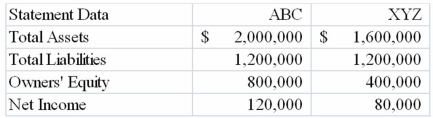 Required:
1) For each company, calculate the debt to assets ratio and the return on equity ratio.
2) For each company, calculate the return on assets ratio.
3) Which company had a greater level of debt risk? Why?
4) What is financial leverage? Which company is using financial leverage more successfully?
Required:
1) For each company, calculate the debt to assets ratio and the return on equity ratio.
2) For each company, calculate the return on assets ratio.
3) Which company had a greater level of debt risk? Why?
4) What is financial leverage? Which company is using financial leverage more successfully? (Essay)
4.8/5 (90)
(90) The three primary asset use transactions are incurring expenses, settling liabilities, and paying dividends.
(True/False)
4.8/5 (80)
(80) A trial balance can only be prepared at the end of the fiscal year, as part of the adjusting and closing processes.
(True/False)
4.8/5 (79)
(79) Indicate whether each of the following statements is true or false.
_____ a) A journal entry includes at least one debit and one credit entry.
_____ b) The double-entry accounting format records two separate events simultaneously.
_____ c) The double-entry system requires that total debits equal total credits.
_____ d) When an asset decreases in a double-entry system, an equity account may also decrease.
_____ e) The double entry system does not ensure complete accuracy in a company's accounting records.
(Short Answer)
4.8/5 (82)
(82) At the end of its fiscal year, a company must adjust its accounting records for unrecorded accruals and deferrals before it can prepare financial statements.
(True/False)
4.7/5 (70)
(70) 
A transaction recorded as a debit to Cash and a credit to Common Stock. 
(Short Answer)
4.8/5 (75)
(75) When a company receives cash in advance from a customer, it should debit Cash and credit Accounts Receivable.
(True/False)
4.9/5 (74)
(74) The Warner Company issued common stock for $500,000 cash. Which of the following shows the proper entry using T-accounts?
(Multiple Choice)
4.9/5 (79)
(79) 
Filters
- Essay(0)
- Multiple Choice(0)
- Short Answer(0)
- True False(0)
- Matching(0)