



 Chat with AI
Exam 12: Instrumental Variables Regression

Exam 1: Economic Questions and Data17 Questions
Exam 2: Review of Probability71 Questions
Exam 3: Review of Statistics63 Questions
Exam 4: Linear Regression With One Regressor65 Questions
Exam 5: Regression With a Single Regressor: Hypothesis Tests and Confidence Intervals59 Questions
Exam 6: Linear Regression With Multiple Regressors65 Questions
Exam 7: Hypothesis Tests and Confidence Intervals in Multiple Regression65 Questions
Exam 8: Nonlinear Regression Functions62 Questions
Exam 9: Assessing Studies Based on Multiple Regression65 Questions
Exam 10: Regression With Panel Data50 Questions
Exam 11: Regression With a Binary Dependent Variable50 Questions
Exam 12: Instrumental Variables Regression50 Questions
Exam 13: Experiments and Quasi-Experiments50 Questions
Exam 14: Introduction to Time Series Regression and Forecasting50 Questions
Exam 15: Estimation of Dynamic Causal Effects50 Questions
Exam 16: Additional Topics in Time Series Regression50 Questions
Exam 17: The Theory of Linear Regression With One Regressor49 Questions
Exam 18: The Theory of Multiple Regression50 Questions
Select questions type


The IV estimator can be used to potentially eliminate bias resulting from
(Multiple Choice)
4.9/5  (68)
(68) Studies of the effect of minimum wages on teenage employment typically regress the teenage employment to population ratio on the real minimum wage or the minimum wage relative to average hourly earnings using OLS.Assume that you have a cross section of United States for two years.Do you think that there are problems with simultaneous equation bias?
(Essay)
4.7/5 (77)
(77) (Requires Matrix Algebra)The population multiple regression model can be written in matrix form as
Y = Xβ + U
where
Y =  ,U =
 ,X =
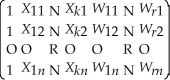 ,and β =
 Note that the X matrix contains both k endogenous regressors and (r +1)included exogenous regressors (the constant is obviously exogenous).
The instrumental variable estimator for the overidentified case is
 where Z is a matrix,which contains two types of variables: first the r included exogenous regressors plus the constant,and second,m instrumental variables.
Z =
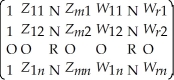 It is of order n × (m+r+1).
For this estimator to exist,both (
 Z)and [
 Z(
 Z)-1
 X] must be invertible.State the conditions under which this will be the case and relate them to the degree of overidentification.
,U = ,X = ,and β = Note that the X matrix contains both k endogenous regressors and (r +1)included exogenous regressors (the constant is obviously exogenous).
The instrumental variable estimator for the overidentified case is where Z is a matrix,which contains two types of variables: first the r included exogenous regressors plus the constant,and second,m instrumental variables.
Z = It is of order n × (m+r+1).
For this estimator to exist,both ( Z)and [ Z( Z)-1 X] must be invertible.State the conditions under which this will be the case and relate them to the degree of overidentification. (Essay)
4.9/5 (78)
(78) To analyze the year-to-year variation in temperature data for a given city,you regress the daily high temperature (Temp)for 100 randomly selected days in two consecutive years (1997 and 1998)for Phoenix.The results are (heteroskedastic-robust standard errors in parenthesis):  = 15.63 + 0.80 ×
 ;R2= 0.65,SER = 9.63
(0.10)
(a)Calculate the predicted temperature for the current year if the temperature in the previous year was 40°F,78°F,and 100°F.How does this compare with you prior expectation? Sketch the regression line and compare it to the 45 degree line.What are the implications?
(b)You recall having studied errors-in-variables before.Although the web site you received your data from seems quite reliable in measuring data accurately,what if the temperature contained measurement error in the following sense: for any given day,say January 28,there is a true underlying seasonal temperature (X),but each year there are different temporary weather patterns (v,w)which result in a temperature
 different from X.For the two years in your data set,the situation can be described as follows:

 Hence the population parameter for the intercept and slope are zero and one,as expected.It is not difficult to show that the OLS estimator for the slope is inconsistent,where
 As a result you consider estimating the slope and intercept by TSLS.You think about an instrument and consider the temperature one month ahead of the observation in the previous year.Discuss instrument validity for this case.
(c)The TSLS estimation result is as follows:
 = -6.24 + 1.07×
 ;
(0.06)
Perform a t-test on whether or not the slope is now significantly different from one.
= 15.63 + 0.80 × ;R2= 0.65,SER = 9.63
(0.10)
(a)Calculate the predicted temperature for the current year if the temperature in the previous year was 40°F,78°F,and 100°F.How does this compare with you prior expectation? Sketch the regression line and compare it to the 45 degree line.What are the implications?
(b)You recall having studied errors-in-variables before.Although the web site you received your data from seems quite reliable in measuring data accurately,what if the temperature contained measurement error in the following sense: for any given day,say January 28,there is a true underlying seasonal temperature (X),but each year there are different temporary weather patterns (v,w)which result in a temperature different from X.For the two years in your data set,the situation can be described as follows: Hence the population parameter for the intercept and slope are zero and one,as expected.It is not difficult to show that the OLS estimator for the slope is inconsistent,where As a result you consider estimating the slope and intercept by TSLS.You think about an instrument and consider the temperature one month ahead of the observation in the previous year.Discuss instrument validity for this case.
(c)The TSLS estimation result is as follows: = -6.24 + 1.07× ;
(0.06)
Perform a t-test on whether or not the slope is now significantly different from one. (Essay)
4.8/5 (76)
(76) Earnings functions,whereby the log of earnings is regressed on years of education,years of on the job training,and individual characteristics,have been studied for a variety of reasons.Some studies have focused on the returns to education,others on discrimination,union non-union differentials,etc.For all these studies,a major concern has been the fact that ability should enter as a determinant of earnings,but that it is close to impossible to measure and therefore represents an omitted variable.
Assume that the coefficient on years of education is the parameter of interest.Given that education is positively correlated to ability,since,for example,more able students attract scholarships and hence receive more years of education,the OLS estimator for the returns to education could be upward biased.To overcome this problem,various authors have used instrumental variable estimation techniques.For each of the instruments potential instruments listed below briefly discuss instrument validity.
(a)The individual's postal zip code.
(b)The individual's IQ or testscore on a work related exam.
(c)Years of education for the individual's mother or father.
(d)Number of siblings the individual has.
(Essay)
4.9/5 (79)
(79) Consider the following population regression model relating the dependent variable Yi and regressor Xi,
Yi = β0 + β1Xi + ui,i = 1,…,n.
Xi ≡ Yi + Zi
where Z is a valid instrument for X.
(a)Explain why you should not use OLS to estimate β1.
(b)To generate a consistent estimator for β1,what should you do?
(c)The two equations above make up a system of equations in two unknowns.Specify the two reduced form equations in terms of the original coefficients.(Hint: substitute the identity into the first equation and solve for Y.Similarly,substitute Y into the identity and solve for X. )
(d)Do the two reduced form equations satisfy the OLS assumptions? If so,can you find consistent estimators of the two slopes? What is the ratio of the two estimated slopes? This estimator is called "Indirect Least Squares." How does it compare to the TSLS in this example?
(Essay)
4.7/5 (88)
(88) The two conditions for instrument validity are corr(Zi,Xi)≠ 0 and corr(Zi,ui)= 0.The reason for the inconsistency of OLS is that corr(Xi,ui)≠ 0.But if X and Z are correlated,and X and u are also correlated,then how can Z and u not be correlated? Explain.
(Essay)
4.9/5 (70)
(70) 
Filters
- Essay(0)
- Multiple Choice(0)
- Short Answer(0)
- True False(0)
- Matching(0)