



 Chat with AI
Exam 11: Managing Transaction Exposure

Exam 1: Multinational Financial Management: an Overview79 Questions
Exam 2: International Flow of Funds75 Questions
Exam 3: International Financial Markets102 Questions
Exam 4: Exchange Rate Determination74 Questions
Exam 5: Currency Derivatives163 Questions
Exam 6: Government Influence on Exchange Rates117 Questions
Exam 7: International Arbitrage and Interest Rate Parity97 Questions
Exam 8: Relationships Among Inflation, Interest Rates, and Exchange Rates62 Questions
Exam 9: Forecasting Exchange Rates92 Questions
Exam 10: Measuring Exposure to Exchange Rate Fluctuations90 Questions
Exam 11: Managing Transaction Exposure92 Questions
Exam 12: Managing Economic Exposure and Translation Exposure63 Questions
Exam 13: Direct Foreign Investment62 Questions
Exam 14: Multinational Capital Budgeting63 Questions
Exam 15: International Corporate Governance and Control74 Questions
Exam 16: Country Risk Analysis57 Questions
Exam 17: Multinational Cost of Capital and Capital Structure71 Questions
Exam 18: Long-Term Debt Financing54 Questions
Exam 19: Financing International Trade73 Questions
Exam 20: Short-Term Financing55 Questions
Exam 21: International Cash Management49 Questions
Select questions type


Assume that Smith Corporation will need to purchase 200,000 British pounds in 90 days. A call option exists on British pounds with an exercise price of $1.68, a 90-day expiration date, and a premium of $.04. A put option exists on British pounds, with an exercise price of $1.69, a 90-day expiration date, and a premium of $.03. Smith Corporation plans to purchase options to cover its future payables. It will exercise the option in 90 days (if at all). It expects the spot rate of the pound to be $1.76 in 90 days. Determine the amount of dollars it will pay for the payables, including the amount paid for the option premium.
(Multiple Choice)
4.9/5  (89)
(89) If hedging projections cause a firm to believe that it will definitely be adversely affected by its transaction exposure, a currency option hedge is more appropriate than other methods.
(True/False)
4.9/5 (89)
(89) An advantage of using options to hedge is that the MNC can let the option expire. However, a disadvantage of using options is that a premium must be paid for it.
(True/False)
4.8/5 (69)
(69) If Lazer Co. desired to lock in the maximum it would have to pay for its net payables in euros but wanted to be able to capitalize if the euro depreciates substantially against the dollar by the time payment is to be made, the most appropriate hedge would be:
(Multiple Choice)
4.9/5 (91)
(91) Exhibit 11-1
 -Refer to Exhibit 11-1. Perkins Corp. will receive 250,000 Jordanian dinar (JOD) in 360 days. The current spot rate of the dinar is $1.48, while the 360-day forward rate is $1.50. How much will Perkins receive in 360 days from implementing a money market hedge (assume any receipts before the date of the receivable are invested)?
 (Multiple Choice)
4.9/5 (85)
(85) MNCs generally do not need to hedge because shareholders can hedge their own risk.
(True/False)
4.8/5 (79)
(79) Lorre Company needs 200,000 Canadian dollars (C$) in 90 days and is trying to determine whether or not to hedge this position. Lorre has developed the following probability distribution for the Canadian dollar: 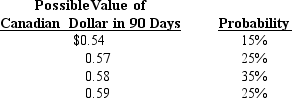 The 90-day forward rate of the Canadian dollar is $.575, and the expected spot rate of the Canadian dollar in 90 days is $.55. If Lorre implements a forward hedge, what is the probability that hedging will be more costly to the firm than not hedging?
 (Multiple Choice)
4.9/5 (74)
(74) Assume that Jones Co. will need to purchase 100,000 Singapore dollars (S$) in 180 days. Today's spot rate of the S$ is $.50, and the 180-day forward rate is $.53. A call option on S$ exists, with an exercise price of $.52, a premium of $.02, and a 180-day expiration date. A put option on S$ exists, with an exercise price of $.51, a premium of $.02, and a 180-day expiration date. Jones has developed the following probability distribution for the spot rate in 180 days: 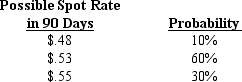 The probability that the forward hedge will result in a higher payment than the options hedge is ____ (include the amount paid for the premium when estimating the U.S. dollars required for the options hedge).
 (Multiple Choice)
4.8/5 (89)
(89) Lagging refers to the delay of payment by a subsidiary if the currency denominating the payable is expected to depreciate.
(True/False)
5.0/5 (85)
(85) Use the following information to calculate the dollar cost of using a money market hedge to hedge 200,000 pounds of payables due in 180 days. Assume the firm has no excess cash. Assume the spot rate of the pound is $2.02, the 180-day forward rate is $2.00. The British interest rate is 5%, and the U.S. interest rate is 4% over the 180-day period.
(Multiple Choice)
4.8/5 (83)
(83) To hedge a payable position with a currency option hedge, an MNC would write a call option.
(True/False)
4.8/5 (79)
(79) When a perfect hedge is not available to eliminate transaction exposure, the firm may consider methods to at least reduce exposure, such as ____.
(Multiple Choice)
4.9/5 (84)
(84) Spears Co. will receive SF1,000,000 in 30 days. Use the following information to determine the total dollar amount received (after accounting for the option premium) if the firm purchases and exercises a put option: 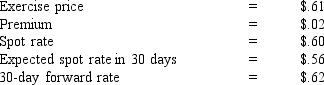
(Multiple Choice)
4.8/5 (91)
(91) The real cost of hedging payables with a forward contract equals:
(Multiple Choice)
4.9/5 (72)
(72) Foghat Co. has 1,000,000 euros as receivables due in 30 days, and is certain that the euro will depreciate substantially over time. Assuming that the firm is correct, the ideal strategy is to:
(Multiple Choice)
4.8/5 (79)
(79) A money market hedge on payables would involve, among others, borrowing ____ and investing in the ____.
(Multiple Choice)
4.9/5 (73)
(73) Blake Inc. needs €1,000,000 in 30 days. It can earn 5 percent annualized on a German security. The current spot rate for the euro is $1.00. Blake can borrow funds in the U.S. at an annualized interest rate of 6 percent. If Blake uses a money market hedge to hedge the payable, what is the cost of implementing the hedge?
(Multiple Choice)
4.7/5 (76)
(76) If an MNC is hedging various currencies, it should measure the real cost of hedging in each currency as a dollar amount for comparison purposes.
(True/False)
4.7/5 (74)
(74) If an MNC is extremely risk-averse, it may decide to hedge even though its hedging analysis indicates that remaining unhedged will probably be less costly than hedging.
(True/False)
4.8/5 (73)
(73) From the perspective of Detroit Co., which has payables in Mexican pesos and receivables in Canadian dollars, hedging the payables would be most desirable if the expected real cost of hedging payables is ____, and hedging the receivables would be most desirable if the expected real cost of hedging receivables is ____.
(Multiple Choice)
4.9/5 (84)
(84) 
Filters
- Essay(0)
- Multiple Choice(0)
- Short Answer(0)
- True False(0)
- Matching(0)