



 Chat with AI
Exam 8: Relationships Among Inflation, Interest Rates, and Exchange Rates

Exam 1: Multinational Financial Management: an Overview79 Questions
Exam 2: International Flow of Funds75 Questions
Exam 3: International Financial Markets102 Questions
Exam 4: Exchange Rate Determination74 Questions
Exam 5: Currency Derivatives163 Questions
Exam 6: Government Influence on Exchange Rates117 Questions
Exam 7: International Arbitrage and Interest Rate Parity97 Questions
Exam 8: Relationships Among Inflation, Interest Rates, and Exchange Rates62 Questions
Exam 9: Forecasting Exchange Rates92 Questions
Exam 10: Measuring Exposure to Exchange Rate Fluctuations90 Questions
Exam 11: Managing Transaction Exposure92 Questions
Exam 12: Managing Economic Exposure and Translation Exposure63 Questions
Exam 13: Direct Foreign Investment62 Questions
Exam 14: Multinational Capital Budgeting63 Questions
Exam 15: International Corporate Governance and Control74 Questions
Exam 16: Country Risk Analysis57 Questions
Exam 17: Multinational Cost of Capital and Capital Structure71 Questions
Exam 18: Long-Term Debt Financing54 Questions
Exam 19: Financing International Trade73 Questions
Exam 20: Short-Term Financing55 Questions
Exam 21: International Cash Management49 Questions
Select questions type


Assume that the inflation rate in Singapore is 3%, while the inflation rate in the U.S. is 8%. According to PPP, the Singapore dollar should ____ by ____%.

Free
(Multiple Choice)
4.8/5  (68)
(68) Correct Answer: Verified
A
The inflation rate in the U.S. is 3%, while the inflation rate in Japan is 10%. The current exchange rate for the Japanese yen (¥) is $0.0075. After supply and demand for the Japanese yen has adjusted in the manner suggested by purchasing power parity, the new exchange rate for the yen will be:
Free
(Multiple Choice)
4.8/5 (84)
(84) Correct Answer:Verified
VerifiedC
Under purchasing power parity, the future spot exchange rate is a function of the initial spot rate in equilibrium and:
Free
(Multiple Choice)
4.7/5 (80)
(80) Correct Answer:Verified
VerifiedC
The international Fisher effect (IFE) suggests that the currencies with relatively high interest rates will appreciate because those high rates will attract investment and increase the demand for that currency.
(True/False)
4.8/5 (85)
(85) If interest rates on the euro are consistently below U.S. interest rates, then for the international Fisher effect (IFE) to hold:
(Multiple Choice)
4.9/5 (84)
(84) Latin American countries have historically experienced relatively high inflation, and their currencies have weakened. This information is somewhat consistent with the concept of:
(Multiple Choice)
4.8/5 (79)
(79) The relative form of purchasing power parity (PPP) accounts for the possibility of market imperfections such as transportation costs, tariffs, and quotas in establishing a relationship between inflation rates and exchange rate changes.
(True/False)
4.8/5 (83)
(83) The IFE theory suggests that foreign currencies with relatively high interest rates will appreciate because the high nominal interest rates reflect expected inflation.
(True/False)
4.8/5 (83)
(83) Which of the following theories suggests the percentage change in spot exchange rate of a currency should be equal to the interest rate differential between two countries?
(Multiple Choice)
4.8/5 (89)
(89) Because there are a variety of factors in addition to inflation that affect exchange rates, this will:
(Multiple Choice)
4.8/5 (79)
(79) According to the IFE, if British interest rates exceed U.S. interest rates:
(Multiple Choice)
4.9/5 (76)
(76) Assume a two-country world: Country A and Country B. Which of the following is correct about purchasing power parity (PPP) as related to these two countries?
(Multiple Choice)
4.9/5 (79)
(79) Assume that the U.S. one-year interest rate is 3% and the one-year interest rate on Australian dollars is 6%. The U.S. expected annual inflation is 5%, while the Australian inflation is expected to be 7%. You have $100,000 to invest for one year and you believe that PPP holds. The spot exchange rate of an Australian dollar is $0.689. What will be the yield on your investment if you invest in the Australian market?
(Multiple Choice)
4.8/5 (82)
(82) The following regression analysis was conducted for the inflation rate information and exchange rate of the British pound: 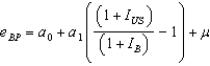 Regression results indicate that a0 = 0 and a1 = 1. Therefore:
 (Multiple Choice)
4.8/5 (87)
(87) If interest rate parity holds, then the one-year forward rate of a currency will be ____ the predicted spot rate of the currency in one year according to the international Fisher effect.
(Multiple Choice)
5.0/5 (83)
(83) Assume that U.S. and British investors require a real return of 2%. If the nominal U.S. interest rate is 15%, and the nominal British rate is 13%, then according to the IFE, the British inflation rate is expected to be about ____ the U.S. inflation rate, and the British pound is expected to ____.
(Multiple Choice)
4.9/5 (91)
(91) Among the reasons that purchasing power parity (PPP) does not consistently occur are:
(Multiple Choice)
4.9/5 (87)
(87) Assume that the U.S. and Chile nominal interest rates are equal. Then, the U.S. nominal interest rate decreases while the Chilean nominal interest rate remains stable. According to the international Fisher effect, this implies expectations of ____ than before, and that the Chilean peso should ____ against the dollar.
(Multiple Choice)
4.9/5 (72)
(72) The following regression analysis was conducted for the inflation rate information and exchange rate of the British pound: 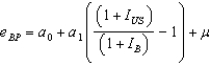 Regression results indicate that a0 = 0 and a1 = 2. Therefore:
 (Multiple Choice)
4.8/5 (81)
(81) 
Filters
- Essay(0)
- Multiple Choice(0)
- Short Answer(0)
- True False(0)
- Matching(0)