



 Chat with AI
Exam 42: Energy From the Nucleus

Exam 1: Measurement37 Questions
Exam 2: Motion Along a Straight Line90 Questions
Exam 3: Vectors43 Questions
Exam 4: Motion in Two and Three Dimensions56 Questions
Exam 5: Force and Motion73 Questions
Exam 6: Force and Motion74 Questions
Exam 7: Kinetic Energy and Work73 Questions
Exam 8: Potential Energy and Conservation of Energy65 Questions
Exam 9: Center of Mass and Linear Momentum99 Questions
Exam 10: Rotation102 Questions
Exam 11: Rolling, Torque, and Angular Momentum67 Questions
Exam 12: Equilibrium and Elasticity57 Questions
Exam 13: Gravitation61 Questions
Exam 14: Fluids91 Questions
Exam 15: Oscillations80 Questions
Exam 16: Waves83 Questions
Exam 17: Waves72 Questions
Exam 18: Temperature, Heat, and the First Law of Thermodynamics96 Questions
Exam 19: The Kinetic Theory of Gases114 Questions
Exam 20: Entropy and the Second Law of Thermodynamics61 Questions
Exam 21: Coulombs Law52 Questions
Exam 22: Electric Fields55 Questions
Exam 23: Gauss Law44 Questions
Exam 24: Electric Potential55 Questions
Exam 25: Capacitance61 Questions
Exam 26: Current and Resistance55 Questions
Exam 27: Circuits75 Questions
Exam 28: Magnetic Fields53 Questions
Exam 29: Magnetic Fields Due to Currents49 Questions
Exam 30: Induction and Inductance90 Questions
Exam 31: Electromagnetic Oscillations and Alternating Current89 Questions
Exam 32: Maxwells Equations; Magnetism of Matter87 Questions
Exam 33: Electromagnetic Waves83 Questions
Exam 34: Images79 Questions
Exam 35: Interference 147 Questions
Exam 36: Diffraction77 Questions
Exam 37: Relativity69 Questions
Exam 38: Photons and Matter Waves59 Questions
Exam 39: More About Matter Waves45 Questions
Exam 40: All About Atoms79 Questions
Exam 41: Conduction of Electricity in Solids51 Questions
Exam 42: Energy From the Nucleus50 Questions
Exam 43: Quarks, Leptons, and the Big Bang59 Questions
Select questions type


Separation of the isotopes of uranium requires a physical, rather than chemical, method because:
(Multiple Choice)
4.9/5  (71)
(71) Consider all possible fission events.Which of the following statements is true?
(Multiple Choice)
4.9/5 (87)
(87) The energy released in a complete proton-proton cycle is about:
(Multiple Choice)
4.7/5 (80)
(80) Nuclear fusion in stars produces all the chemical elements with mass numbers less than:
(Multiple Choice)
4.9/5 (84)
(84) Which one of the following represents a fission reaction that can be activated by slow neutrons?
(Multiple Choice)
5.0/5 (65)
(65) Two billion years ago, a natural nuclear reactor formed in a uranium deposit in Africa.Why is it not possible for such a natural reactor to form somewhere on Earth today?
(Multiple Choice)
4.8/5 (85)
(85) Lawson's number is 1020 s.m-3.If the density of deuteron nuclei is 2 * 1021 m-3 what should the confinement time be to achieve sustained fusion?
(Multiple Choice)
4.8/5 (81)
(81) For purposes of a practical (energy producing)reaction one wants a disintegration energy Q that is:
(Multiple Choice)
4.8/5 (74)
(74) The energy supplied by a thermal neutron in a fission event is essentially its:
(Multiple Choice)
4.9/5 (82)
(82) A nuclear reactor is operating at a certain power level, with its multiplication factor adjusted to unity.The control rods are now used to reduce the power output to one-half its former value.After the reduction in power the multiplication factor is maintained at:
(Multiple Choice)
4.8/5 (89)
(89) The table lists properties of several heavy nuclei when they are struck by thermal neutrons; En is the excitation energy and Eb is the energy barrier.Which quantity, or combination of quantities, represents the energy put into the oscillation of the resulting compound nucleus? 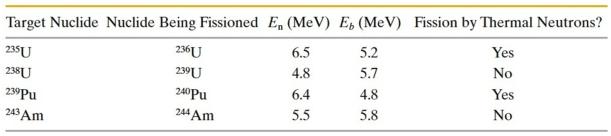
(Multiple Choice)
4.8/5 (67)
(67) 235U is readily made fissionable by a thermal neutron but 238U is not because:
(Multiple Choice)
4.8/5 (64)
(64) 
Filters
- Essay(0)
- Multiple Choice(0)
- Short Answer(0)
- True False(0)
- Matching(0)