



 Chat with AI
Exam 39: More About Matter Waves

Exam 1: Measurement37 Questions
Exam 2: Motion Along a Straight Line90 Questions
Exam 3: Vectors43 Questions
Exam 4: Motion in Two and Three Dimensions56 Questions
Exam 5: Force and Motion73 Questions
Exam 6: Force and Motion74 Questions
Exam 7: Kinetic Energy and Work73 Questions
Exam 8: Potential Energy and Conservation of Energy65 Questions
Exam 9: Center of Mass and Linear Momentum99 Questions
Exam 10: Rotation102 Questions
Exam 11: Rolling, Torque, and Angular Momentum67 Questions
Exam 12: Equilibrium and Elasticity57 Questions
Exam 13: Gravitation61 Questions
Exam 14: Fluids91 Questions
Exam 15: Oscillations80 Questions
Exam 16: Waves83 Questions
Exam 17: Waves72 Questions
Exam 18: Temperature, Heat, and the First Law of Thermodynamics96 Questions
Exam 19: The Kinetic Theory of Gases114 Questions
Exam 20: Entropy and the Second Law of Thermodynamics61 Questions
Exam 21: Coulombs Law52 Questions
Exam 22: Electric Fields55 Questions
Exam 23: Gauss Law44 Questions
Exam 24: Electric Potential55 Questions
Exam 25: Capacitance61 Questions
Exam 26: Current and Resistance55 Questions
Exam 27: Circuits75 Questions
Exam 28: Magnetic Fields53 Questions
Exam 29: Magnetic Fields Due to Currents49 Questions
Exam 30: Induction and Inductance90 Questions
Exam 31: Electromagnetic Oscillations and Alternating Current89 Questions
Exam 32: Maxwells Equations; Magnetism of Matter87 Questions
Exam 33: Electromagnetic Waves83 Questions
Exam 34: Images79 Questions
Exam 35: Interference 147 Questions
Exam 36: Diffraction77 Questions
Exam 37: Relativity69 Questions
Exam 38: Photons and Matter Waves59 Questions
Exam 39: More About Matter Waves45 Questions
Exam 40: All About Atoms79 Questions
Exam 41: Conduction of Electricity in Solids51 Questions
Exam 42: Energy From the Nucleus50 Questions
Exam 43: Quarks, Leptons, and the Big Bang59 Questions
Select questions type


Take the potential energy of a hydrogen atom to be zero for infinite separation of the electron and proton.Then the ground state energy of a hydrogen atom is -13.6 eV.The minus sign indicates:
(Multiple Choice)
4.8/5  (76)
(76) An electron in an atom drops from an energy level at -1.1 *10-18 J to an energy level at -2.4* 10-18 J.The wave associated with the emitted photon has a frequency of:
(Multiple Choice)
4.7/5 (86)
(86) An electron in an atom initially has an energy 5.5 eV above the ground state energy.It drops to a state with energy 3.2 eV above the ground state energy and emits a photon in the process.The wave associated with the photon has a wavelength of:
(Multiple Choice)
4.9/5 (71)
(71) The binding energy of an electron in the ground state in a hydrogen atom is about:
(Multiple Choice)
4.9/5 (83)
(83) An electron is in a one-dimensional trap with zero potential energy in the interior and infinite potential energy at the walls.A graph of its probability density P(x)versus x is shown.The value of the quantum number n is: 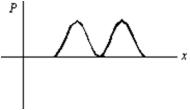
(Multiple Choice)
4.9/5 (76)
(76) The wavelength of a particle in a one-dimensional trap with zero potential energy in the interior and infinite potential energy at the walls is proportional to (n = quantum number):
(Multiple Choice)
4.8/5 (85)
(85) The quantum number n is most closely associated with what property of the electron in a hydrogen atom?
(Multiple Choice)
4.7/5 (87)
(87) A particle is trapped in a finite potential energy well that is deep enough so that the electron can be in the state with n = 4.For this state how many nodes does the probability density have?
(Multiple Choice)
4.8/5 (72)
(72) The radial probability density for the electron in the ground state of a hydrogen atom has a peak at about:
(Multiple Choice)
4.8/5 (89)
(89) A particle is trapped in an infinite potential energy well.It is in the state with quantum number n = 14.How many nodes does the probability density have (counting the nodes at the ends of the well)?
(Multiple Choice)
4.9/5 (80)
(80) The figure shows the energy levels for an electron in a finite potential energy well.If the electron makes a transition from the n = 3 state to the ground state, what is the wavelength of the emitted photon? 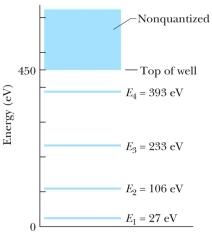
(Multiple Choice)
4.8/5 (94)
(94) An electron confined in a one-dimensional infinite potential well has an energy of 180 eV.What is its wavelength?
(Multiple Choice)
5.0/5 (91)
(91) Which of the following sets of quantum numbers is possible for an electron in a hydrogen atom?
(Multiple Choice)
4.8/5 (89)
(89) Take the potential energy of a hydrogen atom to be zero for infinite separation of the electron and proton.Then, according to the quantum theory the energy En of a state with principal quantum number n is proportional to:
(Multiple Choice)
4.8/5 (85)
(85) A particle in a certain finite potential energy well can have any of five quantized energy values and no more.Which of the following would allow it to have any of six quantized energy levels?
(Multiple Choice)
4.7/5 (69)
(69) The wave function for an electron in a state with zero angular momentum:
(Multiple Choice)
5.0/5 (81)
(81) Take the potential energy of a hydrogen atom to be zero for infinite separation of the electron and proton.Then the ground state energy of a hydrogen atom is -13.6 eV.When the electron is in the first excited state its excitation energy (the difference between the energy of the state and that of the ground state)is:
(Multiple Choice)
5.0/5 (86)
(86) Take the potential energy of a hydrogen atom to be zero for infinite separation of the electron and proton.Then the ground state energy of a hydrogen atom is -13.6 eV.The energy of the first excited state is:
(Multiple Choice)
5.0/5 (87)
(87) An electron is trapped in an infinitely deep rectangular well with sides of length Lx = L and Ly = 2L.The energy of the state nx = 2, ny = 4 is:
(Multiple Choice)
4.8/5 (88)
(88) 
Filters
- Essay(0)
- Multiple Choice(0)
- Short Answer(0)
- True False(0)
- Matching(0)