



 Chat with AI
Exam 29: Magnetic Fields Due to Currents

Exam 1: Measurement37 Questions
Exam 2: Motion Along a Straight Line90 Questions
Exam 3: Vectors43 Questions
Exam 4: Motion in Two and Three Dimensions56 Questions
Exam 5: Force and Motion73 Questions
Exam 6: Force and Motion74 Questions
Exam 7: Kinetic Energy and Work73 Questions
Exam 8: Potential Energy and Conservation of Energy65 Questions
Exam 9: Center of Mass and Linear Momentum99 Questions
Exam 10: Rotation102 Questions
Exam 11: Rolling, Torque, and Angular Momentum67 Questions
Exam 12: Equilibrium and Elasticity57 Questions
Exam 13: Gravitation61 Questions
Exam 14: Fluids91 Questions
Exam 15: Oscillations80 Questions
Exam 16: Waves83 Questions
Exam 17: Waves72 Questions
Exam 18: Temperature, Heat, and the First Law of Thermodynamics96 Questions
Exam 19: The Kinetic Theory of Gases114 Questions
Exam 20: Entropy and the Second Law of Thermodynamics61 Questions
Exam 21: Coulombs Law52 Questions
Exam 22: Electric Fields55 Questions
Exam 23: Gauss Law44 Questions
Exam 24: Electric Potential55 Questions
Exam 25: Capacitance61 Questions
Exam 26: Current and Resistance55 Questions
Exam 27: Circuits75 Questions
Exam 28: Magnetic Fields53 Questions
Exam 29: Magnetic Fields Due to Currents49 Questions
Exam 30: Induction and Inductance90 Questions
Exam 31: Electromagnetic Oscillations and Alternating Current89 Questions
Exam 32: Maxwells Equations; Magnetism of Matter87 Questions
Exam 33: Electromagnetic Waves83 Questions
Exam 34: Images79 Questions
Exam 35: Interference 147 Questions
Exam 36: Diffraction77 Questions
Exam 37: Relativity69 Questions
Exam 38: Photons and Matter Waves59 Questions
Exam 39: More About Matter Waves45 Questions
Exam 40: All About Atoms79 Questions
Exam 41: Conduction of Electricity in Solids51 Questions
Exam 42: Energy From the Nucleus50 Questions
Exam 43: Quarks, Leptons, and the Big Bang59 Questions
Select questions type


In the figure, the current element  , the point P, and the three vectors (1, 2, 3)are all in the plane of the page.The direction of
 , due to this current element, at the point P is:
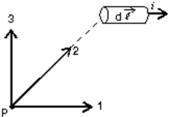
, the point P, and the three vectors (1, 2, 3)are all in the plane of the page.The direction of , due to this current element, at the point P is: (Multiple Choice)
4.8/5  (81)
(81) Two parallel long wires carry the same current and repel each other with a force F per unit length.If both these currents are doubled and the wire separation tripled, the force per unit length becomes:
(Multiple Choice)
4.8/5 (70)
(70) In Ampere's law, 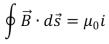 the direction of the integration around the path:
 (Multiple Choice)
5.0/5 (79)
(79) Electrons are going around a circle in a counterclockwise direction as shown.At the center of the circle they produce a magnetic field that is: 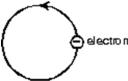
(Multiple Choice)
4.8/5 (73)
(73) A hollow cylindrical conductor (inner radius = a, outer radius = b)carries a current i uniformly spread over its cross section.Which graph below correctly gives B as a function of the distance r from the center of the cylinder? 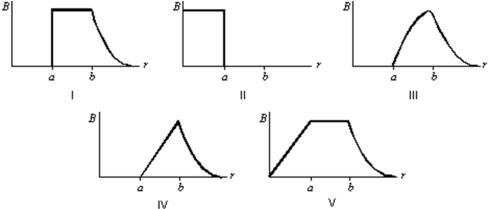
(Multiple Choice)
4.8/5 (83)
(83) A toroid has a square cross section with the length of an edge equal to the radius of the inner surface.The ratio of the magnitude of the magnetic field at the inner surface to the magnitude of the field at the outer surface is:
(Multiple Choice)
4.8/5 (88)
(88) The magnitude of the magnetic field at point P, at the center of the semicircle shown, is given by: 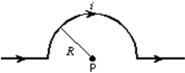
(Multiple Choice)
4.9/5 (90)
(90) A constant current is sent through a helical coil made of flexible wire.The coil:
(Multiple Choice)
4.9/5 (81)
(81) 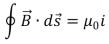 , the integration must be over any:
Two long ideal solenoids (with radii 20 mm and 30 mm respectively)have the same number of turns of wire per unit length.The smaller solenoid is mounted inside the larger, along a common axis.It is observed that there is zero magnetic field within the inner solenoid.The current in the inner solenoid must be:
(Multiple Choice)
4.8/5 (77)
(77) Two long straight wires pierce the plane of the paper at vertices of an equilateral triangle as shown below.They each carry 2.0 A, out of the paper.The magnetic field at the third vertex (P)has magnitude: 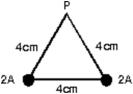
(Multiple Choice)
4.9/5 (69)
(69) Which graph correctly gives the magnitude of the magnetic field outside an infinitely long, very thin, straight current-carrying wire as a function of the distance r from the wire? 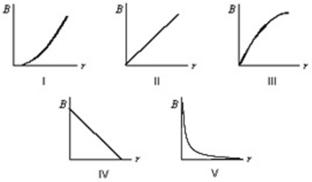
(Multiple Choice)
4.9/5 (84)
(84) If R is the distance from a magnetic dipole, then the magnetic field it produces is proportional to:
(Multiple Choice)
5.0/5 (60)
(60) 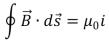 the symbol
 is:
The magnetic field  inside a long ideal solenoid is independent of:
 (Multiple Choice)
5.0/5 (53)
(53) 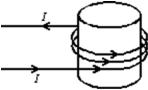
Two long straight wires enter a room through a window.One carries a current of 3.0 A into the room while the other carries a current of 5.0 A out.The magnitude of the path integral  around the window frame is:
 (Multiple Choice)
4.8/5 (94)
(94) The magnetic field outside a long straight current-carrying wire depends on the distance R from the wire axis according to:
(Multiple Choice)
4.7/5 (83)
(83) A solenoid is 3.0 cm long and has a radius of 0.50 cm.It is wrapped with 500 turns of wire carrying a current of 2.0 A.The magnetic field at the center of the solenoid is:
(Multiple Choice)
4.7/5 (72)
(72) In an overhead straight wire, the current is north.The magnetic field due to this current, at our point of observation, is:
(Multiple Choice)
4.9/5 (83)
(83) 
Filters
- Essay(0)
- Multiple Choice(0)
- Short Answer(0)
- True False(0)
- Matching(0)