



 Chat with AI
Exam 28: Magnetic Fields

Exam 1: Measurement37 Questions
Exam 2: Motion Along a Straight Line90 Questions
Exam 3: Vectors43 Questions
Exam 4: Motion in Two and Three Dimensions56 Questions
Exam 5: Force and Motion73 Questions
Exam 6: Force and Motion74 Questions
Exam 7: Kinetic Energy and Work73 Questions
Exam 8: Potential Energy and Conservation of Energy65 Questions
Exam 9: Center of Mass and Linear Momentum99 Questions
Exam 10: Rotation102 Questions
Exam 11: Rolling, Torque, and Angular Momentum67 Questions
Exam 12: Equilibrium and Elasticity57 Questions
Exam 13: Gravitation61 Questions
Exam 14: Fluids91 Questions
Exam 15: Oscillations80 Questions
Exam 16: Waves83 Questions
Exam 17: Waves72 Questions
Exam 18: Temperature, Heat, and the First Law of Thermodynamics96 Questions
Exam 19: The Kinetic Theory of Gases114 Questions
Exam 20: Entropy and the Second Law of Thermodynamics61 Questions
Exam 21: Coulombs Law52 Questions
Exam 22: Electric Fields55 Questions
Exam 23: Gauss Law44 Questions
Exam 24: Electric Potential55 Questions
Exam 25: Capacitance61 Questions
Exam 26: Current and Resistance55 Questions
Exam 27: Circuits75 Questions
Exam 28: Magnetic Fields53 Questions
Exam 29: Magnetic Fields Due to Currents49 Questions
Exam 30: Induction and Inductance90 Questions
Exam 31: Electromagnetic Oscillations and Alternating Current89 Questions
Exam 32: Maxwells Equations; Magnetism of Matter87 Questions
Exam 33: Electromagnetic Waves83 Questions
Exam 34: Images79 Questions
Exam 35: Interference 147 Questions
Exam 36: Diffraction77 Questions
Exam 37: Relativity69 Questions
Exam 38: Photons and Matter Waves59 Questions
Exam 39: More About Matter Waves45 Questions
Exam 40: All About Atoms79 Questions
Exam 41: Conduction of Electricity in Solids51 Questions
Exam 42: Energy From the Nucleus50 Questions
Exam 43: Quarks, Leptons, and the Big Bang59 Questions
Select questions type


The diagram shows a straight wire carrying a flow of electrons into the page.The wire is between the poles of a permanent magnet.The direction of the magnetic force exerted on the wire is: 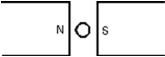
(Multiple Choice)
4.8/5  (89)
(89) A beam of electrons is sent horizontally down the axis of a tube to strike a fluorescent screen at the end of the tube.On the way, the electrons encounter a magnetic field directed vertically downward.The spot on the screen will therefore be deflected:
(Multiple Choice)
4.8/5 (77)
(77) An electron moves in the negative x direction, through a uniform magnetic field that is in the negative y direction.The magnetic force on the electron is: 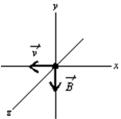
(Multiple Choice)
4.8/5 (99)
(99) The figure shows the motion of electrons in a wire which is near the N pole of a magnet.The wire will be pushed: 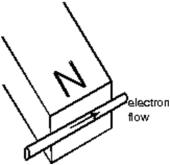
(Multiple Choice)
5.0/5 (93)
(93) A hydrogen atom that has lost its electron is moving east in a region where the magnetic field is directed from south to north.It will be deflected:
(Multiple Choice)
4.9/5 (68)
(68) The current is from left to right in the conductor shown.The magnetic field is into the page and point S is at a higher potential than point T.The charge carriers are: 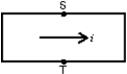
(Multiple Choice)
4.8/5 (62)
(62) A current is clockwise around the outside edge of this page and a uniform magnetic field is directed parallel to the page, from left to right.If the magnetic force is the only force acting on the page, the page will rotate so the right edge:
(Multiple Choice)
4.8/5 (80)
(80) An electron is launched with velocity  in a uniform magnetic field
 .The angle 0between
 and
 is between 0 and 90o.As a result, the electron follows a helix, its velocity vector
 returning to its initial value in a time interval of:
in a uniform magnetic field .The angle 0between and is between 0 and 90o.As a result, the electron follows a helix, its velocity vector returning to its initial value in a time interval of: (Multiple Choice)
4.8/5 (74)
(74)  :
J.J.Thomson's experiment, involving the motion of an electron beam in mutually perpendicular  and
 fields, gave the value of:
and fields, gave the value of: (Multiple Choice)
4.8/5 (89)
(89) An electron and a proton are both initially moving with the same speed and in the same direction at 90˚ to the same uniform magnetic field.They experience magnetic forces, which are initially:
(Multiple Choice)
4.8/5 (75)
(75) The diagrams show five possible orientations of a magnetic dipole  in a uniform magnetic field
 .For which of these is the potential energy the greatest?

in a uniform magnetic field .For which of these is the potential energy the greatest? (Multiple Choice)
4.9/5 (75)
(75) An electron is moving north in a region where the magnetic field is south.The magnetic force exerted on the electron is:
(Multiple Choice)
4.8/5 (86)
(86) The magnetic torque exerted on a flat current-carrying loop of wire by a uniform magnetic field  is:
is: (Multiple Choice)
4.8/5 (73)
(73) At any point the magnetic field lines are in the direction of:
(Multiple Choice)
4.8/5 (75)
(75) An electron is travelling in the positive x direction.A uniform electric field  is in the negative y direction.If a uniform magnetic field with the appropriate magnitude and direction also exists in the region, the total force on the electron will be zero.The appropriate direction for the magnetic field is:
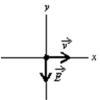
is in the negative y direction.If a uniform magnetic field with the appropriate magnitude and direction also exists in the region, the total force on the electron will be zero.The appropriate direction for the magnetic field is: (Multiple Choice)
4.9/5 (85)
(85) Electrons (mass m, charge -e)are accelerated from rest through a potential difference V and are then deflected by a magnetic field  that is perpendicular to their velocity.The radius of the resulting electron trajectory is:
 (Multiple Choice)
4.9/5 (83)
(83) A loop of current-carrying wire has a magnetic dipole moment of 5.0 *10-4 A.m2.If the dipole moment makes an angle of 57° with a magnetic field of 0.35 T, what is its potential energy?
(Multiple Choice)
4.7/5 (69)
(69) The magnetic dipole moment of a current-carrying loop of wire is in the positive z direction.If a uniform magnetic field is in the positive x direction the magnetic torque on the loop is:
(Multiple Choice)
4.8/5 (73)
(73) 
Filters
- Essay(0)
- Multiple Choice(0)
- Short Answer(0)
- True False(0)
- Matching(0)