



 Chat with AI
Exam 25: Capacitance

Exam 1: Measurement37 Questions
Exam 2: Motion Along a Straight Line90 Questions
Exam 3: Vectors43 Questions
Exam 4: Motion in Two and Three Dimensions56 Questions
Exam 5: Force and Motion73 Questions
Exam 6: Force and Motion74 Questions
Exam 7: Kinetic Energy and Work73 Questions
Exam 8: Potential Energy and Conservation of Energy65 Questions
Exam 9: Center of Mass and Linear Momentum99 Questions
Exam 10: Rotation102 Questions
Exam 11: Rolling, Torque, and Angular Momentum67 Questions
Exam 12: Equilibrium and Elasticity57 Questions
Exam 13: Gravitation61 Questions
Exam 14: Fluids91 Questions
Exam 15: Oscillations80 Questions
Exam 16: Waves83 Questions
Exam 17: Waves72 Questions
Exam 18: Temperature, Heat, and the First Law of Thermodynamics96 Questions
Exam 19: The Kinetic Theory of Gases114 Questions
Exam 20: Entropy and the Second Law of Thermodynamics61 Questions
Exam 21: Coulombs Law52 Questions
Exam 22: Electric Fields55 Questions
Exam 23: Gauss Law44 Questions
Exam 24: Electric Potential55 Questions
Exam 25: Capacitance61 Questions
Exam 26: Current and Resistance55 Questions
Exam 27: Circuits75 Questions
Exam 28: Magnetic Fields53 Questions
Exam 29: Magnetic Fields Due to Currents49 Questions
Exam 30: Induction and Inductance90 Questions
Exam 31: Electromagnetic Oscillations and Alternating Current89 Questions
Exam 32: Maxwells Equations; Magnetism of Matter87 Questions
Exam 33: Electromagnetic Waves83 Questions
Exam 34: Images79 Questions
Exam 35: Interference 147 Questions
Exam 36: Diffraction77 Questions
Exam 37: Relativity69 Questions
Exam 38: Photons and Matter Waves59 Questions
Exam 39: More About Matter Waves45 Questions
Exam 40: All About Atoms79 Questions
Exam 41: Conduction of Electricity in Solids51 Questions
Exam 42: Energy From the Nucleus50 Questions
Exam 43: Quarks, Leptons, and the Big Bang59 Questions
Select questions type


The capacitance of a parallel-plate capacitor with plate area A and plate separation d is given by:
(Multiple Choice)
4.9/5  (73)
(73) Capacitors C1 and C2 are connected in series.The equivalent capacitance is given by:
(Multiple Choice)
4.9/5 (77)
(77) The capacitance of a cylindrical capacitor can be increased by:
(Multiple Choice)
4.7/5 (72)
(72) Two parallel-plate capacitors with the same plate area but different capacitance are connected in parallel to a battery.Both capacitors are filled with air.The quantity that is the same for both capacitors when they are fully charged is:
(Multiple Choice)
4.9/5 (80)
(80) A 2- F and a 1- F capacitor are connected in series and a potential difference is applied across the combination.The 2- F capacitor has:
(Multiple Choice)
4.8/5 (68)
(68) Capacitors C1 and C2 are connected in parallel and a potential difference is applied to the combination.If the capacitor that is equivalent to the combination has the same potential difference, then the charge on the equivalent capacitor is the same as:
(Multiple Choice)
4.7/5 (90)
(90) Let Q denote charge, V denote potential difference and U denote stored energy.Of these quantities, capacitors in series must have the same:
(Multiple Choice)
4.8/5 (67)
(67) A parallel-plate capacitor has a plate area of 0.2 m2 and a plate separation of 0.1 mm.If the charge on each plate has a magnitude of 4 *10-6 C the potential difference across the plates is approximately:
(Multiple Choice)
4.8/5 (61)
(61) The plate areas and plate separations of five parallel plate capacitors are 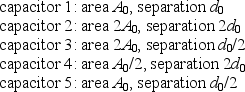 Rank these according to their capacitances, least to greatest.
 (Multiple Choice)
4.7/5 (84)
(84) Each plate of a capacitor stores a charge of magnitude 1 mC when a 100-V potential difference is applied.The capacitance is:
(Multiple Choice)
4.9/5 (74)
(74) The capacitance of a single isolated spherical conductor with radius R is proportional to:
(Multiple Choice)
4.9/5 (66)
(66) A parallel-plate capacitor has a plate area of 0.2 m2 and a plate separation of 0.1 mm.To obtain an electric field of 2.0 * 106 V/m between the plates, the magnitude of the charge on each plate should be:
(Multiple Choice)
4.8/5 (83)
(83) A battery is used to charge a parallel-plate capacitor, after which it is disconnected.Then the plates are pulled apart to twice their original separation.This process will double the:
(Multiple Choice)
4.8/5 (65)
(65) What happens to the atoms in a dielectric when it is placed between the plates of a charged capacitor?
(Multiple Choice)
4.7/5 (82)
(82) Two capacitors are identical except that one is filled with air and the other with oil.Both capacitors carry the same charge.The ratio of the electric fields Eair/Eoil is:
(Multiple Choice)
4.8/5 (66)
(66) Two parallel-plate capacitors with different capacitance but the same plate separation are connected in series to a battery.Both capacitors are filled with air.The quantity that is the same for both capacitors when they are fully charged is:
(Multiple Choice)
4.9/5 (79)
(79) If the plate separation of an isolated charged parallel-plate capacitor is doubled:
(Multiple Choice)
4.9/5 (77)
(77) Two parallel-plate capacitors with the same plate separation but different capacitance are connected in parallel to a battery.Both capacitors are filled with air.The quantity that is NOT the same for both capacitors when they are fully charged is:
(Multiple Choice)
4.9/5 (74)
(74) A 2- F and a 1- F capacitor are connected in parallel and a potential difference is applied across the combination.The 2- F capacitor has:
(Multiple Choice)
4.8/5 (82)
(82) Capacitors A and B are identical.Capacitor A is charged so it stores 4 J of energy and capacitor B is uncharged.The capacitors are then connected in parallel.The total stored energy in the capacitors is now:
(Multiple Choice)
4.8/5 (78)
(78) 
Filters
- Essay(0)
- Multiple Choice(0)
- Short Answer(0)
- True False(0)
- Matching(0)