



 Chat with AI
Exam 24: Electric Potential

Exam 1: Measurement37 Questions
Exam 2: Motion Along a Straight Line90 Questions
Exam 3: Vectors43 Questions
Exam 4: Motion in Two and Three Dimensions56 Questions
Exam 5: Force and Motion73 Questions
Exam 6: Force and Motion74 Questions
Exam 7: Kinetic Energy and Work73 Questions
Exam 8: Potential Energy and Conservation of Energy65 Questions
Exam 9: Center of Mass and Linear Momentum99 Questions
Exam 10: Rotation102 Questions
Exam 11: Rolling, Torque, and Angular Momentum67 Questions
Exam 12: Equilibrium and Elasticity57 Questions
Exam 13: Gravitation61 Questions
Exam 14: Fluids91 Questions
Exam 15: Oscillations80 Questions
Exam 16: Waves83 Questions
Exam 17: Waves72 Questions
Exam 18: Temperature, Heat, and the First Law of Thermodynamics96 Questions
Exam 19: The Kinetic Theory of Gases114 Questions
Exam 20: Entropy and the Second Law of Thermodynamics61 Questions
Exam 21: Coulombs Law52 Questions
Exam 22: Electric Fields55 Questions
Exam 23: Gauss Law44 Questions
Exam 24: Electric Potential55 Questions
Exam 25: Capacitance61 Questions
Exam 26: Current and Resistance55 Questions
Exam 27: Circuits75 Questions
Exam 28: Magnetic Fields53 Questions
Exam 29: Magnetic Fields Due to Currents49 Questions
Exam 30: Induction and Inductance90 Questions
Exam 31: Electromagnetic Oscillations and Alternating Current89 Questions
Exam 32: Maxwells Equations; Magnetism of Matter87 Questions
Exam 33: Electromagnetic Waves83 Questions
Exam 34: Images79 Questions
Exam 35: Interference 147 Questions
Exam 36: Diffraction77 Questions
Exam 37: Relativity69 Questions
Exam 38: Photons and Matter Waves59 Questions
Exam 39: More About Matter Waves45 Questions
Exam 40: All About Atoms79 Questions
Exam 41: Conduction of Electricity in Solids51 Questions
Exam 42: Energy From the Nucleus50 Questions
Exam 43: Quarks, Leptons, and the Big Bang59 Questions
Select questions type


Two large parallel conducting plates are separated by a distance d, placed in a vacuum, and connected to a source of potential difference V.An oxygen ion, with charge 2e, starts from rest on the surface of one plate and accelerates to the other.If e denotes the magnitude of the electron charge, the final kinetic energy of this ion is:
(Multiple Choice)
4.9/5  (80)
(80) A solid metal sphere carries a charge of 5 *10-9 C and is at a potential of 400 V, relative to the potential far away.The potential at the center of the sphere is:
(Multiple Choice)
4.9/5 (82)
(82) If 500 J of work are required to carry a 40-C charge from one point to another, the potential difference between these two points is:
(Multiple Choice)
4.9/5 (71)
(71) The potential difference between two points is 100 V.If a particle with a charge of 2 C is transported from one of these points to the other, the magnitude of the work done is:
(Multiple Choice)
4.9/5 (75)
(75) A conducting sphere with radius R is charged until the magnitude of the electric field just outside its surface is E.The electric potential of the sphere, relative to the potential for away, is:
(Multiple Choice)
4.9/5 (77)
(77) The graph shows the electric potential as a function of x in a certain region.What is the x component of the electric field in this region if Vs = 50 V? 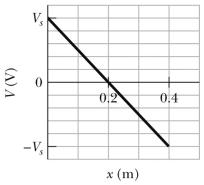
(Multiple Choice)
4.8/5 (72)
(72) In separate experiments, four different particles each start from far away with the same speed and impinge directly on a gold nucleus.The masses and charges of the particles are 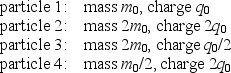 Rank the particles according to the distance of closest approach to the gold nucleus, from smallest to largest.
 (Multiple Choice)
4.9/5 (82)
(82) Two particles with charges Q and -Q are fixed at the vertices of an equilateral triangle with sides of length a.If k = 1/4  , the work required to move a particle with a charge q from the other vertex to the center of the line joining the fixed charges is:
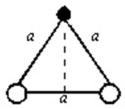
, the work required to move a particle with a charge q from the other vertex to the center of the line joining the fixed charges is: (Multiple Choice)
4.9/5 (85)
(85) The work required to carry a particle with a charge of 6.0-µC from a 5.0-V equipotential surface to a 6.0-V equipotential surface and back again to the 5.0-V surface is:
(Multiple Choice)
4.7/5 (82)
(82) An electron is accelerated from rest through a potential difference V.Its final speed is proportional to:
(Multiple Choice)
4.9/5 (81)
(81) A wire carrying a charge density of λ C/m is bent into a circle of radius r.What is the electric potential at the center of the circle?
(Multiple Choice)
4.8/5 (85)
(85) A particle with a charge of 5.5 *10-8C is fixed at the origin.A particle with a charge of -2.3 *10-8C is moved from x = 3.5 cm on the x axis to y = 4.3 cm on the y axis.The change in potential energy of the two-particle system is:
(Multiple Choice)
4.8/5 (74)
(74) A geologist measures the Earth's electric field near the surface, and finds that equipotential lines 100 V apart are at a distance of 75 cm from each other.Assuming the electric field is uniform, what is its magnitude?
(Multiple Choice)
4.8/5 (90)
(90) Compared to the magnitude of the electric potential far from a point charge, the magnitude of the electric potential far from an electric dipole:
(Multiple Choice)
4.8/5 (88)
(88) An electron has charge -e and mass me.A proton has charge e and mass 1840me.A "proton volt" is equal to:
(Multiple Choice)
4.8/5 (84)
(84) Points R and T are each a distance d from each of two particles with charges of equal magnitudes and opposite signs as shown.If k = 1/4  , the work required to move a particle with negative charge q from R to T is:
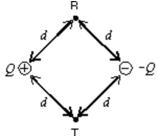
, the work required to move a particle with negative charge q from R to T is: (Multiple Choice)
4.8/5 (69)
(69) Positive charge is distributed uniformly throughout a non-conducting sphere.The highest electric potential occurs:
(Multiple Choice)
4.8/5 (80)
(80) An electron moves from point i to point f, in the direction of a uniform electric field.During this motion: 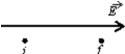
(Multiple Choice)
4.7/5 (87)
(87) Equipotential surfaces associated with an electric dipole are:
(Multiple Choice)
4.8/5 (90)
(90) An electrically charged object creates an electric field.The electric potential due to this object:
(Multiple Choice)
4.7/5 (91)
(91) 
Filters
- Essay(0)
- Multiple Choice(0)
- Short Answer(0)
- True False(0)
- Matching(0)