



 Chat with AI
Exam 22: Electric Fields

Exam 1: Measurement37 Questions
Exam 2: Motion Along a Straight Line90 Questions
Exam 3: Vectors43 Questions
Exam 4: Motion in Two and Three Dimensions56 Questions
Exam 5: Force and Motion73 Questions
Exam 6: Force and Motion74 Questions
Exam 7: Kinetic Energy and Work73 Questions
Exam 8: Potential Energy and Conservation of Energy65 Questions
Exam 9: Center of Mass and Linear Momentum99 Questions
Exam 10: Rotation102 Questions
Exam 11: Rolling, Torque, and Angular Momentum67 Questions
Exam 12: Equilibrium and Elasticity57 Questions
Exam 13: Gravitation61 Questions
Exam 14: Fluids91 Questions
Exam 15: Oscillations80 Questions
Exam 16: Waves83 Questions
Exam 17: Waves72 Questions
Exam 18: Temperature, Heat, and the First Law of Thermodynamics96 Questions
Exam 19: The Kinetic Theory of Gases114 Questions
Exam 20: Entropy and the Second Law of Thermodynamics61 Questions
Exam 21: Coulombs Law52 Questions
Exam 22: Electric Fields55 Questions
Exam 23: Gauss Law44 Questions
Exam 24: Electric Potential55 Questions
Exam 25: Capacitance61 Questions
Exam 26: Current and Resistance55 Questions
Exam 27: Circuits75 Questions
Exam 28: Magnetic Fields53 Questions
Exam 29: Magnetic Fields Due to Currents49 Questions
Exam 30: Induction and Inductance90 Questions
Exam 31: Electromagnetic Oscillations and Alternating Current89 Questions
Exam 32: Maxwells Equations; Magnetism of Matter87 Questions
Exam 33: Electromagnetic Waves83 Questions
Exam 34: Images79 Questions
Exam 35: Interference 147 Questions
Exam 36: Diffraction77 Questions
Exam 37: Relativity69 Questions
Exam 38: Photons and Matter Waves59 Questions
Exam 39: More About Matter Waves45 Questions
Exam 40: All About Atoms79 Questions
Exam 41: Conduction of Electricity in Solids51 Questions
Exam 42: Energy From the Nucleus50 Questions
Exam 43: Quarks, Leptons, and the Big Bang59 Questions
Select questions type


A disk with a uniform positive surface charge density lies in the x-y plane, centered on the origin.The disk contains 2.5 x 10⁻⁶ C/m2 of charge, and is 7.5 cm in radius.What is the electric field at z = 15 cm?
(Multiple Choice)
4.7/5  (73)
(73) Two point particles, one with charge +8 *10-9 C and the other with charge-2 *0 10-9 C, are separated by 4 m.The electric field midway between them is:
(Multiple Choice)
4.9/5 (96)
(96) An electric dipole consists of two charges, ±2.5 µC, separated by 1.0 x 10⁻⁴ m and centered on the origin.If the dipole is oriented along the x axis, what is the electric field at x = 15 cm?
(Multiple Choice)
4.9/5 (70)
(70) Two thin spherical shells, one with radius R and the other with radius 2R, surround an isolated charge point particle.The ratio of the number of field lines through the larger sphere to the number through the smaller is:
(Multiple Choice)
4.8/5 (93)
(93) A uniform electric field of 300 N/C makes an angle of 25 ° with the dipole moment of an electric dipole.If the torque exerted by the field has a magnitude of 2.5 * 10-7 N.m, the dipole moment must be:
(Multiple Choice)
4.8/5 (89)
(89) Two point charges are arranged as shown.In which region could a third charge +1 C be placed so that the net electrostatic force on it is zero? 
(Multiple Choice)
4.8/5 (64)
(64) A certain physics textbook shows a region of space in which two electric field lines cross each other.We conclude that:
(Multiple Choice)
4.8/5 (91)
(91) A charged oil drop with a mass of 2 *10-4 kg is held suspended by a downward electric field of 300 N/C.The charge on the drop is:
(Multiple Choice)
4.9/5 (74)
(74) Experimenter A uses a test charge q0 and experimenter B uses a test charge 2q0 to measure an electric field produced by stationary charges.A finds a field that is:
(Multiple Choice)
4.7/5 (63)
(63) Charge is placed on the surface of a 2.7-cm radius isolated conducting sphere.The surface charge density is uniform and has the value 6.9 * 10-6 C/m2.The total charge on the sphere is:
(Multiple Choice)
4.9/5 (80)
(80) A total charge of 6.3 *10-8 C is distributed uniformly throughout a 2.7-cm radius sphere.The volume charge density is:
(Multiple Choice)
4.9/5 (65)
(65) Two charged point particles are located at two vertices of an equilateral triangle and the electric field is zero at the third vertex.We conclude:
(Multiple Choice)
4.9/5 (81)
(81) Choose the correct statement concerning electric field lines:
(Multiple Choice)
4.9/5 (76)
(76) The diagram shows the electric field lines due to two charged parallel metal plates.We conclude that: 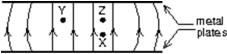
(Multiple Choice)
4.8/5 (77)
(77) An electron traveling north enters a region where the electric field is uniform and points west.The electron:
(Multiple Choice)
4.9/5 (75)
(75) The diagram shows a particle with positive charge Q and a particle with negative charge -Q.The electric field at point P on the perpendicular bisector of the line joining them is: 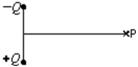
(Multiple Choice)
4.9/5 (89)
(89) The dipole moment of a dipole in a 300-N/C electric field is initially perpendicular to the field, but it rotates so it is in the same direction as the field.If the moment has a magnitude of 2 * 10-9 CF.m the work done by the field is:
(Multiple Choice)
4.8/5 (95)
(95) 
Filters
- Essay(0)
- Multiple Choice(0)
- Short Answer(0)
- True False(0)
- Matching(0)