



 Chat with AI
Exam 21: Coulombs Law

Exam 1: Measurement37 Questions
Exam 2: Motion Along a Straight Line90 Questions
Exam 3: Vectors43 Questions
Exam 4: Motion in Two and Three Dimensions56 Questions
Exam 5: Force and Motion73 Questions
Exam 6: Force and Motion74 Questions
Exam 7: Kinetic Energy and Work73 Questions
Exam 8: Potential Energy and Conservation of Energy65 Questions
Exam 9: Center of Mass and Linear Momentum99 Questions
Exam 10: Rotation102 Questions
Exam 11: Rolling, Torque, and Angular Momentum67 Questions
Exam 12: Equilibrium and Elasticity57 Questions
Exam 13: Gravitation61 Questions
Exam 14: Fluids91 Questions
Exam 15: Oscillations80 Questions
Exam 16: Waves83 Questions
Exam 17: Waves72 Questions
Exam 18: Temperature, Heat, and the First Law of Thermodynamics96 Questions
Exam 19: The Kinetic Theory of Gases114 Questions
Exam 20: Entropy and the Second Law of Thermodynamics61 Questions
Exam 21: Coulombs Law52 Questions
Exam 22: Electric Fields55 Questions
Exam 23: Gauss Law44 Questions
Exam 24: Electric Potential55 Questions
Exam 25: Capacitance61 Questions
Exam 26: Current and Resistance55 Questions
Exam 27: Circuits75 Questions
Exam 28: Magnetic Fields53 Questions
Exam 29: Magnetic Fields Due to Currents49 Questions
Exam 30: Induction and Inductance90 Questions
Exam 31: Electromagnetic Oscillations and Alternating Current89 Questions
Exam 32: Maxwells Equations; Magnetism of Matter87 Questions
Exam 33: Electromagnetic Waves83 Questions
Exam 34: Images79 Questions
Exam 35: Interference 147 Questions
Exam 36: Diffraction77 Questions
Exam 37: Relativity69 Questions
Exam 38: Photons and Matter Waves59 Questions
Exam 39: More About Matter Waves45 Questions
Exam 40: All About Atoms79 Questions
Exam 41: Conduction of Electricity in Solids51 Questions
Exam 42: Energy From the Nucleus50 Questions
Exam 43: Quarks, Leptons, and the Big Bang59 Questions
Select questions type


A wire contains a steady current of 2 A.The number of electrons that pass a cross section in 2 s is:
(Multiple Choice)
4.8/5  (87)
(87) Two uncharged metal spheres, L and M, are in contact.A negatively charged rod is brought close to L, but not touching it, as shown.The two spheres are slightly separated and the rod is then withdrawn.As a result: 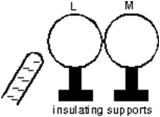
(Multiple Choice)
4.9/5 (83)
(83) Is it ever possible for the following process to occur? γ → e+ + e- + e+
(Multiple Choice)
4.8/5 (84)
(84) The diagram shows a pair of highly charged plastic cubes that attract each other.  Cube 3 is a conductor and is uncharged.Which of the following illustrates the forces between cubes1 and 3 and between cubes 2 and 3?
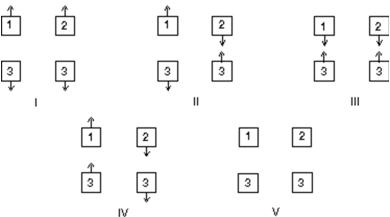
Cube 3 is a conductor and is uncharged.Which of the following illustrates the forces between cubes1 and 3 and between cubes 2 and 3? (Multiple Choice)
4.8/5 (91)
(91) Two electrons (e1 and e2)and a proton (p)lie on a straight line, as shown.The directions of the force of e2 on e1, the force of p on e1, and the total force on e1, respectively, are: 
(Multiple Choice)
4.9/5 (75)
(75) Charge is distributed uniformly on the surface of a spherical nonconducting shell.A point particle with charge q is inside.The electrical force on the particle q is least when:
(Multiple Choice)
4.9/5 (77)
(77) The magnitude of the total negative charge on the electrons in 1 mol of helium (atomic number 2, atomic mass 4)is:
(Multiple Choice)
4.9/5 (80)
(80) Two particles, each with charge Q, and a third particle, with a charge q, are placed at the vertices of an equilateral triangle as shown.The total force on the particle with charge q is: 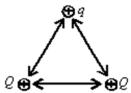
(Multiple Choice)
4.9/5 (72)
(72) Two small charged objects repel each other with a force F when separated by a distance d.If the charge on each object is reduced to one-fourth of its original value and the distance between them is reduced to d/2 the force becomes:
(Multiple Choice)
4.9/5 (81)
(81) A particle with a charge of 5 *10-6 C and a mass of 20 g moves uniformly with a speed of 7 m/s in a circular orbit around a stationary particle with a charge of -5 * 10-6 C.The radius of the orbit is:
(Multiple Choice)
5.0/5 (82)
(82) The magnitude of the total negative charge on the electrons in 1 kg of helium (atomic number 2, atomic mass 4)is:
(Multiple Choice)
4.9/5 (85)
(85) Two identical conducting spheres A and B carry equal charge and exert electrostatic forces of magnitude F on each other.They are separated by a distance much larger than their diameters.A third identical conducting sphere C is uncharged.Sphere C is first touched to A, then to B, and finally removed.As a result, the electrostatic force between A and B becomes:
(Multiple Choice)
4.9/5 (72)
(72) A positively charged insulating rod is brought close to an object that is suspended by a string.If the object is repelled away from the rod we can conclude:
(Multiple Choice)
4.8/5 (80)
(80) Two identical charges, 2.0 m apart, exert forces of magnitude 4.0 N on each other.The value of either charge is:
(Multiple Choice)
4.8/5 (83)
(83) Particle 1 with charge q1, and particle 2, with a charge q2, are on the x axis, with particle 1 at x = a with and particle 2 at x = -2a.For the net force on a third charged particle, at the origin to be zero q1 and q2 must be related by q2=:
(Multiple Choice)
4.8/5 (88)
(88) A particle with charge 2°C is placed at the origin.An identical particle, with the same charge, is placed 2 m from the origin on the x axis, and a third identical particle, with the same charge, is placed 2 m from the origin on the y axis.The magnitude of the force on the particle at the origin is:
(Multiple Choice)
4.9/5 (80)
(80) In the Rutherford model of the hydrogen atom, a proton (mass M, charge Q)is the nucleus and an electron (mass m, charge q)moves around the proton in a circle of radius r.Let k denote the Coulomb force constant (1/4  )and G the universal gravitational constant.The ratio of the electrostatic force to the gravitational force between electron and proton is:
 (Multiple Choice)
4.8/5 (83)
(83) A nucleus of carbon 14 has 6 protons and 8 neutrons.The atomic number and mass number of carbon 14 are, respectively,
(Multiple Choice)
4.7/5 (75)
(75) A charged insulator can be discharged by passing it just above a flame.This is because the flame:
(Multiple Choice)
4.8/5 (86)
(86) 
Filters
- Essay(0)
- Multiple Choice(0)
- Short Answer(0)
- True False(0)
- Matching(0)