



 Chat with AI
Exam 17: Waves

Exam 1: Measurement37 Questions
Exam 2: Motion Along a Straight Line90 Questions
Exam 3: Vectors43 Questions
Exam 4: Motion in Two and Three Dimensions56 Questions
Exam 5: Force and Motion73 Questions
Exam 6: Force and Motion74 Questions
Exam 7: Kinetic Energy and Work73 Questions
Exam 8: Potential Energy and Conservation of Energy65 Questions
Exam 9: Center of Mass and Linear Momentum99 Questions
Exam 10: Rotation102 Questions
Exam 11: Rolling, Torque, and Angular Momentum67 Questions
Exam 12: Equilibrium and Elasticity57 Questions
Exam 13: Gravitation61 Questions
Exam 14: Fluids91 Questions
Exam 15: Oscillations80 Questions
Exam 16: Waves83 Questions
Exam 17: Waves72 Questions
Exam 18: Temperature, Heat, and the First Law of Thermodynamics96 Questions
Exam 19: The Kinetic Theory of Gases114 Questions
Exam 20: Entropy and the Second Law of Thermodynamics61 Questions
Exam 21: Coulombs Law52 Questions
Exam 22: Electric Fields55 Questions
Exam 23: Gauss Law44 Questions
Exam 24: Electric Potential55 Questions
Exam 25: Capacitance61 Questions
Exam 26: Current and Resistance55 Questions
Exam 27: Circuits75 Questions
Exam 28: Magnetic Fields53 Questions
Exam 29: Magnetic Fields Due to Currents49 Questions
Exam 30: Induction and Inductance90 Questions
Exam 31: Electromagnetic Oscillations and Alternating Current89 Questions
Exam 32: Maxwells Equations; Magnetism of Matter87 Questions
Exam 33: Electromagnetic Waves83 Questions
Exam 34: Images79 Questions
Exam 35: Interference 147 Questions
Exam 36: Diffraction77 Questions
Exam 37: Relativity69 Questions
Exam 38: Photons and Matter Waves59 Questions
Exam 39: More About Matter Waves45 Questions
Exam 40: All About Atoms79 Questions
Exam 41: Conduction of Electricity in Solids51 Questions
Exam 42: Energy From the Nucleus50 Questions
Exam 43: Quarks, Leptons, and the Big Bang59 Questions
Select questions type


A standing wave in a pipe has nodes that are 1.2 m apart.What is the wavelength of the wave?
(Multiple Choice)
4.9/5  (87)
(87) A microphone of surface area 2.0 cm2 absorbs 1.1 mW of sound.What is the intensity of sound hitting the microphone?
(Multiple Choice)
4.8/5 (82)
(82) The diagram shows four situations in which a source of sound S and a detector D are either moving or stationary.The arrows indicate the directions of motion.The speeds (when not zero)are all the same.(Note that the detector in situation 3 is stationary).Rank the situations according to the apparent frequency of the source, lowest to highest. 
(Multiple Choice)
4.7/5 (80)
(80) The sound level at a point P is 14 db below the sound level at a point 1.0 m from a point source.Assuming the intensity from a point source drops off like the inverse square of the distance, the distance from the source to point P is:
(Multiple Choice)
4.8/5 (86)
(86) A sound wave has a wavelength of 3.0 m.The distance from a compression center to the adjacent rarefaction center is:
(Multiple Choice)
4.9/5 (78)
(78) Two stationary tuning forks (350 and 352 Hz)are struck simultaneously.The resulting sound is observed to:
(Multiple Choice)
4.9/5 (73)
(73) The longitudinal displacement of a mass element in a medium as a sound wave passes through it is given by s = sm cos (kx - ωt).Consider a sound wave of frequency 440 Hz and wavelength 0.75m.If sm = 12 µm, how long does it take an element of air to move from a displacement of 12 µm to a displacement of 0 µm?
(Multiple Choice)
4.8/5 (83)
(83) This graph shows the position of an element of air as a function of time as a sound wave passes through it.Which letter corresponds to the period of the wave? 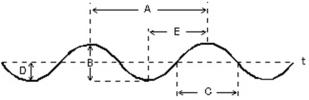
(Multiple Choice)
4.8/5 (64)
(64) The Doppler shift formula for the frequency detected is 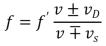 where f ' is the frequency emitted, v is the speed of sound, vD is the speed of the detector, and vs is the speed of the source.Suppose the source is traveling at 5 m/s away from the detector, the detector is traveling at 7 m/s toward the source, and there is a 3 m/s wind blowing from the source toward the detector.The values that should be substituted into the Doppler shift equation are:
 (Multiple Choice)
4.9/5 (74)
(74) Two small identical speakers are connected (in phase)to the same source.The speakers are 3 m apart and at ear level.An observer stands at X, 4 m in front of one speaker as shown.The sound she hears will be most intense if the wavelength is: 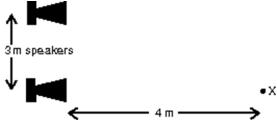
(Multiple Choice)
4.9/5 (79)
(79) In order for two sound waves to produce audible beats, it is essential that the two waves have:
(Multiple Choice)
4.8/5 (72)
(72) When listening to tuning forks of frequency 256 Hz and 260 Hz, one hears the following number of beats per second:
(Multiple Choice)
4.8/5 (76)
(76) The bulk modulus of water is 2.2 x 10⁹ Pa, and its density is 1.0 x 10³ kg/m3.What is the speed of sound in water?
(Multiple Choice)
4.8/5 (72)
(72) An organ pipe with both ends open is 0.85 m long.Assuming that the speed of sound is 340 m/s, the frequency of the third harmonic of this pipe is:
(Multiple Choice)
4.8/5 (87)
(87) Take the speed of sound to be 340 m/s.A thunder clap is heard about 3 s after the lightning is seen.The source of both light and sound is:
(Multiple Choice)
4.9/5 (70)
(70) A source emits sound with a frequency of 1000 Hz.It is moving at 20 m/s toward a stationary reflecting wall.If the speed of sound is 340 m/s an observer at rest directly behind the source hears a beat frequency of:
(Multiple Choice)
4.9/5 (79)
(79) Two notes are an octave apart.The ratio of their frequencies is:
(Multiple Choice)
4.8/5 (84)
(84) Two waves are out of phase by half a wavelength.What is this in radians?
(Multiple Choice)
4.9/5 (70)
(70) 
Filters
- Essay(0)
- Multiple Choice(0)
- Short Answer(0)
- True False(0)
- Matching(0)