



 Chat with AI
Exam 16: Waves

Exam 1: Measurement37 Questions
Exam 2: Motion Along a Straight Line90 Questions
Exam 3: Vectors43 Questions
Exam 4: Motion in Two and Three Dimensions56 Questions
Exam 5: Force and Motion73 Questions
Exam 6: Force and Motion74 Questions
Exam 7: Kinetic Energy and Work73 Questions
Exam 8: Potential Energy and Conservation of Energy65 Questions
Exam 9: Center of Mass and Linear Momentum99 Questions
Exam 10: Rotation102 Questions
Exam 11: Rolling, Torque, and Angular Momentum67 Questions
Exam 12: Equilibrium and Elasticity57 Questions
Exam 13: Gravitation61 Questions
Exam 14: Fluids91 Questions
Exam 15: Oscillations80 Questions
Exam 16: Waves83 Questions
Exam 17: Waves72 Questions
Exam 18: Temperature, Heat, and the First Law of Thermodynamics96 Questions
Exam 19: The Kinetic Theory of Gases114 Questions
Exam 20: Entropy and the Second Law of Thermodynamics61 Questions
Exam 21: Coulombs Law52 Questions
Exam 22: Electric Fields55 Questions
Exam 23: Gauss Law44 Questions
Exam 24: Electric Potential55 Questions
Exam 25: Capacitance61 Questions
Exam 26: Current and Resistance55 Questions
Exam 27: Circuits75 Questions
Exam 28: Magnetic Fields53 Questions
Exam 29: Magnetic Fields Due to Currents49 Questions
Exam 30: Induction and Inductance90 Questions
Exam 31: Electromagnetic Oscillations and Alternating Current89 Questions
Exam 32: Maxwells Equations; Magnetism of Matter87 Questions
Exam 33: Electromagnetic Waves83 Questions
Exam 34: Images79 Questions
Exam 35: Interference 147 Questions
Exam 36: Diffraction77 Questions
Exam 37: Relativity69 Questions
Exam 38: Photons and Matter Waves59 Questions
Exam 39: More About Matter Waves45 Questions
Exam 40: All About Atoms79 Questions
Exam 41: Conduction of Electricity in Solids51 Questions
Exam 42: Energy From the Nucleus50 Questions
Exam 43: Quarks, Leptons, and the Big Bang59 Questions
Select questions type


A sinusoidal wave is traveling toward the right as shown.Which letter correctly labels the wavelength of the wave? 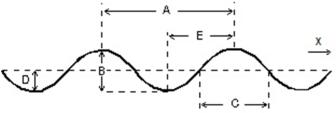
(Multiple Choice)
4.8/5  (86)
(86) Two identical but separate strings, with the same tension, carry sinusoidal waves with the same amplitude.Wave A has a frequency that is twice that of wave B and transmits energy at a rate that is __________ that of wave B.
(Multiple Choice)
4.9/5 (80)
(80) Let f be the frequency, v the speed, and T the period of a sinusoidal traveling wave.The correct relationship is:
(Multiple Choice)
4.8/5 (79)
(79) When a certain string is clamped at both ends, the lowest four resonant frequencies are 50, 100, 150, and 200 Hz.When the string is also clamped at its midpoint, the lowest four resonant frequencies are:
(Multiple Choice)
4.7/5 (89)
(89) A wave is described by y(x,t)= 0.1 sin(3x + 10t), where x is in meters, y is in centimeters and t is in seconds.The angular wave number is:
(Multiple Choice)
4.7/5 (92)
(92) Two separated sources emit sinusoidal traveling waves that have the same wavelength and are in phase at their respective sources.One travels a distance 1 to get to the observation point while the other travels a distance 2.The amplitude is a minimum at the observation point if 1 2 is:
(Multiple Choice)
4.9/5 (81)
(81) A 40-cm long string, with one end clamped and the other free to move transversely, is vibrating in its fundamental standing wave mode.The wavelength of the constituent traveling waves is:
(Multiple Choice)
4.8/5 (70)
(70) Two sinusoidal waves, each of wavelength 5 m and amplitude 10 cm, travel in opposite directions on a 20-m stretched string which is clamped at each end.Excluding the nodes at the ends of the string, how many nodes appear in the resulting standing wave?
(Multiple Choice)
4.9/5 (86)
(86) A transverse wave travels on a string of length 1.3 m and diameter 1.1 mm, whose mass is 10 g and which is under a tension of 16 N.What is the linear mass density of the string?
(Multiple Choice)
4.8/5 (78)
(78) A sinusoidal wave is generated by moving the end of a string up and down periodically.The generator must supply the greatest power when the end of the string:
(Multiple Choice)
4.8/5 (90)
(90) A string carries a sinusoidal wave with an amplitude of 2.0 cm and a frequency of 100 Hz.The maximum speed of any point on the string is:
(Multiple Choice)
4.8/5 (72)
(72) A wave traveling to the right on a stretched string is shown below.The direction of the instantaneous velocity of the point P on the string is: 
(Multiple Choice)
4.7/5 (69)
(69) A wave on a stretched string is reflected from a fixed end P of the string.The phase difference, at P, between the incident and reflected waves is:
(Multiple Choice)
4.9/5 (79)
(79) This plot shows the displacement of a string as a function of time, as a sinusoidal wave travels along it.Which letter corresponds to the period of the wave? 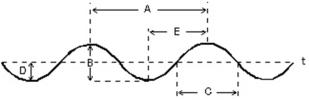
(Multiple Choice)
4.9/5 (75)
(75) Two separated sources emit sinusoidal traveling waves that have the same wavelength and are in phase at their respective sources.One travels a distance 1 to get to the observation point while the other travels a distance 2 The amplitude is a maximum at the observation point if 1 2 is:
(Multiple Choice)
4.9/5 (82)
(82) The sinusoidal wave y(x,t)= ymsin(kx -  t)
Is incident on the fixed end of a string at x = L.The reflected wave is given by:
t)
Is incident on the fixed end of a string at x = L.The reflected wave is given by: (Multiple Choice)
4.7/5 (90)
(90) The displacement of a string carrying a traveling sinusoidal wave is given by  At time t = 0 the point at x = 0 has velocity v0 and displacement y0.The phase constant
 is given by tan 11ef007b_a973_2e1e_bc85_7b3bfc1d1daa_TB6585_11 =:
At time t = 0 the point at x = 0 has velocity v0 and displacement y0.The phase constant is given by tan 11ef007b_a973_2e1e_bc85_7b3bfc1d1daa_TB6585_11 =: (Multiple Choice)
4.9/5 (80)
(80) 
Filters
- Essay(0)
- Multiple Choice(0)
- Short Answer(0)
- True False(0)
- Matching(0)