



 Chat with AI
Exam 15: Oscillations

Exam 1: Measurement37 Questions
Exam 2: Motion Along a Straight Line90 Questions
Exam 3: Vectors43 Questions
Exam 4: Motion in Two and Three Dimensions56 Questions
Exam 5: Force and Motion73 Questions
Exam 6: Force and Motion74 Questions
Exam 7: Kinetic Energy and Work73 Questions
Exam 8: Potential Energy and Conservation of Energy65 Questions
Exam 9: Center of Mass and Linear Momentum99 Questions
Exam 10: Rotation102 Questions
Exam 11: Rolling, Torque, and Angular Momentum67 Questions
Exam 12: Equilibrium and Elasticity57 Questions
Exam 13: Gravitation61 Questions
Exam 14: Fluids91 Questions
Exam 15: Oscillations80 Questions
Exam 16: Waves83 Questions
Exam 17: Waves72 Questions
Exam 18: Temperature, Heat, and the First Law of Thermodynamics96 Questions
Exam 19: The Kinetic Theory of Gases114 Questions
Exam 20: Entropy and the Second Law of Thermodynamics61 Questions
Exam 21: Coulombs Law52 Questions
Exam 22: Electric Fields55 Questions
Exam 23: Gauss Law44 Questions
Exam 24: Electric Potential55 Questions
Exam 25: Capacitance61 Questions
Exam 26: Current and Resistance55 Questions
Exam 27: Circuits75 Questions
Exam 28: Magnetic Fields53 Questions
Exam 29: Magnetic Fields Due to Currents49 Questions
Exam 30: Induction and Inductance90 Questions
Exam 31: Electromagnetic Oscillations and Alternating Current89 Questions
Exam 32: Maxwells Equations; Magnetism of Matter87 Questions
Exam 33: Electromagnetic Waves83 Questions
Exam 34: Images79 Questions
Exam 35: Interference 147 Questions
Exam 36: Diffraction77 Questions
Exam 37: Relativity69 Questions
Exam 38: Photons and Matter Waves59 Questions
Exam 39: More About Matter Waves45 Questions
Exam 40: All About Atoms79 Questions
Exam 41: Conduction of Electricity in Solids51 Questions
Exam 42: Energy From the Nucleus50 Questions
Exam 43: Quarks, Leptons, and the Big Bang59 Questions
Select questions type


A block attached to a spring undergoes simple harmonic motion on a horizontal frictionless surface.Its total energy is 50 J.When the displacement is half the amplitude, the kinetic energy is:
(Multiple Choice)
4.9/5  (75)
(75) When a body executes simple harmonic motion, its acceleration at the ends of its path must be:
(Multiple Choice)
5.0/5 (77)
(77) A disk whose rotational inertia is 450 kg∙m2 hangs from a wire whose torsion constant is 2300 N∙m/rad.When its angular displacement is −0.23 rad, what is its angular acceleration?
(Multiple Choice)
4.8/5 (66)
(66) A block attached to a spring oscillates in simple harmonic motion along the x axis.The limits of its motion are x = 10 cm and x = 50 cm and it goes from one of these extremes to the other in 0.25 s.Its amplitude and frequency are:
(Multiple Choice)
5.0/5 (91)
(91) Two identical undamped oscillators have the same amplitude of oscillation only if:
(Multiple Choice)
4.8/5 (102)
(102) In simple harmonic motion, the restoring force must be proportional to the:
(Multiple Choice)
4.9/5 (85)
(85) An object is undergoing simple harmonic motion.Throughout a complete cycle it:
(Multiple Choice)
5.0/5 (81)
(81) A mass-spring system is oscillating with amplitude A.The kinetic energy will equal the potential energy only when the displacement is
(Multiple Choice)
4.9/5 (78)
(78) The amplitude and phase constant of an oscillator are determined by:
(Multiple Choice)
4.9/5 (75)
(75) A particle is in simple harmonic motion along the x axis.The amplitude of the motion is xm.When it is at x = x1, its kinetic energy is K = 5 J and its potential energy (measured with U = 0 at x = 0)is U = 3 J.When its kinetic energy is 8 J, it is at:
(Multiple Choice)
4.9/5 (83)
(83) A particle is in simple harmonic motion along the x axis.The amplitude of the motion is xm.At one point in its motion its kinetic energy is K = 5 J and its potential energy (measured with U = 0 at x = 0)is U = 3 J.When it is at x = xm, the kinetic and potential energies are:
(Multiple Choice)
4.8/5 (83)
(83) An object attached to one end of a spring makes 20 vibrations in 10 seconds.Its frequency is:
(Multiple Choice)
4.9/5 (65)
(65) If the length of a simple pendulum is doubled, its period will:
(Multiple Choice)
4.9/5 (77)
(77) Five hoops are each pivoted at a point on the rim and allowed to swing as physical pendulums.The masses and radii are 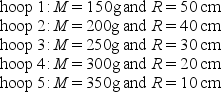 Order the hoops according to the periods of their motions, smallest to largest.
 (Multiple Choice)
4.9/5 (69)
(69) A 0.25-kg block oscillates on the end of the spring with a spring constant of 200 N/m.If the oscillation is started by elongating the spring 0.15 m and giving the block a speed of 3.0 m/s, then the amplitude of the oscillation is:
(Multiple Choice)
4.9/5 (69)
(69) Both the x and y coordinates of a point execute simple harmonic motion.The frequencies are the same but the amplitudes are different.The resulting orbit might be:
(Multiple Choice)
4.8/5 (89)
(89) A meter stick is pivoted at a point a distance a from its center and swings as a physical pendulum.Of the following values for a, which results in the shortest period of oscillation?
(Multiple Choice)
4.9/5 (73)
(73) Let U be the potential energy (with the zero at zero displacement)and K be the kinetic energy of a simple harmonic oscillator.Uavg and Kavg are the average values over a cycle.Then:
(Multiple Choice)
4.7/5 (85)
(85) An object on the end of a spring is set into oscillation by giving it an initial velocity while it is at its equilibrium position.In the first trial the initial velocity is v0 and in the second it is 4v0.In the second trial:
(Multiple Choice)
5.0/5 (64)
(64) 
Filters
- Essay(0)
- Multiple Choice(0)
- Short Answer(0)
- True False(0)
- Matching(0)