



 Chat with AI
Exam 14: Fluids

Exam 1: Measurement37 Questions
Exam 2: Motion Along a Straight Line90 Questions
Exam 3: Vectors43 Questions
Exam 4: Motion in Two and Three Dimensions56 Questions
Exam 5: Force and Motion73 Questions
Exam 6: Force and Motion74 Questions
Exam 7: Kinetic Energy and Work73 Questions
Exam 8: Potential Energy and Conservation of Energy65 Questions
Exam 9: Center of Mass and Linear Momentum99 Questions
Exam 10: Rotation102 Questions
Exam 11: Rolling, Torque, and Angular Momentum67 Questions
Exam 12: Equilibrium and Elasticity57 Questions
Exam 13: Gravitation61 Questions
Exam 14: Fluids91 Questions
Exam 15: Oscillations80 Questions
Exam 16: Waves83 Questions
Exam 17: Waves72 Questions
Exam 18: Temperature, Heat, and the First Law of Thermodynamics96 Questions
Exam 19: The Kinetic Theory of Gases114 Questions
Exam 20: Entropy and the Second Law of Thermodynamics61 Questions
Exam 21: Coulombs Law52 Questions
Exam 22: Electric Fields55 Questions
Exam 23: Gauss Law44 Questions
Exam 24: Electric Potential55 Questions
Exam 25: Capacitance61 Questions
Exam 26: Current and Resistance55 Questions
Exam 27: Circuits75 Questions
Exam 28: Magnetic Fields53 Questions
Exam 29: Magnetic Fields Due to Currents49 Questions
Exam 30: Induction and Inductance90 Questions
Exam 31: Electromagnetic Oscillations and Alternating Current89 Questions
Exam 32: Maxwells Equations; Magnetism of Matter87 Questions
Exam 33: Electromagnetic Waves83 Questions
Exam 34: Images79 Questions
Exam 35: Interference 147 Questions
Exam 36: Diffraction77 Questions
Exam 37: Relativity69 Questions
Exam 38: Photons and Matter Waves59 Questions
Exam 39: More About Matter Waves45 Questions
Exam 40: All About Atoms79 Questions
Exam 41: Conduction of Electricity in Solids51 Questions
Exam 42: Energy From the Nucleus50 Questions
Exam 43: Quarks, Leptons, and the Big Bang59 Questions
Select questions type


Which of the following five statements, concerning the upper surface pressure of a liquid, is FALSE?
(Multiple Choice)
4.7/5  (85)
(85) One end of a cylindrical pipe has a radius of 1.5 cm.Water (density = 1.0 x 10³ kg/m3)streams steadily out at 7.0 m/s.The rate at which mass is leaving the pipe is:
(Multiple Choice)
4.9/5 (76)
(76) A small steel ball floats in a half-full container of mercury.When water is added:
(Multiple Choice)
4.9/5 (84)
(84) An open-tube manometer is used to measure the gauge pressure in a tank.If the manometer is filled with mercury, and the open end is at a height of 15 cm above the end attached to the tank, what is the gauge pressure in the tank? The density of mercury is 14 x 103 kg/m3.
(Multiple Choice)
4.8/5 (73)
(73) The principle of fluid pressure which is used in hydraulic brakes or lifts is that:
(Multiple Choice)
4.9/5 (77)
(77) A large tank filled with water has two holes in the bottom, one with twice the radius of the other.In steady flow the speed of water leaving the larger hole is ________ the speed of the water leaving the smaller.
(Multiple Choice)
4.7/5 (81)
(81) Barometers and open-tube manometers are two instruments that are used to measure pressure.Which statement is true?
(Multiple Choice)
4.8/5 (87)
(87) A large water tank, open at the top, has a small hole in the bottom.When the water level is 30 m above the bottom of the tank, the speed of the water leaking from the hole:
(Multiple Choice)
4.9/5 (78)
(78) The dimensions of a wooden raft (density = 150 kg/m3)are 3.0 m x 3.0 m x1.0 m.What maximum load can it carry in sea water (density =1020 kg/m3)?
(Multiple Choice)
4.9/5 (73)
(73) The diagram shows a pipe of uniform cross section in which water is flowing.The directions of flow and the volume flow rates (in cm3/s)are shown for various portions of the pipe.The direction of flow and the volume flow rate in the portion marked A are: 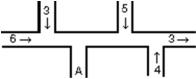
(Multiple Choice)
4.9/5 (72)
(72) 
Filters
- Essay(0)
- Multiple Choice(0)
- Short Answer(0)
- True False(0)
- Matching(0)