



 Chat with AI
Exam 13: Gravitation

Exam 1: Measurement37 Questions
Exam 2: Motion Along a Straight Line90 Questions
Exam 3: Vectors43 Questions
Exam 4: Motion in Two and Three Dimensions56 Questions
Exam 5: Force and Motion73 Questions
Exam 6: Force and Motion74 Questions
Exam 7: Kinetic Energy and Work73 Questions
Exam 8: Potential Energy and Conservation of Energy65 Questions
Exam 9: Center of Mass and Linear Momentum99 Questions
Exam 10: Rotation102 Questions
Exam 11: Rolling, Torque, and Angular Momentum67 Questions
Exam 12: Equilibrium and Elasticity57 Questions
Exam 13: Gravitation61 Questions
Exam 14: Fluids91 Questions
Exam 15: Oscillations80 Questions
Exam 16: Waves83 Questions
Exam 17: Waves72 Questions
Exam 18: Temperature, Heat, and the First Law of Thermodynamics96 Questions
Exam 19: The Kinetic Theory of Gases114 Questions
Exam 20: Entropy and the Second Law of Thermodynamics61 Questions
Exam 21: Coulombs Law52 Questions
Exam 22: Electric Fields55 Questions
Exam 23: Gauss Law44 Questions
Exam 24: Electric Potential55 Questions
Exam 25: Capacitance61 Questions
Exam 26: Current and Resistance55 Questions
Exam 27: Circuits75 Questions
Exam 28: Magnetic Fields53 Questions
Exam 29: Magnetic Fields Due to Currents49 Questions
Exam 30: Induction and Inductance90 Questions
Exam 31: Electromagnetic Oscillations and Alternating Current89 Questions
Exam 32: Maxwells Equations; Magnetism of Matter87 Questions
Exam 33: Electromagnetic Waves83 Questions
Exam 34: Images79 Questions
Exam 35: Interference 147 Questions
Exam 36: Diffraction77 Questions
Exam 37: Relativity69 Questions
Exam 38: Photons and Matter Waves59 Questions
Exam 39: More About Matter Waves45 Questions
Exam 40: All About Atoms79 Questions
Exam 41: Conduction of Electricity in Solids51 Questions
Exam 42: Energy From the Nucleus50 Questions
Exam 43: Quarks, Leptons, and the Big Bang59 Questions
Select questions type


Of the following where would the weight of an object be the least?
(Multiple Choice)
4.9/5  (73)
(73) Assume that Earth is in circular orbit around the Sun with kinetic energy K and potential energy U, taken to be zero for infinite separation.Then, the relationship between K and U:
(Multiple Choice)
4.8/5 (86)
(86) A planet travels in an elliptical orbit about a star X as shown.The magnitude of the acceleration of the planet is: 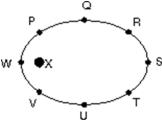
(Multiple Choice)
4.9/5 (77)
(77) Consider the statement: "Earth moves in a stable orbit around the Sun and is therefore in equilibrium".The statement is:
(Multiple Choice)
4.9/5 (86)
(86) The mass density of a certain planet has spherical symmetry but varies in such a way that the mass inside every spherical surface with center at the center of the planet is proportional to the radius of the surface.If r is the distance from the center of the planet to a point mass inside the planet, the gravitational force on the mass is:
(Multiple Choice)
4.9/5 (67)
(67) The escape velocity at the surface of Earth is approximately 11 km/s.What is the mass, in units of ME (the mass of the Earth), of a planet with twice the radius of Earth for which the escape speed is twice that for Earth?
(Multiple Choice)
4.8/5 (80)
(80) Each of the four corners of a square with edge a is occupied by a point mass m.There is a fifth mass, also m, at the center of the square.To remove the mass from the center to a point far away the work that must be done by an external agent is given by:
(Multiple Choice)
4.9/5 (74)
(74) A spherical shell has inner radius R1, outer radius R2, and mass M, distributed uniformly throughout the shell.The magnitude of the gravitational force exerted on the shell by a point mass m a distance d from the center, inside the inner radius, is:
(Multiple Choice)
4.9/5 (87)
(87) An object at the surface of Earth (at a distance R from the center of Earth)weighs 90 N.Its weight at a distance 3R from the center of Earth is:
(Multiple Choice)
4.8/5 (74)
(74) A spring scale, calibrated in newtons, is used to weigh sugar.If it were possible to weigh sugar at the following locations, where will the buyer get the most sugar to a newton?
(Multiple Choice)
4.9/5 (87)
(87) For a planet in orbit around a star the perihelion distance is rp and its speed at perihelion is vp.The aphelion distance is ra and its speed at aphelion is va.Which of following is true?
(Multiple Choice)
4.8/5 (71)
(71) Let F1 be the magnitude of the gravitational force exerted on the Sun by Earth and F2 be the magnitude of the force exerted on Earth by the Sun.Then:
(Multiple Choice)
4.8/5 (71)
(71) Planet 1 and planet 2 are both in circular orbits around the same central star.The orbit of planet 2 has a radius that is much larger than the radius of the orbit of planet 1.This means that:
(Multiple Choice)
4.7/5 (82)
(82) A rocket ship is coasting toward a planet.Its captain wishes to know the value of g at the surface of the planet.This may be inferred by:
(Multiple Choice)
4.9/5 (84)
(84) An artificial Earth satellite is moved from a circular orbit with radius R to a circular orbit with radius 2R.During this move:
(Multiple Choice)
4.9/5 (64)
(64) An astronaut on the Moon simultaneously drops a feather and a hammer.The fact that they land together shows that:
(Multiple Choice)
5.0/5 (71)
(71) A small satellite is in elliptical orbit around Earth as shown.If L denotes the magnitude of its angular momentum and K denotes kinetic energy: 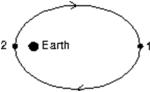
(Multiple Choice)
4.7/5 (76)
(76) 
Filters
- Essay(0)
- Multiple Choice(0)
- Short Answer(0)
- True False(0)
- Matching(0)