



 Chat with AI
Exam 2: Motion Along a Straight Line

Exam 1: Measurement37 Questions
Exam 2: Motion Along a Straight Line90 Questions
Exam 3: Vectors43 Questions
Exam 4: Motion in Two and Three Dimensions56 Questions
Exam 5: Force and Motion73 Questions
Exam 6: Force and Motion74 Questions
Exam 7: Kinetic Energy and Work73 Questions
Exam 8: Potential Energy and Conservation of Energy65 Questions
Exam 9: Center of Mass and Linear Momentum99 Questions
Exam 10: Rotation102 Questions
Exam 11: Rolling, Torque, and Angular Momentum67 Questions
Exam 12: Equilibrium and Elasticity57 Questions
Exam 13: Gravitation61 Questions
Exam 14: Fluids91 Questions
Exam 15: Oscillations80 Questions
Exam 16: Waves83 Questions
Exam 17: Waves72 Questions
Exam 18: Temperature, Heat, and the First Law of Thermodynamics96 Questions
Exam 19: The Kinetic Theory of Gases114 Questions
Exam 20: Entropy and the Second Law of Thermodynamics61 Questions
Exam 21: Coulombs Law52 Questions
Exam 22: Electric Fields55 Questions
Exam 23: Gauss Law44 Questions
Exam 24: Electric Potential55 Questions
Exam 25: Capacitance61 Questions
Exam 26: Current and Resistance55 Questions
Exam 27: Circuits75 Questions
Exam 28: Magnetic Fields53 Questions
Exam 29: Magnetic Fields Due to Currents49 Questions
Exam 30: Induction and Inductance90 Questions
Exam 31: Electromagnetic Oscillations and Alternating Current89 Questions
Exam 32: Maxwells Equations; Magnetism of Matter87 Questions
Exam 33: Electromagnetic Waves83 Questions
Exam 34: Images79 Questions
Exam 35: Interference 147 Questions
Exam 36: Diffraction77 Questions
Exam 37: Relativity69 Questions
Exam 38: Photons and Matter Waves59 Questions
Exam 39: More About Matter Waves45 Questions
Exam 40: All About Atoms79 Questions
Exam 41: Conduction of Electricity in Solids51 Questions
Exam 42: Energy From the Nucleus50 Questions
Exam 43: Quarks, Leptons, and the Big Bang59 Questions
Select questions type


An object is thrown straight up from ground level with a speed of 50 m/s.If g = 10 m/s2 its distance above ground level 6.0 s later is:
(Multiple Choice)
4.8/5  (81)
(81) A particle moves from point x1 to point x2.Its displacement is given by:
(Multiple Choice)
4.7/5 (75)
(75) Is it possible for an object to have zero velocity and constant nonzero acceleration?
(Multiple Choice)
5.0/5 (85)
(85) The coordinate-time graph of an object is a straight line with a positive slope.The object has:
(Multiple Choice)
4.9/5 (74)
(74) An elevator is moving upward with constant acceleration.The dashed curve shows the position y of the ceiling of the elevator as a function of the time t.At the instant indicated by the dot, a bolt breaks loose and drops from the ceiling.Which curve best represents the position of the bolt as a function of time? 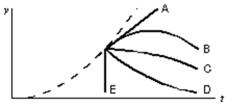
(Multiple Choice)
4.8/5 (68)
(68) A particle moves along the x axis according to the equation x = 6t2 where x is in meters and t is in seconds.Therefore:
(Multiple Choice)
4.8/5 (73)
(73) An object is thrown vertically upward with a certain initial velocity in a world where the acceleration due to gravity is 19.6 m/s2.The height to which it rises is ____ that to which the object would rise if thrown upward with the same initial velocity on the Earth.Neglect air resistance.
(Multiple Choice)
4.8/5 (82)
(82) Throughout a time interval, while the speed of a particle increases as it moves along the x axis, its velocity and acceleration could be:
(Multiple Choice)
4.8/5 (78)
(78) Which of the following is NOT true of an object in free fall in the absence of air resistance?
(Multiple Choice)
4.9/5 (73)
(73) A stone is released from a balloon that is descending at a constant speed of 10 m/s.Neglecting air resistance, after 20 s the speed of the stone is:
(Multiple Choice)
4.8/5 (76)
(76) The coordinate of an object is given as a function of time by x = 7t - 3t2, where x is in meters and t is in seconds.Its velocity at t = 3s is:
(Multiple Choice)
4.9/5 (86)
(86) A stone is thrown vertically upward with an initial speed of 19.5 m/s.It will rise to a maximum height of:
(Multiple Choice)
4.9/5 (75)
(75) The graph represents the straight line motion of a car.How far does the car travel between t = 2 seconds and t = 5 seconds? 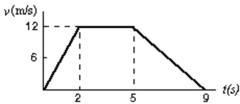
(Multiple Choice)
4.7/5 (83)
(83) A car accelerates from rest on a straight road.A short time later, the car decelerates to a stop and then returns to its original position in a similar manner, by speeding up and then slowing to a stop.Which of the following five coordinate versus time graphs best describes the motion? 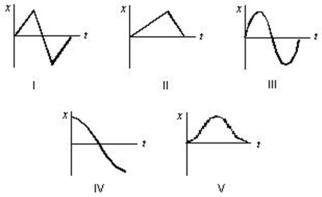
(Multiple Choice)
4.8/5 (95)
(95) When can you treat a moving object as if it were a point-like particle?
(Multiple Choice)
5.0/5 (84)
(84) At time t = 0 a car has a velocity of 16 m/s.It slows down with an acceleration given by a = -0.50t, in m/s2 for t in seconds.By the time it stops it has traveled:
(Multiple Choice)
4.9/5 (65)
(65) 
Filters
- Essay(0)
- Multiple Choice(0)
- Short Answer(0)
- True False(0)
- Matching(0)