



 Chat with AI
Exam 15: Mass Movements: Landscapes in Motion

Exam 1: Why Study Earth84 Questions
Exam 2: Minerals: Building Blocks of the Planet88 Questions
Exam 3: Rocks and Rock-Forming Processes90 Questions
Exam 4: Formation of Magma and Igneous Rocks88 Questions
Exam 5: Formation of Sediment and Sedimentary Rocks83 Questions
Exam 6: Formation of Metamorphic Rocks84 Questions
Exam 7: Earth Materials As Time Keepers91 Questions
Exam 8: Earth Materials As Time Keepers85 Questions
Exam 9: Making Earth74 Questions
Exam 10: Motion Inside Earth62 Questions
Exam 11: Deformation of Rocks88 Questions
Exam 12: Global Tectonics: Plates and Plumes80 Questions
Exam 13: Tectonics and Surface Relief85 Questions
Exam 14: Soil Formation and Landscape Stability79 Questions
Exam 15: Mass Movements: Landscapes in Motion85 Questions
Exam 16: Streams: Flowing Water Shapes the Landscape85 Questions
Exam 17: Water Flowing Underground85 Questions
Exam 18: Glaciers: Cold-Climate Sculptors of Continents83 Questions
Exam 19: Shorelines: Changing Landscapes Where Land Meets Sea84 Questions
Exam 20: Wind: a Global Geologic Process85 Questions
Exam 21: Global Warming: Real Time Change in the Earth System79 Questions
Select questions type


Which of the following statements is not true of cohesion?
(Multiple Choice)
4.9/5  (104)
(104) Cohesion is a particularly important component of resisting strength in ________ minerals.
(Multiple Choice)
4.9/5 (59)
(59) When describing the nature of materials involved in gravity-driven, downslope movement in order to classify the event it is crucial to describe the material after it has moved downslope.
(True/False)
4.9/5 (74)
(74) Which of the following terms is not a classification based on particle size?
(Multiple Choice)
4.8/5 (80)
(80) What caused the debris avalanche from Mount St. Helens in 1980?
(Multiple Choice)
4.8/5 (68)
(68) Planar slides typically occur along bedding planes, foliation, or joint planes oriented ________ to the slope.
(Multiple Choice)
4.9/5 (74)
(74) Which of the following scenarios would be most susceptible to mass movements?
(Multiple Choice)
4.9/5 (80)
(80) Coarse-grained regolith where 20 to 80 percent of the fragments are greater than 2 millimeters in size is called
(Multiple Choice)
4.7/5 (76)
(76) Figure 15.11 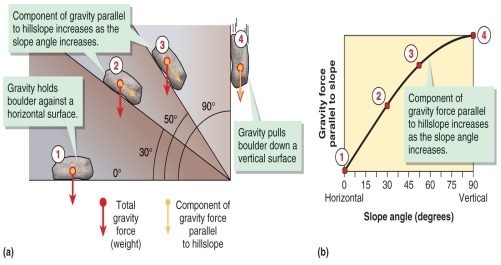 -Study Figure 15.11 in your textbook. At which minimum angle will the component of gravity that pulls a boulder downward be greater than the component of gravity that holds a boulder against a surface?
 (Multiple Choice)
4.9/5 (73)
(73) If uplift increases elevation, which process most effectively lowers elevation?
(Multiple Choice)
4.8/5 (85)
(85) The type of gravity-driven, downslope movement where the material rotates as it moves downslope in contact with a curved surface of rupture is called
(Multiple Choice)
4.8/5 (80)
(80) Choose the option that lists the factors that are not influences of slope stability studied during hazard assessment?
(Multiple Choice)
4.8/5 (80)
(80) Which of the following is not a factor used to describe mass-movement processes?
(Multiple Choice)
4.8/5 (91)
(91) Which set of data relating to the 1991 collapse of New Zealand's Mount Cook is correct?
(Multiple Choice)
4.9/5 (76)
(76) Which is not a factor that contributes to the modern increase in catastrophes in urban areas?
(Multiple Choice)
5.0/5 (72)
(72) Which two main factors determine the resisting strength that occurs in a mass movement?
(Multiple Choice)
4.7/5 (84)
(84) 
Filters
- Essay(0)
- Multiple Choice(0)
- Short Answer(0)
- True False(0)
- Matching(0)