



 Chat with AI
Exam 17: International Banking: Reserves, debt, and Risk

Exam 1: the International Economy and Globalization48 Questions
Exam 2: Foundations of Modern Trade Theory: Comparative Advantage166 Questions
Exam 3: Sources of Comparative Advantage106 Questions
Exam 4: Tariffs118 Questions
Exam 5: Nontariff Trade Barriers130 Questions
Exam 6: Trade Regulations and Industrial Policies124 Questions
Exam 7: Trade Policies for the Developing Nations98 Questions
Exam 8: Regional Trading Arrangements129 Questions
Exam 9: International Factor Movements and Multinational Enterprises93 Questions
Exam 10: the Balance of Payments99 Questions
Exam 11: Foreign Exchange120 Questions
Exam 12: Exchange-rate Determination129 Questions
Exam 13: Balance-of-payments Adjustments107 Questions
Exam 14: Exchange-rate Adjustments and the Balance of Payments96 Questions
Exam 15: Exchange-rate Systems and Currency Crises105 Questions
Exam 16: Macroeconomic Policy in an Open Economy72 Questions
Exam 17: International Banking: Reserves, debt, and Risk93 Questions
Select questions type


All of the following are major goals of the International Monetary Fund except:
(Multiple Choice)
4.7/5  (81)
(81) To the extent that adjustments in prices,interest rates,and income levels promote balance-of-payments equilibrium,the demand for international reserves decreases.
(True/False)
4.9/5 (93)
(93) The demand for international reserves tend to increase with the level of world income and trade activity.
(True/False)
4.8/5 (74)
(74) Concerning international lending risk,credit risk refers to the probability that part or all of the interest rate or principal of a loan will not be repaid.
(True/False)
4.9/5 (74)
(74) If a nation with a balance-of-payments deficit is willing and able to initiate quick actions to increase export receipts and decrease import payments,the amount of international reserves needed will be relatively large.
(True/False)
4.8/5 (82)
(82) When granting loans to financially troubled nations,the International Monetary Fund requires some degree of conditionality,meaning that the borrowing nation must agree to implement economic policies as mandated by the IMF.
(True/False)
4.9/5 (76)
(76) Which of the following assets was (were)created in 1970 to provide additional international liquidity,in the belief that increasing world trade requires more liquidity for larger expected payments imbalances?
(Multiple Choice)
4.9/5 (87)
(87) Most analysts feel that the financial difficulties in East Asia were triggered by
(Multiple Choice)
4.9/5 (84)
(84) To reduce their exposure to developing country debt,lending commercial banks have practiced all of the following except:
(Multiple Choice)
4.8/5 (75)
(75) IMF drawings,swap arrangements,buffer stock facility,and compensatory financing for exports are classified as owned reserves rather than borrowed reserves.
(True/False)
4.8/5 (72)
(72) Bilateral agreements between central banks,which provide for an exchange of currencies to help finance temporary balance-of-payments disequilibriums,are referred to as:
(Multiple Choice)
4.9/5 (92)
(92) The so-called General Arrangements to Borrow provide a permanent increase in the supply of international reserves.
(True/False)
4.9/5 (78)
(78) Foreign currencies constitute the smallest component of the world's international reserves.
(True/False)
4.8/5 (70)
(70) Which organization is largely intended to make long-term reconstruction loans to developing nations?
(Multiple Choice)
4.9/5 (81)
(81) With floating exchange rates,payments imbalances tend to be corrected by market-induced fluctuations in the exchange rate,and the need for exchange-rate stabilization and international reserves disappears.
(True/False)
4.8/5 (79)
(79) In 1974 the United States revoked a 41-year ban on U.S.citizen's ownership of gold.
(True/False)
4.9/5 (94)
(94) Figure 17.1 Foreign Exchange Market
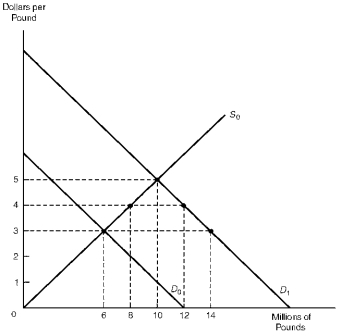 -Refer to Figure 17.1.Under a floating exchange rate system,the exchange rate would rise to $4 and U.S.monetary authorities would have to supply 4 million pounds to the foreign exchange market in exchange for dollars to maintain this rate.
 (True/False)
4.8/5 (86)
(86) 
Filters
- Essay(0)
- Multiple Choice(0)
- Short Answer(0)
- True False(0)
- Matching(0)