



 Chat with AI
Exam 7: Trade Policies for the Developing Nations

Exam 1: the International Economy and Globalization48 Questions
Exam 2: Foundations of Modern Trade Theory: Comparative Advantage166 Questions
Exam 3: Sources of Comparative Advantage106 Questions
Exam 4: Tariffs118 Questions
Exam 5: Nontariff Trade Barriers130 Questions
Exam 6: Trade Regulations and Industrial Policies124 Questions
Exam 7: Trade Policies for the Developing Nations98 Questions
Exam 8: Regional Trading Arrangements129 Questions
Exam 9: International Factor Movements and Multinational Enterprises93 Questions
Exam 10: the Balance of Payments99 Questions
Exam 11: Foreign Exchange120 Questions
Exam 12: Exchange-rate Determination129 Questions
Exam 13: Balance-of-payments Adjustments107 Questions
Exam 14: Exchange-rate Adjustments and the Balance of Payments96 Questions
Exam 15: Exchange-rate Systems and Currency Crises105 Questions
Exam 16: Macroeconomic Policy in an Open Economy72 Questions
Exam 17: International Banking: Reserves, debt, and Risk93 Questions
Select questions type


If the bauxite exporting countries form a cartel to boost the price of bauxite so as to increase sales revenue,they believe that the demand for bauxite:

Free
(Multiple Choice)
4.8/5  (74)
(74) Correct Answer: Verified
A
Figure 7.3. World Oil Market
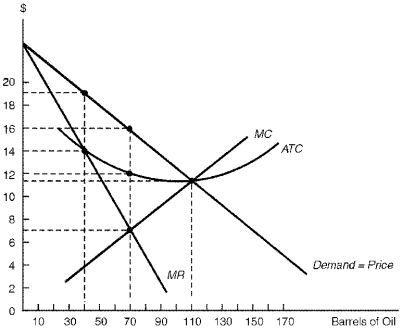 -Consider Figure 7.3.Under a profit-maximizing cartel,producers realize:
Free
(Multiple Choice)
4.9/5 (82)
(82) Correct Answer:Verified
VerifiedA
Which method has not generally been used by the international commodity agreements to stabilize commodity prices?
(Multiple Choice)
4.9/5 (80)
(80) The OPEC nations during the 1970s manifested their market power by utilizing:
(Multiple Choice)
4.7/5 (92)
(92) The development of countries like South Korea and Singapore has been underlaid by all of the following except:
(Multiple Choice)
4.9/5 (69)
(69) During periods of weak demand,the Organization of Petroleum Countries has implemented production (export)quotas to ensure that excess oil supplies be kept off the market.
(True/False)
4.7/5 (82)
(82) In its transition toward capitalism,by the 1990s China permitted free enterprise as well as democracy for its people.
(True/False)
4.8/5 (88)
(88) The so-called Four Tigers include Australia,South Korea,Taiwan,and Hong Kong.
(True/False)
4.7/5 (84)
(84) To be considered a good candidate for an export cartel,a commodity should:
(Multiple Choice)
4.9/5 (75)
(75) Most developing-nation exports go to industrial nations while most developing-nation imports originate in industrial nations.
(True/False)
4.9/5 (75)
(75) Figure 7.2. Defending the Target Price in Face of Changing Supply Conditions
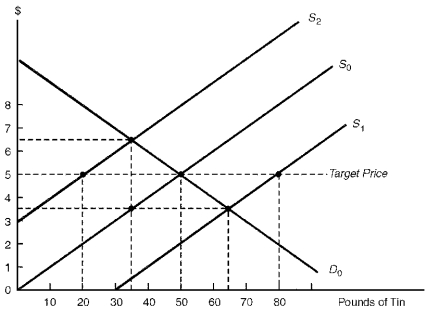 -Consider Figure 7.2.Suppose the supply of tin decreases from S? to S?.Under a buffer stock system,the buffer-stock manager could maintain the target price by:
 (Multiple Choice)
4.8/5 (88)
(88) As a profit-maximizing cartel,the Organization of Petroleum Exporting Countries would produce a greater output and charge a lower price than what would occur in a competitive market.
(True/False)
4.9/5 (90)
(90) In recent decades,the East Asian "newly industrializing countries" have pursued export-led growth (outward orientation)as an industrialization strategy.
(True/False)
5.0/5 (67)
(67) The "newly industrializing countries" of East Asia have emphasized the implementation of import-substitution policies to insulate their industries from international competition.
(True/False)
4.9/5 (84)
(84) If the demand for coffee is price inelastic,an increase in the supply of coffee leads to falling prices and rising sales revenues.
(True/False)
4.9/5 (68)
(68) For the oil-importing countries,the increases in oil prices in 1973-1974 and 1979-1980 resulted in all of the following except:
(Multiple Choice)
4.9/5 (78)
(78) It is widely agreed that import-substitution policies have been a main contributor to above-average growth rates in developing countries.
(True/False)
4.8/5 (80)
(80) A multilateral contract specifies the maximum price at which exporting countries agree to sell a product and the minimum price at which importing countries agree to buy a product.
(True/False)
5.0/5 (80)
(80) Figure 7.3. World Oil Market
-Consider Figure 7.3.Under a profit-maximizing cartel,the quantity of oil produced equals:
-Consider Figure 7.3.Under a profit-maximizing cartel,the quantity of oil produced equals: (Multiple Choice)
4.7/5 (83)
(83) 
Filters
- Essay(0)
- Multiple Choice(0)
- Short Answer(0)
- True False(0)
- Matching(0)