



 Chat with AI
Exam 7: Trade Policies for the Developing Nations

Exam 1: the International Economy and Globalization48 Questions
Exam 2: Foundations of Modern Trade Theory: Comparative Advantage166 Questions
Exam 3: Sources of Comparative Advantage106 Questions
Exam 4: Tariffs118 Questions
Exam 5: Nontariff Trade Barriers130 Questions
Exam 6: Trade Regulations and Industrial Policies124 Questions
Exam 7: Trade Policies for the Developing Nations98 Questions
Exam 8: Regional Trading Arrangements129 Questions
Exam 9: International Factor Movements and Multinational Enterprises93 Questions
Exam 10: the Balance of Payments99 Questions
Exam 11: Foreign Exchange120 Questions
Exam 12: Exchange-rate Determination129 Questions
Exam 13: Balance-of-payments Adjustments107 Questions
Exam 14: Exchange-rate Adjustments and the Balance of Payments96 Questions
Exam 15: Exchange-rate Systems and Currency Crises105 Questions
Exam 16: Macroeconomic Policy in an Open Economy72 Questions
Exam 17: International Banking: Reserves, debt, and Risk93 Questions
Select questions type


Developing countries have complained that because their commodity terms of trade has deteriorated in recent decades,they should receive preferential tariff treatment from industrialized countries.
(True/False)
4.8/5  (79)
(79) A key factor underlying the instability of primary product prices and export receipts of developing nations is the
(Multiple Choice)
4.8/5 (75)
(75) If the supply schedule for tin is relatively inelastic to price changes,a decrease in the demand schedule for tin will cause a:
(Multiple Choice)
4.8/5 (70)
(70) A widely used indicator to differentiate developed countries from developing countries is:
(Multiple Choice)
4.9/5 (83)
(83) Which nation accounts for the largest amount of OPEC's oil reserves and production?
(Multiple Choice)
4.9/5 (78)
(78) Under the Generalized System of Preferences program,the major industrial countries agree to temporarily reduce tariffs on designated imports from other industrial countries.
(True/False)
4.7/5 (85)
(85) During periods of falling demand for coffee,an International Commodity Agreement could offset downward pressure on price by implementing policies to increase the supply of coffee.
(True/False)
4.8/5 (82)
(82) Figure 7.3. World Oil Market
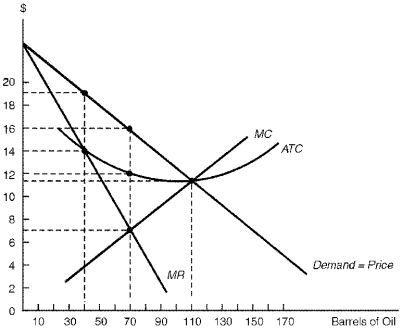 -Consider Figure 7.3.Under competitive conditions,the quantity of oil produced equals:
 (Multiple Choice)
4.8/5 (95)
(95) In 1999 the United States revoked the normal-trade-relations (most-favored-nation)status it provided China in retaliation for China's suppression of human rights.
(True/False)
5.0/5 (75)
(75) Which device has the International Tin Agreement utilized as a way of stabilizing tin prices?
(Multiple Choice)
4.8/5 (66)
(66) Hong Kong and South Korea are examples of developing nations that have recently pursued industrialization policies.
(Multiple Choice)
4.8/5 (91)
(91) Figure 7.1. Defending the Target Price in Face of Changing Demand Conditions
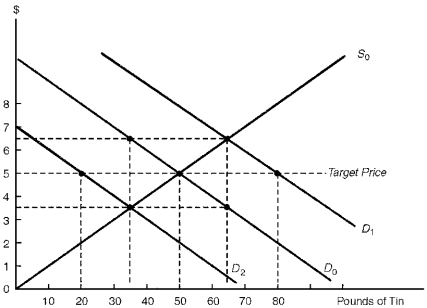 -Consider Figure 7.1.Suppose the demand for tin decreases from D? to D?.Under a buffer stock system,the buffer-stock manager could maintain the target price by:
 (Multiple Choice)
4.9/5 (100)
(100) Figure 7.1. Defending the Target Price in Face of Changing Demand Conditions
-Consider Figure 7.1.Suppose the demand for tin decreases from D? to D?.Under a system of export quotas,the tin producers could maintain the target price by:
-Consider Figure 7.1.Suppose the demand for tin decreases from D? to D?.Under a system of export quotas,the tin producers could maintain the target price by: (Multiple Choice)
4.9/5 (71)
(71) Stabilizing commodity prices around long-term trends tends to benefit exporters at the expense of importers in markets characterized by:
(Multiple Choice)
4.7/5 (75)
(75) Prior to the formation of the Organization of Petroleum Exporting Countries,individual oil producing nations,
(Multiple Choice)
4.7/5 (83)
(83) A cartel tends to be most successful in maximizing the profits of its members when there are a large number of producers in the cartel and these producers' cost and demand conditions greatly differ from each other.
(True/False)
4.9/5 (96)
(96) 
Filters
- Essay(0)
- Multiple Choice(0)
- Short Answer(0)
- True False(0)
- Matching(0)