



 Chat with AI
Exam 17: International Banking: Reserves, debt, and Risk

Exam 1: the International Economy and Globalization48 Questions
Exam 2: Foundations of Modern Trade Theory: Comparative Advantage166 Questions
Exam 3: Sources of Comparative Advantage106 Questions
Exam 4: Tariffs118 Questions
Exam 5: Nontariff Trade Barriers130 Questions
Exam 6: Trade Regulations and Industrial Policies124 Questions
Exam 7: Trade Policies for the Developing Nations98 Questions
Exam 8: Regional Trading Arrangements129 Questions
Exam 9: International Factor Movements and Multinational Enterprises93 Questions
Exam 10: the Balance of Payments99 Questions
Exam 11: Foreign Exchange120 Questions
Exam 12: Exchange-rate Determination129 Questions
Exam 13: Balance-of-payments Adjustments107 Questions
Exam 14: Exchange-rate Adjustments and the Balance of Payments96 Questions
Exam 15: Exchange-rate Systems and Currency Crises105 Questions
Exam 16: Macroeconomic Policy in an Open Economy72 Questions
Exam 17: International Banking: Reserves, debt, and Risk93 Questions
Select questions type


Which of the following is not a characteristic of the Eurodollar market? It:
(Multiple Choice)
4.7/5  (78)
(78) Figure 17.1 Foreign Exchange Market
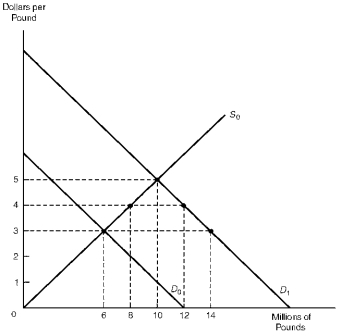 -Refer to Figure 17.1.If the exchange rate was allowed to rise to $4 per pound,U.S.monetary authorities would have to supply 6 million pounds to the foreign exchange market in exchange for dollars to maintain this rate.
 (True/False)
5.0/5 (87)
(87) Which of the following is not a condition of the international gold standard? That a nation must:
(Multiple Choice)
4.7/5 (89)
(89) Which of the following does not represent a form of international liquidity?
(Multiple Choice)
4.8/5 (85)
(85) The U.S.gold outflow that began in the late 1940s and continued through the 1960s was due in part to:
(Multiple Choice)
4.9/5 (75)
(75) The currencies generally referred to as "reserve currencies" are the:
(Multiple Choice)
4.8/5 (73)
(73) Are international reserve needs different for different exchange rate regimes?
(Essay)
4.9/5 (75)
(75) Which international reserve asset was officially phased out of the international monetary system by the United States in the early 1970s?
(Multiple Choice)
4.9/5 (86)
(86) Which of the following is a main central bank function of the International Monetary Fund?
(Multiple Choice)
4.8/5 (95)
(95) The value of the SDR is tied to a currency basket consisting of the U.S.dollar,German mark,Japanese yen,French franc,and British pound.
(True/False)
4.9/5 (80)
(80) "Country risk" analysis is concerned with all of the following except:
(Multiple Choice)
4.9/5 (66)
(66) Figure 17.1 Foreign Exchange Market
-Refer to Figure 17.1.Under a fixed exchange rate system,U.S.monetary authorities would have to supply 8 million pounds in exchange for dollars to keep the exchange rate at $3 per pound.
-Refer to Figure 17.1.Under a fixed exchange rate system,U.S.monetary authorities would have to supply 8 million pounds in exchange for dollars to keep the exchange rate at $3 per pound. (True/False)
4.9/5 (81)
(81) Swap arrangements are bilateral agreements between central banks to allow countries to temporarily borrow funds to ease current-account deficits and discourage speculative capital flows.
(True/False)
4.9/5 (79)
(79) Which of the following assets makes use of the basket valuation technique?
(Multiple Choice)
4.9/5 (62)
(62) The supply of international reserves consists of owned reserves and borrowed reserves.
(True/False)
4.9/5 (83)
(83) In 1975 the official price of gold was abolished as the unit of account for the international monetary system.As a result,gold was demonetized as an international reserve asset.
(True/False)
4.8/5 (78)
(78) For developing countries such as Mexico and Brazil,severe economic problems in the 1980s were caused by:
(Multiple Choice)
4.8/5 (90)
(90) 
Filters
- Essay(0)
- Multiple Choice(0)
- Short Answer(0)
- True False(0)
- Matching(0)