



 Chat with AI
Exam 14: Exchange-rate Adjustments and the Balance of Payments

Exam 1: the International Economy and Globalization48 Questions
Exam 2: Foundations of Modern Trade Theory: Comparative Advantage166 Questions
Exam 3: Sources of Comparative Advantage106 Questions
Exam 4: Tariffs118 Questions
Exam 5: Nontariff Trade Barriers130 Questions
Exam 6: Trade Regulations and Industrial Policies124 Questions
Exam 7: Trade Policies for the Developing Nations98 Questions
Exam 8: Regional Trading Arrangements129 Questions
Exam 9: International Factor Movements and Multinational Enterprises93 Questions
Exam 10: the Balance of Payments99 Questions
Exam 11: Foreign Exchange120 Questions
Exam 12: Exchange-rate Determination129 Questions
Exam 13: Balance-of-payments Adjustments107 Questions
Exam 14: Exchange-rate Adjustments and the Balance of Payments96 Questions
Exam 15: Exchange-rate Systems and Currency Crises105 Questions
Exam 16: Macroeconomic Policy in an Open Economy72 Questions
Exam 17: International Banking: Reserves, debt, and Risk93 Questions
Select questions type


Table 14.1. Hypothetical Costs of Producing an Automobile for Toyota Inc. of Japan
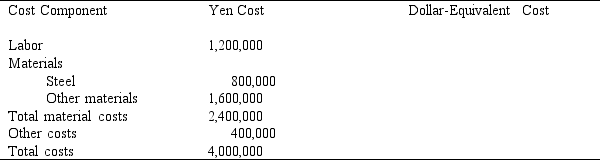 -Refer to Table 14.1.Assuming that Toyota obtains all inputs from Japanese suppliers and that the yen/dollar exchange rate is 200 yen per dollar.The dollar-equivalent cost of a Toyota automobile equals:
 (Multiple Choice)
4.9/5  (78)
(78) According to the Marshall-Lerner condition,currency depreciation would have a positive effect on a country's trade balance if the elasticity of demand for its exports plus the elasticity of demand for its imports equals:
(Multiple Choice)
4.8/5 (72)
(72) Empirical research suggests that most countries' price elasticities of demand for imports and exports are very inelastic,suggesting that currency depreciation would result in a worsening of a country's balance of trade.
(True/False)
5.0/5 (77)
(77) When producing jetliners,suppose that Boeing employs labor and materials whose costs are denominated in dollars and marks respectively.If the dollar's exchange value depreciates 20 percent against the mark,the mark-denominated cost of a Boeing jetliner falls by an amount less than 20 percent.
(True/False)
4.9/5 (65)
(65) The Marshall-Lerner condition asserts that if the sum of a country's elasticity of demand for imports and the foreign elasticity of demand for the country's exports equals 1.0,a depreciation of the country's currency will not affect its balance of trade.
(True/False)
4.9/5 (90)
(90) Suppose the U.S.price elasticity of demand for imports equals 0.4 and the foreign demand elasticity for the U.S.exports equals 0.2.According to the Marshall-Lerner condition,a depreciation of the dollar's exchange value will improve the U.S.balance of trade.
(True/False)
4.8/5 (92)
(92) Suppose the exchange value of the franc rises against the currencies of Switzerland's major trading partners.To protect themselves from decreases in foreign sales caused by the mark's appreciation,Swiss companies could shift production to countries whose currencies had depreciated against the mark.
(True/False)
4.9/5 (83)
(83) By increasing relative U.S.production costs,a dollar depreciation tends to increase U.S.export prices in foreign-currency terms,which results in an increase in the quantity of U.S.goods exported abroad.
(True/False)
4.9/5 (81)
(81) According to the absorption approach,an increase in domestic expenditures must occur for currency devaluation to promote balance of trade equilibrium.
(True/False)
4.9/5 (74)
(74) The elasticity approach to currency depreciation emphasizes the income effects of depreciation.
(True/False)
4.8/5 (83)
(83) Assume the Canadian demand elasticity for imports equals 1.2,while the foreign demand elasticity for Canadian exports equals 1.8.Responding to a trade deficit,suppose the Canadian dollar depreciates by 10 percent.For Canada,the depreciation would lead to a(n):
(Multiple Choice)
4.8/5 (87)
(87) Suppose the U.S.economy is operating at full capacity and the dollar's exchange value depreciates.According to the absorption approach,the United States would have to accept reductions in domestic spending if the U.S.trade balance is to improve as a result of the depreciation.
(True/False)
4.7/5 (83)
(83) Assume that Ford Motor Company obtains some of its inputs in Mexico (foreign sourcing).As the peso becomes a larger portion of Ford's total costs,a dollar appreciation leads to a ____ in the peso cost of a Ford vehicle and a ____ in the dollar cost of a Ford compared to the cost changes that occur when all input costs are dollar denominated.
(Multiple Choice)
4.9/5 (84)
(84) According to the Marshall-Lerner condition,currency depreciation would have a negative effect on a country's trade balance if the elasticity of demand for its exports plus the elasticity of demand for its imports equals:
(Multiple Choice)
4.8/5 (69)
(69) As yen-denominated costs become a larger portion of Ford's total costs,a dollar appreciation results in a smaller increase in the yen-denominated cost of a Ford auto than occurs when all input costs are dollar denominated.
(True/False)
4.8/5 (77)
(77) According to the absorption approach,currency devaluation best improves a country's trade balance when its economy is at maximum capacity.
(True/False)
4.9/5 (78)
(78) 
Filters
- Essay(0)
- Multiple Choice(0)
- Short Answer(0)
- True False(0)
- Matching(0)