



 Chat with AI
Exam 14: Exchange-rate Adjustments and the Balance of Payments

Exam 1: the International Economy and Globalization48 Questions
Exam 2: Foundations of Modern Trade Theory: Comparative Advantage166 Questions
Exam 3: Sources of Comparative Advantage106 Questions
Exam 4: Tariffs118 Questions
Exam 5: Nontariff Trade Barriers130 Questions
Exam 6: Trade Regulations and Industrial Policies124 Questions
Exam 7: Trade Policies for the Developing Nations98 Questions
Exam 8: Regional Trading Arrangements129 Questions
Exam 9: International Factor Movements and Multinational Enterprises93 Questions
Exam 10: the Balance of Payments99 Questions
Exam 11: Foreign Exchange120 Questions
Exam 12: Exchange-rate Determination129 Questions
Exam 13: Balance-of-payments Adjustments107 Questions
Exam 14: Exchange-rate Adjustments and the Balance of Payments96 Questions
Exam 15: Exchange-rate Systems and Currency Crises105 Questions
Exam 16: Macroeconomic Policy in an Open Economy72 Questions
Exam 17: International Banking: Reserves, debt, and Risk93 Questions
Select questions type


The J-curve effect implies that in the short run a currency depreciation will result in a balance of trade surplus for the home country.As time passes,however,the home country's balance of trade will move toward deficit.
(True/False)
4.9/5  (76)
(76) Complete currency pass-through arises when a 10 percent depreciation in the value of the dollar causes U.S.:
(Multiple Choice)
4.9/5 (77)
(77) When manufacturing computer software,suppose that Microsoft Inc.uses labor and materials whose costs are denominated in dollars and francs respectively.If the dollar's exchange value depreciates 10 percent against the franc,the franc-denominated cost of the firm's software falls by 10 percent.
(True/False)
5.0/5 (94)
(94) According to the J-curve concept,which of the following is false--that the effects of a currency depreciation on the balance of payments are:
(Multiple Choice)
4.9/5 (75)
(75) According to the J-curve effect,a depreciation of the pound's exchange value has:
(Multiple Choice)
4.8/5 (84)
(84) Assume that Brazil has a constant money supply and that it devalues its currency.The monetary approach to devaluation reasons that one of the following tends to occur for Brazil:
(Multiple Choice)
4.8/5 (70)
(70) Suppose the dollar appreciates 10 percent against the Swiss franc.According to the J-curve effect,the U.S.balance of trade will initially worsen,but then improve as time passes.
(True/False)
4.9/5 (66)
(66) The monetary approach emphasizes the effects of currency depreciation on the purchasing power of money,and the resulting impact on domestic expenditure levels.
(True/False)
5.0/5 (85)
(85) How is the absorption approach used for analyzing the effects of currency devaluation?
(Essay)
4.8/5 (85)
(85) Table 14.1. Hypothetical Costs of Producing an Automobile for Toyota Inc. of Japan
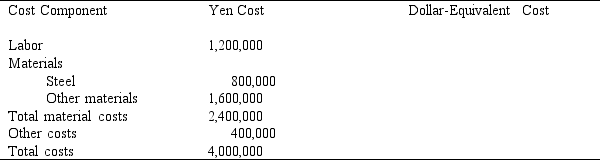 -Refer to Table 14.1.Assume that Toyota Inc.obtains all of its automobile inputs from Japanese suppliers.If the yen's exchange value appreciates from 200 yen = $1 to 100 yen = $1,the dollar-equivalent cost of a Toyota automobile equals:
 (Multiple Choice)
4.8/5 (85)
(85) The absorption approach suggests that one of the following causes a trade deficit to decrease following currency depreciation:
(Multiple Choice)
4.7/5 (88)
(88) Currency devaluation is initiated by governmental policy rather than the free-market forces of supply and demand.
(True/False)
5.0/5 (83)
(83) If a currency's exchange rate is undervalued,a government would likely initiate actions to devalue the currency.
(True/False)
4.9/5 (80)
(80) The extent to which changing currency values result in changing prices of imports and exports is known as the J-curve effect.
(True/False)
4.8/5 (77)
(77) The time period that it takes for companies to increase output of commodities for which demand has increased due to currency depreciation is known as the:
(Multiple Choice)
4.9/5 (78)
(78) How do demand elasticities influence a country's trade position when exchange rates change?
(Essay)
4.8/5 (86)
(86) The extent to which a change in the exchange rate leads to changes in import and export prices is known as:
(Multiple Choice)
5.0/5 (81)
(81) The purpose of currency devaluation is to cause a depreciation in a currency's exchange value.
(True/False)
4.9/5 (88)
(88) 
Filters
- Essay(0)
- Multiple Choice(0)
- Short Answer(0)
- True False(0)
- Matching(0)