



 Chat with AI
Exam 8: Regional Trading Arrangements

Exam 1: the International Economy and Globalization48 Questions
Exam 2: Foundations of Modern Trade Theory: Comparative Advantage166 Questions
Exam 3: Sources of Comparative Advantage106 Questions
Exam 4: Tariffs118 Questions
Exam 5: Nontariff Trade Barriers130 Questions
Exam 6: Trade Regulations and Industrial Policies124 Questions
Exam 7: Trade Policies for the Developing Nations98 Questions
Exam 8: Regional Trading Arrangements129 Questions
Exam 9: International Factor Movements and Multinational Enterprises93 Questions
Exam 10: the Balance of Payments99 Questions
Exam 11: Foreign Exchange120 Questions
Exam 12: Exchange-rate Determination129 Questions
Exam 13: Balance-of-payments Adjustments107 Questions
Exam 14: Exchange-rate Adjustments and the Balance of Payments96 Questions
Exam 15: Exchange-rate Systems and Currency Crises105 Questions
Exam 16: Macroeconomic Policy in an Open Economy72 Questions
Exam 17: International Banking: Reserves, debt, and Risk93 Questions
Select questions type


In the former Soviet Union,major manufacturing firms were typically:
(Multiple Choice)
4.7/5  (90)
(90) Figure 8.1 depicts the supply and demand schedules of calculators for Greece, a "small" country that is unable to affect the world price. Greece's supply and demand schedules of calculators are respectively depicted by SG and DG. Assume that Greece imports calculators from either Germany or France. Suppose Germany is the world's low-cost producer who can supply calculators to Greece at $20 per unit, while France can supply calculators at $30 per unit.
Figure 8.1. Effects of a Customs Union
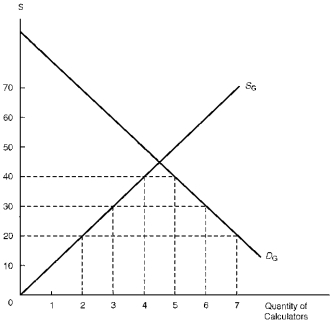 -Consider Figure 8.1.Assume Greece levies a per-unit tariff of $20 on imports from both Germany and France.
The deadweight welfare loss to Greece,resulting from the $20 tariff,equals:
-Consider Figure 8.1.Assume Greece levies a per-unit tariff of $20 on imports from both Germany and France.
The deadweight welfare loss to Greece,resulting from the $20 tariff,equals: (Multiple Choice)
4.8/5 (75)
(75) If Chile and Mexico abolish all tariffs on each other's products while maintaining their own tariffs against other countries,these two countries have formed a customs union.
(True/False)
5.0/5 (61)
(61) The transition of the former Soviet Union from a planned economy to a market economy would require the elimination of price controls,the privatization of public property,and the promotion of business competition.
(True/False)
4.9/5 (82)
(82) When Mexico became a part of NAFTA,along with Canada and the United States,it:
(Multiple Choice)
4.7/5 (84)
(84) Over the long run,the formation of a customs union may yield welfare gains due to economies of scale,greater competition,and stimulus to investment.
(True/False)
4.9/5 (76)
(76) 
Filters
- Essay(0)
- Multiple Choice(0)
- Short Answer(0)
- True False(0)
- Matching(0)