



 Chat with AI
Exam 8: Regional Trading Arrangements

Exam 1: the International Economy and Globalization48 Questions
Exam 2: Foundations of Modern Trade Theory: Comparative Advantage166 Questions
Exam 3: Sources of Comparative Advantage106 Questions
Exam 4: Tariffs118 Questions
Exam 5: Nontariff Trade Barriers130 Questions
Exam 6: Trade Regulations and Industrial Policies124 Questions
Exam 7: Trade Policies for the Developing Nations98 Questions
Exam 8: Regional Trading Arrangements129 Questions
Exam 9: International Factor Movements and Multinational Enterprises93 Questions
Exam 10: the Balance of Payments99 Questions
Exam 11: Foreign Exchange120 Questions
Exam 12: Exchange-rate Determination129 Questions
Exam 13: Balance-of-payments Adjustments107 Questions
Exam 14: Exchange-rate Adjustments and the Balance of Payments96 Questions
Exam 15: Exchange-rate Systems and Currency Crises105 Questions
Exam 16: Macroeconomic Policy in an Open Economy72 Questions
Exam 17: International Banking: Reserves, debt, and Risk93 Questions
Select questions type


The common agriculture policy of the European Union has supported European farmers via:
(Multiple Choice)
4.9/5  (84)
(84) Concerning transition economies,what do the advocates of shock therapy propose?
(Essay)
4.9/5 (73)
(73) Suppose that Mexico and Canada form a free-trade area.The Mexicans then decrease refrigerator manufacturing and increase imports of refrigerators from Canada,while the Canadians decrease auto manufacturing and import more autos from Mexico.This is an example of trade creation.
(True/False)
4.7/5 (63)
(63) Which of the following organizations is considered a regional trading arrangement?
(Multiple Choice)
4.8/5 (79)
(79) From the 1940s to the 1980s,the former communist countries remained isolated from the world economy,primarily due to different tariff systems among the former communist countries.
(True/False)
4.9/5 (74)
(74) The European Union has achieved all of the following except:
(Multiple Choice)
4.9/5 (97)
(97) Forming a free-trade agreement with the United States provided Canadian producers a danger and an opportunity.The danger was that U.S.producers might be more price competitive than Canadian producers; the opportunity was that longer production runs for Canadian producers,made possible by a free-trade agreement,would result in cost reductions due to economies of scale.
(True/False)
4.8/5 (77)
(77) When a group of countries establish a free-trade area,they achieve the highest stage of economic integration.
(True/False)
4.8/5 (73)
(73) Figure 8.2. Portugal's Steel Market
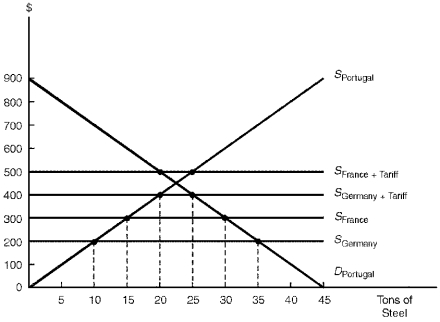 -Consider Figure 8.2.With free trade,Portugal produces 15 tons of steel,consumes 30 tons of steel,and imports 15 tons of steel.
 (True/False)
4.9/5 (86)
(86) Figure 8.1 depicts the supply and demand schedules of calculators for Greece, a "small" country that is unable to affect the world price. Greece's supply and demand schedules of calculators are respectively depicted by SG and DG. Assume that Greece imports calculators from either Germany or France. Suppose Germany is the world's low-cost producer who can supply calculators to Greece at $20 per unit, while France can supply calculators at $30 per unit.
Figure 8.1. Effects of a Customs Union
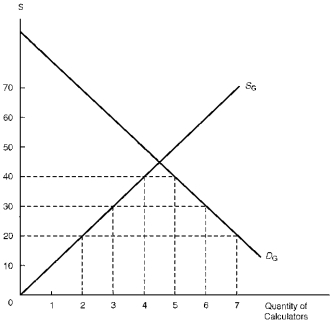 -Referring to Figure 8.1,suppose Greece forms a customs union with France.Greece will import:
 (Multiple Choice)
4.9/5 (89)
(89) Figure 8.1 depicts the supply and demand schedules of calculators for Greece, a "small" country that is unable to affect the world price. Greece's supply and demand schedules of calculators are respectively depicted by SG and DG. Assume that Greece imports calculators from either Germany or France. Suppose Germany is the world's low-cost producer who can supply calculators to Greece at $20 per unit, while France can supply calculators at $30 per unit.
Figure 8.1. Effects of a Customs Union
-Consider Figure 8.1.Assume Greece levies a per-unit tariff of $20 on imports from both Germany and France.
As a result of the $20 tariff,Greece's consumer surplus falls by:
-Consider Figure 8.1.Assume Greece levies a per-unit tariff of $20 on imports from both Germany and France.
As a result of the $20 tariff,Greece's consumer surplus falls by: (Multiple Choice)
4.8/5 (75)
(75) Figure 8.2. Portugal's Steel Market
-Consider Figure 8.2.If Portugal forms a customs union with France,the resulting trade-creation effect equals $500.
-Consider Figure 8.2.If Portugal forms a customs union with France,the resulting trade-creation effect equals $500. (True/False)
4.8/5 (65)
(65) By removing discriminatory government procurement laws within the European Union,member nations hoped to benefit from all of the following except:
(Multiple Choice)
4.9/5 (73)
(73) Under the common agricultural policy,exports of any surplus quantities of EU produce are encouraged through the usage of:
(Multiple Choice)
4.9/5 (80)
(80) In the United States,the proposed North American Free Trade Agreement was generally supported by:
(Multiple Choice)
5.0/5 (87)
(87) Suppose that Canada has domestic firms that could supply its entire market for radios at a price of $50,while U.S.firms could supply radios at $40 and Mexico at $30.Suppose that Canada initially has a 50 percent tariff on imports of radios and then forms a free trade area with the United States.As a result,Canada realizes:
(Multiple Choice)
4.8/5 (72)
(72) The regional trade block of the former communist countries,which lasted from 1949-1991,was known as the:
(Multiple Choice)
4.8/5 (79)
(79) The transition of the former communist countries to market economies requires:
(Multiple Choice)
4.8/5 (92)
(92) When the United States,Canada,and Mexico form a free trade area,and Mexico begins importing a product from Canada rather than from the lowest cost world producer.
(Multiple Choice)
5.0/5 (81)
(81) Pricing of consumer goods in the former Soviet Union was typically regulated by price ceilings which led to shortages.
(True/False)
4.9/5 (73)
(73) 
Filters
- Essay(0)
- Multiple Choice(0)
- Short Answer(0)
- True False(0)
- Matching(0)